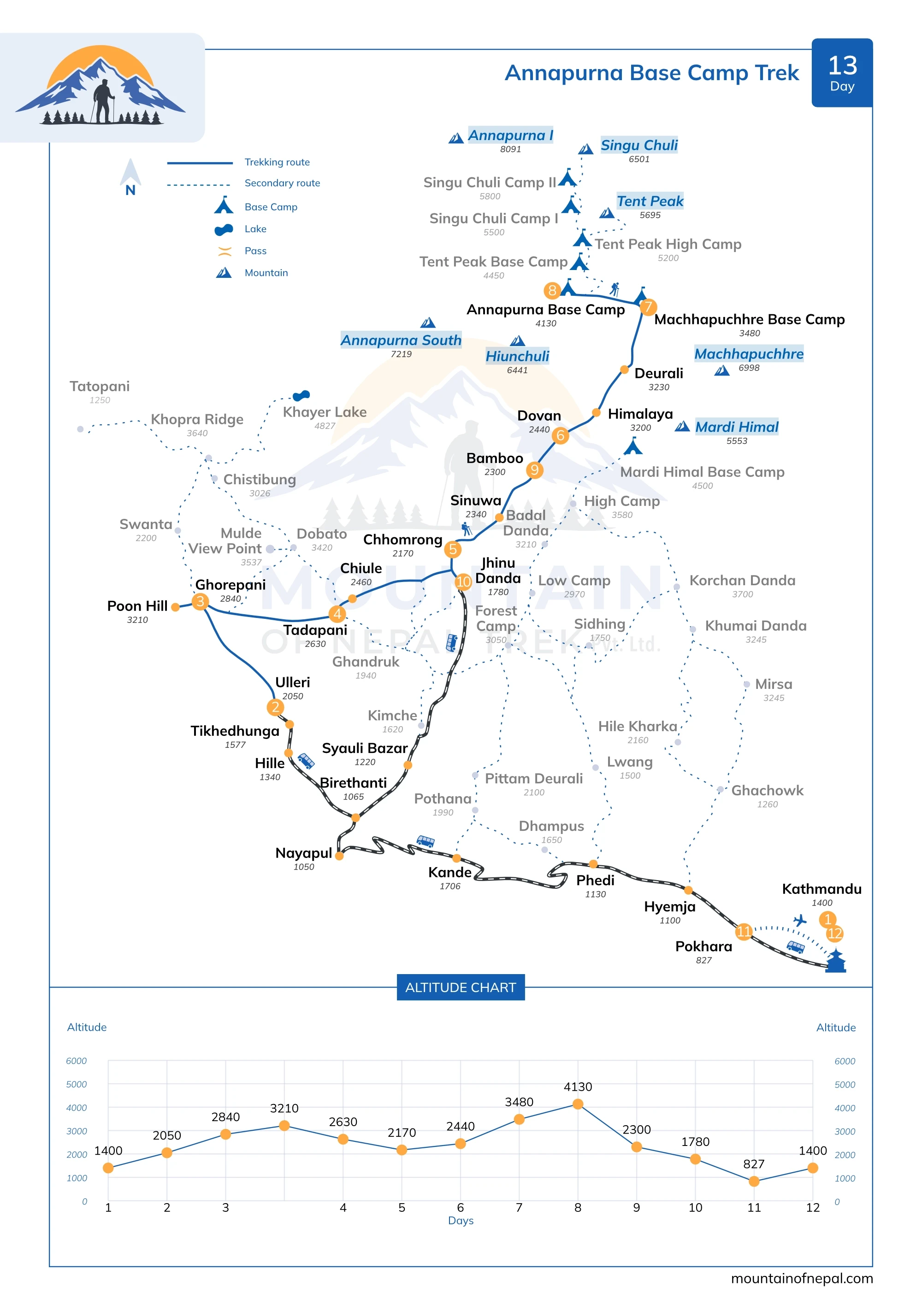
Annapurna Base Camp Trek
| Trip code | |
| Package name | Annapurna Base Camp Trek |
| Duration | 13 |
| Max. elevation | 4130 m |
| Level | Moderate |
| Transportation | Domestic flight and all ground transportation as per the itinerary |
| Accomodation | Hotel in Kathmandu and Pokhara, and Lodge / Tea House during trek |
| Starts at | Kathmandu |
| Ends at | Kathmandu |
| Trip route | |
| Cost | USD 1,255 per person |
Highlights
- Poon Hill Sunrise: Stunning panoramic views of the Annapurna and Dhaulagiri ranges.
- Annapurna Base Camp (4,100 m): Breathtaking 360° Himalayan vistas including Machhapuchhre (Fishtail).
- Machhapuchhre Base Camp: Iconic mountain views and high-altitude trekking experience.
- Chhomrong & Gurung Villages: Cultural immersion in traditional Nepalese village life.
- Rhododendron Forests: Vibrant blooms during spring treks.
- Waterfalls & Suspension Bridges: Scenic trekking trail features.
- Diverse Landscapes: Subtropical forests, alpine meadows, and high Himalayan terrain.
- Trekking via Ulleri & Ghorepani: Gradual altitude gain for comfortable acclimatization.
- Jhinu Danda Hot Springs: Natural relaxation after trekking.
- Sunset & Sunrise Views: Perfect photography opportunities along the trail.
Overview
The Annapurna Base Camp (ABC) Trek is one of Nepal’s most iconic trekking experiences, offering a blend of natural beauty, cultural immersion, and panoramic mountain views. Beginning with a drive from Kathmandu to Pokhara and onward to Ulleri, trekkers slowly ascend through terraced villages, lush rhododendron forests, and cascading waterfalls. Each day of the trek presents a unique experience from the sunrise at Poon Hill to the breathtaking Annapurna and Machhapuchhre peaks. The route passes through well-established villages like Ghorepani, Tadapani, and Chhomrong, where trekkers can witness the lifestyle of local Gurung and Magar communities.
The trek culminates at the Annapurna Base Camp (4,100 m), where trekkers are rewarded with a 360-degree view of towering Himalayan giants including Annapurna I, Machhapuchhre (Fishtail), and Hiunchuli. Beyond just mountain vistas, the journey offers diverse landscapes—subtropical forests at lower altitudes, alpine meadows mid-trek, and high Himalayan terrain near the base camp. Trekkers often comment on the magical sunrise views, the peaceful mountain atmosphere, and the opportunity to disconnect from city life while fully immersing in Nepal’s natural splendor. Organized by Mountain of Nepal, this trek combines comfort, safety, and expert local guidance, ensuring a memorable Himalayan adventure.
- Starts: Kathmandu → Pokhara → Ulleri
- Highlights: Poon Hill sunrise, Annapurna, and Machhapuchhre views
- Villages: Ghorepani, Tadapani, Chhomrong
- Altitude range: 1,400 m – 4,100 m
- Trek style: Moderate, nature and culture blend
Best Season for Annapurna Base Camp Trek
The best seasons to undertake the Annapurna Base Camp Trek are spring (March to May) and autumn (September to November). During spring, rhododendron forests bloom with vibrant red and pink flowers, adding colorful charm to the trekking path. The weather is generally clear and mild, allowing trekkers to enjoy unobstructed mountain views and pleasant hiking conditions. This season is ideal for photography enthusiasts who want to capture both natural landscapes and local village life.
Autumn, on the other hand, offers stable weather with minimal rainfall, crisp air, and spectacular visibility of the snow-capped peaks. This is considered the peak trekking season in Nepal, as most trekkers aim to experience clear skies and moderate temperatures. While winter (December to February) is colder, especially at higher altitudes, it provides a quieter trekking experience with fewer crowds. Monsoon season (June to August) is usually avoided due to heavy rainfall, slippery trails, and limited visibility of mountain panoramas. Mountain of Nepal ensures that itineraries are tailored to each season, optimizing both safety and experience while trekking in the Annapurna region.
Short points:
- Spring (Mar–May): Blooming rhododendrons, mild weather
- Autumn (Sep–Nov): Clear skies, peak trekking season
- Winter (Dec–Feb): Fewer crowds, cold temperatures
- Monsoon (Jun–Aug): Heavy rain, slippery trails
- Guided seasonal planning by Mountain of Nepal
Annapurna Base Camp Trek Difficulty and Transportation
The Annapurna Base Camp Trek is generally classified as a moderate trek, suitable for trekkers with basic fitness levels and some prior hiking experience. While the daily walking duration ranges from 4 to 7 hours, the gradual elevation gain allows trekkers to acclimatize comfortably. Key challenges include steep ascents through Ulleri’s long stone staircases, variable terrain at higher altitudes, and occasional cold or windy conditions near the base camp. Mountain of Nepal provides professional guides and porters to ensure safe pacing and proper acclimatization throughout the trek.
Transportation for the trek begins with a drive from Kathmandu to Pokhara, which can take 6–8 hours on scenic roads. From Pokhara, travelers take a local drive to the trailhead at Nayapul or Ulleri, depending on the itinerary. Trekkers can return via the same route or fly back from Pokhara to Kathmandu, saving travel time. Local transport is typically arranged by the trekking company, including private vehicles, airport transfers, and logistical support along the trail. This combination of road travel and trekking ensures both convenience and flexibility for adventurers exploring the Annapurna region.
Short points:
- Trek difficulty: Moderate
- Daily trek duration: 4–7 hours
- Key challenge: Steep ascents, altitude adjustment
- Transport: Kathmandu → Pokhara → Trailhead
- Return: Pokhara → Kathmandu (flight option)
Food and Accommodation for Annapurna Base Camp Trek
Food and accommodation along the Annapurna Base Camp Trek are comfortable and varied, catering to both local flavors and familiar international dishes. Tea houses and lodges are available in nearly every village along the route, such as Ghorepani, Tadapani, and Chhomrong. Typical meals include dal bhat (Nepalese lentil soup with rice), momo (dumplings), and a variety of noodles and soups. Western dishes like pasta, omelets, and pancakes are also available at most tea houses. The mountain of Nepal ensures that trekkers have access to nutritious meals for energy and supports dietary preferences or restrictions where possible.
Accommodation is mostly in cozy, rustic lodges or tea houses with shared or private rooms, equipped with basic amenities. Higher-altitude stops like Machhapuchhre Base Camp and Annapurna Base Camp offer simpler lodges, but trekkers enjoy spectacular views and a warm, communal atmosphere. Some lodges provide hot showers and Wi-Fi, although facilities may be limited in remote locations. Staying in these lodges allows trekkers to experience local hospitality and connect with fellow adventurers while enjoying nightly views of the Himalayas.
Short points:
- Meals: Dal bhat, momo, noodles, Western options
- Lodges/tea houses: Comfortable, shared or private rooms
- High-altitude facilities: Basic, spectacular views
- Support for dietary needs by Mountain of Nepal
- Social experience: Interaction with locals and trekkers
Annapurna Base Camp Trek Permits
Trekking in the Annapurna region requires specific permits to ensure responsible tourism and conservation of the trails. All trekkers need the Annapurna Conservation Area Permit (ACAP) and the Trekkers’ Information Management System (TIMS) card. ACAP is issued by the National Park Authority and helps fund conservation efforts, local community development, and trail maintenance. TIMS is essential for safety, tracking, and emergency purposes.
Permits can be arranged before departure or obtained in Kathmandu or Pokhara. Mountain of Nepal handles all permit arrangements as part of their trekking packages, ensuring that trekkers comply with regulations without any hassle. Additionally, guides carry copies of permits during the trek, which are required when entering villages and park areas. By following these regulations, trekkers contribute to the sustainable development of the Annapurna region while enjoying a well-managed trekking experience.
Short points:
- Required permits: ACAP, TIMS card
- Purpose: Conservation, safety, community support
- Issued in: Kathmandu or Pokhara
- Arranged by Mountain of Nepal
- Guides carry copies for compliance
Why Choose Annapurna Base Camp Trek
Choosing the Annapurna Base Camp Trek offers a perfect combination of adventure, cultural immersion, and natural beauty. The trek is suitable for moderate-level trekkers and offers rewarding panoramic views of some of the highest peaks in the world. Along the trail, you will experience local village life, interact with welcoming communities, and witness traditional Nepalese culture in its natural setting. The diversity of landscapes from subtropical forests to high alpine meadows makes this trek visually stunning and endlessly engaging.
Partnering with Mountain of Nepal ensures a professional and safe trekking experience. Their expert guides, experienced porters, and well-planned itineraries take care of logistics, accommodations, meals, and permits. Whether you are a first-time trekker or a seasoned adventurer, this trek combines safety, comfort, and adventure. The added benefit of exploring the sunrise at Poon Hill, the majestic Annapurna Base Camp, and the rich Himalayan ecosystem makes this journey truly unforgettable. This trek is not only a physical adventure but also a journey into the heart of Nepalese culture and the grandeur of the Himalayas.
Short points:
- Moderate-level trek, panoramic Himalayan views
- Cultural immersion: Gurung and Magar villages
- Landscapes: Forests, meadows, high-altitude terrain
- Expert guidance by Mountain of Nepal
- Memorable sunrise and base camp experiences
Trip Preparation
Trip Itinerary
Day 1 : Arrival in Kathmandu (1,400 m) and Transfer to Hotel
Upon arrival at Tribhuvan International Airport in Kathmandu, you will be warmly welcomed by the team from Mountain of Nepal. After completing your airport formalities, you will be transferred to your hotel in the bustling heart of Kathmandu. Take this day to relax and acclimatize to the local environment. If time permits, you can explore the vibrant streets nearby, visit local shops, or enjoy traditional Nepali cuisine at a nearby restaurant. In the evening, the team will brief you on the upcoming trek and provide all necessary trekking information and permits.
Day 2 : Drive Kathmandu – Pokhara – Ulleri (2,050 m), 9–10 hours
Today begins early with a scenic drive from Kathmandu to Pokhara, a journey that offers stunning views of the Trishuli River and the Himalayan foothills. After a short stop in Pokhara for refreshments and sightseeing, you will continue by road to the trailhead, eventually reaching Ulleri. Ulleri is a charming village surrounded by terraced hills and offers the first real taste of rural mountain life. Here, you will settle into a teahouse, enjoy your first evening with local cuisine, and rest for the trek ahead while absorbing the fresh mountain air.
Day 3 : Trek to Ghorepani (2,840 m), 4–5 hours
Your trek officially begins today as you leave Ulleri and ascend through rhododendron and oak forests. The trail is well-marked but involves several steep sections, rewarding you with panoramic views of surrounding peaks along the way. You will pass through quaint villages where locals offer tea and snacks, giving you an authentic experience of mountain culture. Arriving in Ghorepani, a hub for trekkers, you will be treated to spectacular views of Dhaulagiri and Annapurna South from the lodge. Enjoy a well-deserved rest and hearty dinner, preparing for an early morning excursion tomorrow.
Day 4 : Poon Hill sunrise – Trek to Tadapani (2,630 m), 6–7 hours
Rise before dawn to witness the legendary Poon Hill sunrise, a breathtaking spectacle where the first light illuminates Annapurna, Dhaulagiri, and Machhapuchhre peaks. After capturing these unforgettable views, return to Ghorepani for breakfast before continuing the trek to Tadapani. The trail winds through dense forests of rhododendron and bamboo, with occasional glimpses of cascading waterfalls and terraced fields. Tadapani itself offers stunning mountain vistas and a serene atmosphere, making it a perfect stop to relax. The evening is spent at a local teahouse, sharing stories with fellow trekkers and enjoying the tranquility of the Himalayas.
Day 5 : Trek to Chhomrong (2,170 m), 5 hours
Today’s trek leads you through diverse landscapes as you descend into lush valleys and cross several suspension bridges over glacial rivers. Passing through small settlements, you will experience the local Gurung culture, often greeted with warm smiles and traditional hospitality. Chhomrong, your destination, is a picturesque village perched on a hillside with spectacular views of Machhapuchhre and Annapurna South. You can explore the village, interact with locals, and enjoy the fresh mountain air. Evening meals will feature traditional Nepali dishes, providing energy for the more challenging days ahead.
Day 6 : Trek to Doban (2,440 m), 6 hours
From Chhomrong, the trail gradually ascends, leading through bamboo forests, terraced fields, and peaceful villages. The path offers intermittent views of waterfalls, rivers, and distant snow-capped peaks. Doban, a small hamlet nestled in the lap of nature, offers a quiet, serene atmosphere ideal for rest. The teahouses here provide basic but comfortable accommodations. Evening conversations with fellow trekkers and guides will help you unwind, while the surrounding Himalayan scenery provides a calming backdrop. You will feel a sense of accomplishment as your altitude gradually increases, bringing you closer to the base camp.
Day 7 : Trek to Machhapuchhre Base Camp (3,480 m), 5–6 hours
Today is an exhilarating climb as you trek toward the Machhapuchhre Base Camp. The trail takes you through a rugged terrain with increasing altitude, offering closer and more dramatic views of Machhapuchhre, Annapurna South, and Hiunchuli. Crossing streams and navigating rocky paths, the trek becomes more challenging but immensely rewarding. At Machhapuchhre Base Camp, the panoramic mountain views are unforgettable, and the sunset over the peaks provides perfect photo opportunities. The night spent at this altitude allows you to prepare physically and mentally for the ultimate destination: Annapurna Base Camp.
Day 8 : Trek to Annapurna Base Camp (4,130 m), 2 hours
The highlight of the trek arrives today as you trek to the iconic Annapurna Base Camp. The trail from Machhapuchhre Base Camp is relatively short but offers awe-inspiring views of the surrounding peaks, glaciers, and the Annapurna Sanctuary. Arriving at the base camp, you will be surrounded by a panoramic 360-degree view of the Annapurna and Machhapuchhre ranges, a truly once-in-a-lifetime experience. Spend time exploring the area, capturing photographs, and soaking in the serene and majestic atmosphere of the high Himalayas. A celebratory dinner at the camp marks your achievement and hard work.
Day 9 : Trek to Bamboo (2,300 m), 6 hours
After witnessing a beautiful sunrise over the mountains, you begin your descent toward Bamboo. The trail leads through a mix of landscapes including rhododendron forests, waterfalls, and terraced farmland, providing diverse scenery. Descending from the high mountains, the air becomes warmer, and the journey is less strenuous than the ascent. Bamboo is a peaceful village with a tranquil ambiance, where you can relax in a teahouse after a long day. The evening is perfect for reflecting on the trek, sharing stories with fellow trekkers, and enjoying traditional Nepali meals.
Day 10 : Trek to Jhinu Danda (1,780 m), 5–6 hours
Today, the trek continues through lush valleys and rivers, eventually reaching Jhinu Danda, famous for its natural hot springs. The descent brings you closer to subtropical forests and farmland, offering a completely different environment from the high-altitude landscapes. Upon arrival, you can soak in the therapeutic hot springs, relieving your tired muscles and relaxing your body. The village has a charming, rustic feel, and the surrounding views of green hills and terraced fields provide a serene backdrop. This is a rejuvenating stop before your return journey to Pokhara.
Day 11 : Drive to Pokhara – Fly to Kathmandu
After breakfast, you trek down to Nayapul or a convenient drop-off point to begin the journey to Pokhara. From there, you will either drive or fly to Kathmandu, enjoying scenic landscapes along the way. Once in Kathmandu, check into your hotel and spend the rest of the day at leisure. You can explore Thamel, shop for souvenirs, or enjoy a relaxing evening with a cultural performance. The team from Mountain of Nepal will ensure that all logistics are smoothly handled, giving you a stress-free return to the city.
Day 12 : Free day in Kathmandu
Today is a free day to explore Kathmandu at your own pace. You can visit UNESCO World Heritage sites such as Swayambhunath Stupa (Monkey Temple), Pashupatinath Temple, or Boudhanath Stupa, all offering rich cultural and spiritual experiences. Enjoy traditional Nepali cuisine, stroll through bustling markets, or simply relax at your hotel. This day allows you to reflect on the incredible journey to Annapurna Base Camp and absorb the vibrant culture, history, and energy of Nepal’s capital city.
Day 13 : Departure from Kathmandu
On your final day, you will be transferred to Tribhuvan International Airport for your onward flight. As you leave Kathmandu, take with you memories of breathtaking Himalayan landscapes, the warmth of local communities, and the accomplishment of completing the Annapurna Base Camp trek. The team from Mountain of Nepal wishes you safe travels and hopes you carry the spirit of the Himalayas with you wherever you go.
- 1 - 1 pax US$ 1,365
- 2 - 4 pax US$ 1,255
- 5 - 9 pax US$ 1,240
- 10 - 15 pax US$ 1,225
- 16 - 20 pax US$ 1,210
Inclusions
What is included?
- Airport transfers in Kathmandu.
- All ground transportation as per the itinerary.
- Hotel accommodation in Pokhara / Kathmandu with breakfast.
- Teahouse accommodations during the trek.
- All meals (breakfast, lunch, dinner) during the trek.
- Annapurna Conservation Area entry permit.
- TIMS (Trekkers' Information Management System) card.
- Experienced, English-speaking trek guide.
- Porters to carry luggage (1 per 2 trekkers).
- Trekking map and group medical kit
- Welcome and farewell dinners in Kathmandu.
What isn't included?
- International flights to/from Kathmandu.
- Nepal entry visa fee.
- Mandatory travel insurance (including emergency rescue).
- Personal trekking equipment.
- Personal expenses (laundry, calls, internet, etc.).
- Alcoholic beverages and bottled water.
- Additional meals and beverages not specified.
- Tips for trekking staff.
Complimentary