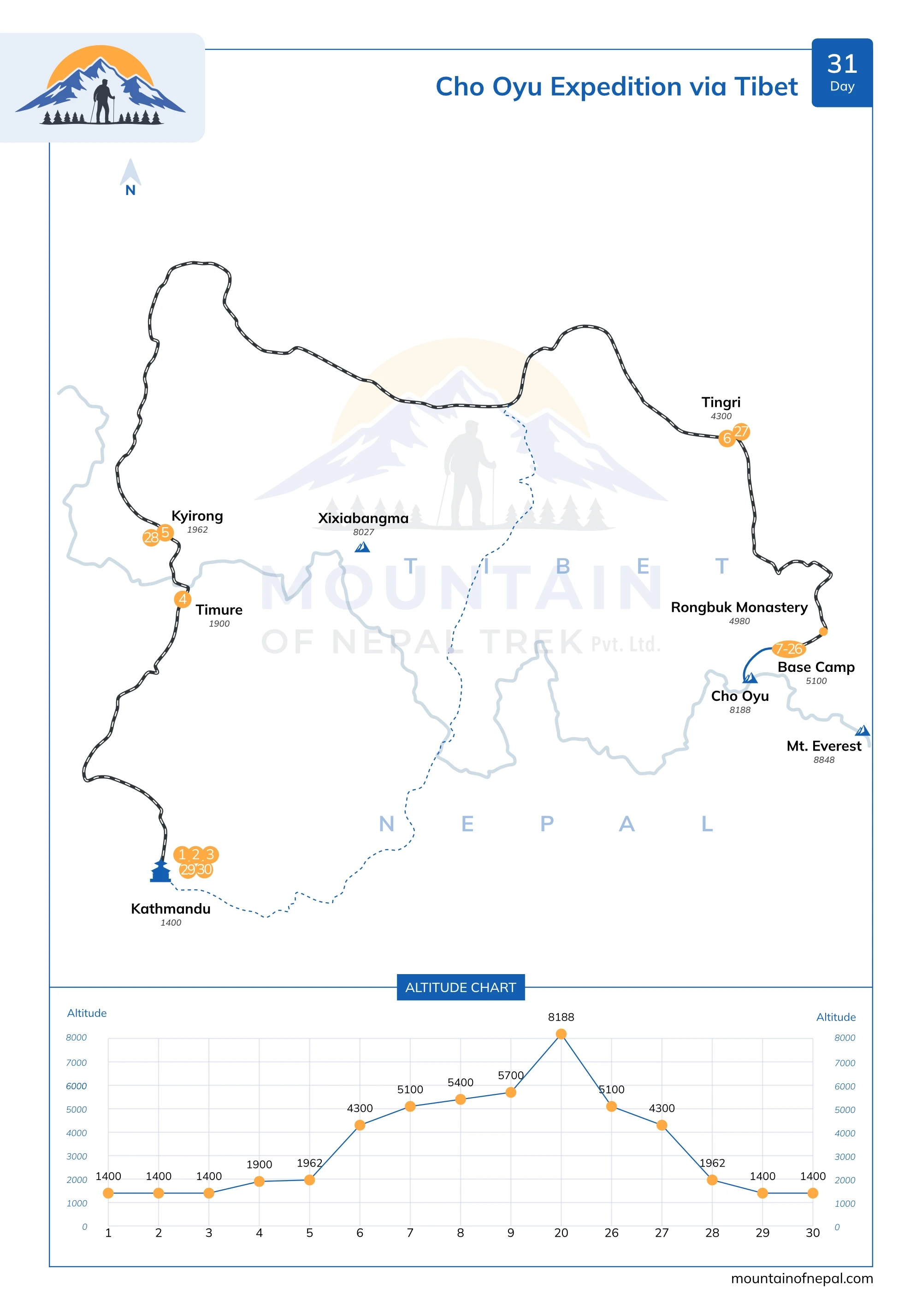
Cho Oyu Expedition via Tibet
| Trip code | |
| Package name | Cho Oyu Expedition via Tibet |
| Duration | 31 |
| Max. elevation | 8188 m |
| Level | Difficult |
| Transportation | All ground transportation as per itinerary |
| Accomodation | 3*** Hotel in Kathmandu and Tea House / Lodge/ Camp during the trek |
| Starts at | Kathmandu |
| Ends at | Kathmandu |
| Trip route | |
| Cost | USD 0 per person |
Highlights
- Summit attempt of Cho Oyu (8,188m) – the world’s sixth-highest peak
- One of the most accessible and safest 8,000-meter expeditions for experienced climbers
- Scenic overland journey from Kathmandu to Tibet via the Nepal–China border
- Drive access (road access) all the way to Chinese Base Camp, reducing long trekking days
- Gradual acclimatization with stays in Kyirong and Thingri
- Visit to Rongbuk Monastery, one of the highest monasteries in the world
- Stunning panoramic views of Himalayan giants including Mount Everest
- Well-structured acclimatization rotations between camps (ABC, Camp I & II)
- Professionally managed expedition by Mountain of Nepal
- Full support team including experienced guides, Sherpas, and high-altitude staff
- High-quality expedition logistics, safety protocols, and equipment support
- Opportunity to experience Tibetan culture, landscapes, and high-altitude plateau life
- Memorable summit experience with breathtaking 360° Himalayan views
- Celebration and cultural experience with a farewell in Kathmandu after success
Overview
The Cho Oyu Expedition via Tibet, organized by Mountain of Nepal, is a carefully designed high-altitude journey to the sixth-highest mountain in the world (8,188m). Known as one of the more accessible 8,000-meter peaks, Cho Oyu offers climbers an excellent introduction to extreme-altitude mountaineering while still demanding strong physical conditioning, technical awareness, and mental resilience. The expedition follows a classic northern approach through Tibet, combining overland travel, gradual acclimatization, and structured climbing rotations to maximize summit success and safety.
This 31-day itinerary ensures a steady ascent profile, beginning in Kathmandu and progressing through the Tibetan Plateau to the Chinese Base Camp and Advanced Base Camp. From there, climbers undergo acclimatization rotations before making their summit push. Throughout the journey, Mountain of Nepal provides experienced guides, Sherpa support, and logistical expertise, ensuring climbers are well-prepared for each stage of the expedition.
- Scenic overland journey from Kathmandu to Tibet
- Gradual altitude gain for proper acclimatization
- Well-planned rotation and summit strategy
- Professional guidance and support team
- Stunning Himalayan and Tibetan landscapes
Best Season for Cho Oyu Expedition via Tibet
Choosing the right season is critical for a successful Cho Oyu expedition. The two primary climbing windows are spring (April–May) and autumn (September–October). During these periods, weather conditions are relatively stable, with clearer skies, moderate winds, and safer climbing conditions. Spring is particularly popular due to slightly warmer temperatures and longer daylight hours, which provide favorable conditions for summit attempts.
Autumn, on the other hand, offers crisp air, excellent visibility, and fewer climbers on the route. However, temperatures tend to be colder, especially at higher camps. Mountain of Nepal carefully schedules expeditions within these optimal windows to reduce weather-related risks and improve overall success rates. Regardless of the season, climbers must be prepared for sudden weather changes typical of high-altitude environments.
Seasonal advantages:
- Spring: Warmer temperatures, stable weather
- Autumn: Clear views, less crowded routes
- Both seasons: Best balance of safety and summit success
Cho Oyu Expedition via Tibet: Difficulty and Transportation
Although Cho Oyu is considered one of the “easier” 8,000-meter peaks, it is still a serious mountaineering challenge. Climbers must deal with extreme altitude, low oxygen levels, and physically demanding conditions. The route involves glacier travel, snow slopes, and moderate technical sections requiring the use of crampons, ice axes, and fixed ropes. Proper acclimatization and prior high-altitude experience are essential for a safe and successful climb.
Transportation plays a significant role in the expedition’s accessibility. Unlike peaks that require long treks, Cho Oyu via Tibet allows vehicle access up to the Chinese Base Camp. The journey begins with a drive from Kathmandu to the Nepal–Tibet border and continues across the Tibetan Plateau. This overland route reduces trekking time and helps conserve energy for the climbing phase.
Difficulty and logistics factors:
- High altitude (above 8,000m) challenges
- Moderate technical climbing sections
- Vehicle access reduces trekking strain
- Requires prior mountaineering experience
Food and Accommodation for Cho Oyu Expedition via Tibet
The mountain of Nepal ensures that climbers are well-supported with nutritious meals and comfortable accommodations throughout the expedition. In Kathmandu and lower regions, climbers stay in quality hotels and lodges with access to a variety of local and international cuisines. As the expedition progresses into Tibet, accommodation transitions to basic lodges and eventually to fully supported tented camps at higher altitudes.
At base camps and higher camps, meals are carefully planned to provide high energy and proper nutrition. The kitchen team prepares a mix of international and expedition-style meals, including soups, rice, pasta, vegetables, and protein-rich foods. Hydration is emphasized, with hot drinks like tea, coffee, and soups readily available. Despite the remote environment, Mountain of Nepal prioritizes hygiene, food quality, and climber comfort.
Food and accommodation features:
- Hotels and lodges in the lower regions
- Tented camps at higher elevations
- High-calorie, nutritious meals
- Dedicated kitchen and support staff
Cho Oyu Expedition via Tibet Permits
Climbing Cho Oyu via Tibet requires multiple permits and official approvals, all of which are managed by Mountain of Nepal. These include a Chinese visa, Tibet Travel Permit, and climbing permits issued by Chinese authorities. The process can be complex and time-sensitive, but the company handles all logistics, allowing climbers to focus on preparation and training.
In addition to climbing permits, environmental and liaison officer fees are also required as part of the expedition regulations. Proper documentation is crucial, as access to Tibet and the mountain is strictly controlled. Mountain of Nepal ensures all paperwork is completed accurately and efficiently, minimizing delays and complications during the journey.
Required permits include:
- Chinese visa
- Tibet Travel Permit
- Climbing permit for Cho Oyu
- Environmental and expedition fees
Why Choose Cho Oyu Expedition via Tibet
Choosing the Cho Oyu Expedition via Tibet with Mountain of Nepal offers a balance of accessibility, safety, and high-altitude experience. The northern route is considered more straightforward compared to other 8,000-meter peaks, making it ideal for climbers aiming to step into extreme-altitude mountaineering. With road access to base camp and a well-established route, the expedition is logistically efficient and less physically draining in the शुरुआती stages.
Mountain of Nepal stands out for its experienced team, strong safety protocols, and personalized approach. From pre-expedition preparation to summit support, the company ensures every detail is managed professionally. Their focus on acclimatization, climber well-being, and success rate makes them a reliable choice for such a demanding adventure.
Reasons to choose this expedition:
- One of the most achievable 8,000m peaks
- Efficient Tibet-side logistics
- Experienced guides and a Sherpa team
- Strong focus on safety and acclimatization
- Comprehensive expedition support
Trip Preparation
Trip Itinerary
Day 1 : Arrival in Kathmandu and Transfer to Hotel (1,400m)
Upon your arrival in Kathmandu, the vibrant capital of Nepal, a representative from Mountain of Nepal will greet you at the airport and transfer you to your hotel. After check-in, you’ll have time to rest and recover from your journey while enjoying the lively atmosphere of the city. Later in the day, there will be a short briefing about the Cho Oyu expedition, where guides will discuss safety protocols, equipment requirements, and the overall itinerary. In the evening, you may explore nearby cultural sites or enjoy local Nepali cuisine as you prepare mentally and physically for the adventure ahead.
Day 2 : Tibet Visa Preparation, Chinese Visa Process & Shopping
These days are dedicated to essential expedition preparations. The team from Mountain of Nepal will handle your Tibet travel permits and Chinese visa processing, ensuring all documentation is properly arranged. Meanwhile, you’ll have time to explore Kathmandu’s trekking markets to purchase or rent any missing climbing gear and supplies. Guides will assist in equipment checks, ensuring you are fully prepared for high-altitude conditions. You may also visit UNESCO World Heritage Sites like Swayambhunath or Boudhanath to experience the spiritual side of Nepal. These days are crucial for organization, acclimatization to the region, and finalizing logistics before heading toward Tibet.
Day 4 : Drive from Kathmandu to Timure
Today begins your overland journey toward the Nepal–Tibet border. After breakfast, you’ll drive through scenic hills, terraced farmland, and traditional villages as you head north toward Timure. The road offers stunning views of rivers and mountain landscapes, gradually transitioning into more rugged terrain. The drive can be long and adventurous, reflecting the remote nature of the region. Upon arrival in Timure, you’ll settle into a lodge for the night. This day provides your first taste of the expedition’s remote travel style and allows you to adjust to the pace of the journey.
Day 5 : Cross Border and Drive to Kyirong (1,962m)
After breakfast, you’ll drive to the Nepal–China border, complete immigration formalities, and enter Tibet. From here, the journey continues to Kyirong (also spelled Kerung or Gyirong), a scenic town surrounded by lush hills and dramatic valleys. The road conditions improve after crossing the border, making the drive more comfortable. Upon arrival, you’ll check into a lodge and rest. This marks the beginning of your Tibetan plateau journey, where landscapes begin to open up and the altitude gradually increases.
Day 6 : Drive from Kyirong to Thingri (4,300m)
Today’s drive takes you deeper into Tibet, climbing steadily in elevation. As you approach Thingri, the scenery transforms into vast, open plains with breathtaking views of the Himalayan giants. Weather permitting, you may catch distant glimpses of peaks like Everest and Cho Oyu. Thingri is a traditional Tibetan settlement and serves as an important acclimatization stop. After arriving, you’ll rest, hydrate, and begin adapting to the higher altitude. The dramatic landscape here offers a true sense of the scale of the Tibetan plateau.
Day 7 : Acclimatization and Preparation in Thingri
This is an important acclimatization day to help your body adjust to the altitude before heading higher. You may take short hikes around Thingri to improve your acclimatization while enjoying views of surrounding peaks. Guides from Mountain of Nepal will monitor your health and provide advice on hydration and pacing. Equipment checks and final packing for the base camp phase will also take place. Taking this day seriously helps reduce the risk of altitude sickness and prepares you for the demanding days ahead.
Day 8 : Drive to Cho Oyu Chinese Base Camp (5,100m) via Rongbuk Monastery
Today you travel to the Chinese Base Camp of Cho Oyu, passing near the famous Rongbuk Monastery, one of the highest monasteries in the world. The route offers spectacular Himalayan views and a spiritual ambiance. Upon arrival at base camp, you’ll settle into tents and begin your high-altitude living experience. The camp is set in a stark yet beautiful landscape, surrounded by towering peaks. The support team will establish camp facilities, including dining and communication areas, ensuring comfort in this remote environment.
Day 9 : Rest Day at Chinese Base Camp
This extra day at base camp allows for rest and acclimatization. You can organize gear, take short walks, and begin adapting to the altitude. The expedition team will conduct training sessions, including the use of climbing equipment and safety techniques. This is also a time to mentally prepare for the trekking and climbing phases ahead. Rest and hydration remain key priorities as your body adjusts to thinner air.
Day 10 : Trek to Intermediate Camp (5,400m)
Leaving base camp, you’ll begin trekking toward the Intermediate Camp. The trail follows a glacial moraine and offers increasingly dramatic mountain views. The trek is physically demanding due to altitude, so a slow and steady pace is essential. Upon arrival, you’ll set up camp and rest. This marks your first move higher into the mountain environment, transitioning from base camp life into expedition climbing mode.
Day 11 : Ascent to Base Camp (5,700m)
Today’s trek takes you to Advanced Base Camp (ABC), the main operational hub for the Cho Oyu climb. The route becomes more rugged, and the altitude gain is significant. Upon arrival, you’ll settle into camp, which will serve as your primary base during the climbing period. From here, stunning views of Cho Oyu dominate the horizon. The team will organize supplies and prepare for upcoming rotations.
Day 12 : Rotation Period
During these crucial acclimatization days, climbers will carry out a series of structured rotations between Advanced Base Camp and the higher camps on Cho Oyu. The first rotation typically involves ascending from Advanced Base Camp to Camp I, continuing upward to touch Camp II for acclimatization purposes, and then descending back to rest. The second rotation is more demanding, including overnight stays at Camp I and Camp II, allowing the body to gradually adjust to the reduced oxygen levels. These rotations are physically taxing and mentally challenging, requiring patience and discipline. The experienced Sherpa team and guides from Mountain of Nepal will carefully monitor each climber’s condition, ensuring safety, proper pacing, and effective adaptation before the summit push.
Day 20 : Summit Push
This period marks the most important and demanding phase of the expedition, as climbers make their final attempt to reach the summit of Cho Oyu (8,188m), the world’s sixth-highest mountain. With favorable weather conditions, the team will ascend from Advanced Base Camp through Camp I and Camp II, establishing higher camps as needed before the summit bid. Summit day is long and physically exhausting, often beginning in the early hours of the morning under extreme cold and high winds. Climbers must rely on their training, endurance, and mental resilience to reach the top. Standing on the summit offers breathtaking panoramic views of the Himalayas and an immense sense of accomplishment. Afterward, a careful and controlled descent is essential, returning safely to lower camps or Advanced Base Camp.
Day 26 : Return to Chinese Base Camp
Following the successful completion of the climbing phase, the team will begin the descent back to the Chinese Base Camp. Although descending is generally less physically demanding than ascending, it still requires careful attention to footing and energy management, especially after the exhaustion of the summit push. The trail retraces the glacial and rocky terrain previously crossed, offering familiar yet rewarding views. Upon arrival at base camp, climbers can finally relax and celebrate their achievement together with the support team. This evening is often filled with gratitude, reflection, and shared stories, marking the conclusion of the high-altitude expedition phase with Mountain of Nepal.
Day 27 : Drive Back to Thingri
Leaving the remote mountain environment behind, the journey continues with a scenic drive across the vast Tibetan plateau as you make your way back to Thingri. The route offers expansive views of the Himalayan range, with snow-capped peaks stretching across the horizon under the open sky. As you descend gradually, the air becomes richer, providing a sense of relief after days spent at high altitude. Passing through isolated landscapes dotted with nomadic settlements and grazing yaks, the drive offers a peaceful transition from expedition life. This day is also a valuable opportunity to reflect on the challenges overcome and the unforgettable experience of climbing Cho Oyu.
Day 28 : Drive from Thingri to Kerung Border
Today’s drive continues across the dramatic Tibetan plateau toward the Kerung border, marking the final stretch of your journey in Tibet. The road winds through wide valleys and rugged terrain, offering one last chance to appreciate the stark beauty of this high-altitude region. As you approach the border near Gyirong, the landscape gradually transitions into greener hills, signaling your return toward Nepal. The journey is both scenic and reflective, allowing time to absorb the magnitude of your expedition. Reaching the border area, you’ll settle into a lodge and prepare for the next day’s crossing, carrying with you lasting memories of Cho Oyu.
Day 29 : Return to Kathmandu & Farewell Dinner
After completing border formalities and re-entering Nepal, the team will drive back to Kathmandu, where the comforts of urban life await. Upon arrival, you’ll check into your hotel and have time to rest and refresh after the long journey. In the evening, Mountain of Nepal will host a special farewell dinner in honor of your successful expedition. This gathering is a wonderful opportunity to celebrate achievements, share stories with fellow climbers and guides, and enjoy authentic Nepali cuisine. The evening marks both the end of the expedition and the beginning of lasting memories and friendships.
Day 30 : Leisure Day in Kathmandu
This optional leisure day in Kathmandu allows you to relax and recover fully after your expedition. You may choose to explore the city’s rich cultural heritage by visiting historic temples, bustling markets, or UNESCO World Heritage Sites. Popular areas like Thamel offer excellent opportunities for souvenir shopping, while spas and cafes provide a comfortable environment to unwind. Whether you spend the day sightseeing or simply resting at your hotel, this day offers a gentle transition back to everyday life after the intensity of high-altitude climbing.
Day 31 : Final Departure
Your incredible journey with Mountain of Nepal comes to an end today. After breakfast, you will be transferred to the international airport in Kathmandu for your onward flight. As you depart, you carry with you not only the achievement of climbing one of the world’s highest peaks but also unforgettable memories of the Himalayas, new friendships, and a deep sense of personal accomplishment. The experience of standing on Cho Oyu will remain a defining moment in your mountaineering journey.
Inclusions
What is included?
- Airport pick-up and drop-off in Kathmandu
- All ground transportation as per itinerary
- Climbing permit for Cho Oyu
- Tibet travel permit & visa support
- Hotel in Kathmandu with Breakfast
- Accommodation (hotel, lodge, tent) during the expedition
- Meals during trekking and climbing (Full Board in the mountains)
- Experienced guides, Sherpa support & base camp staff
- Group climbing equipment (ropes, tents, kitchen gear)
- Oxygen cylinders & masks (as per package)
What isn't included?
- International airfare to/from Kathmandu
- Personal climbing gear & equipment
- Travel insurance (mandatory)
- Personal expenses (laundry, phone, internet, drinks)
- Extra nights in Kathmandu (beyond itinerary)
- Tips for guides and support staff
- Emergency evacuation costs
- Bar bills & alcoholic beverages
Complimentary