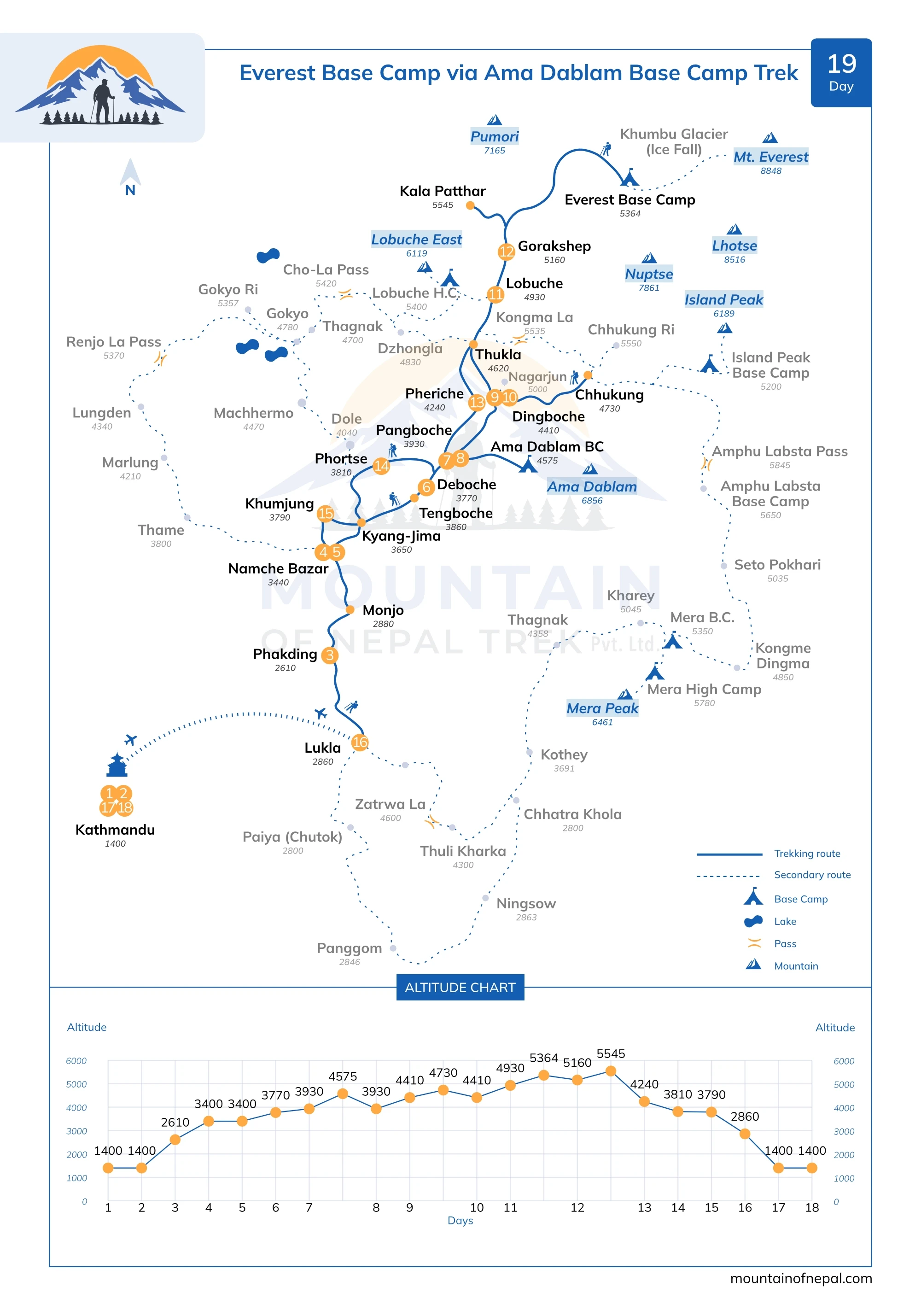
Everest Base Camp via Ama Dablam Base Camp Trek
| Trip code | |
| Package name | Everest Base Camp via Ama Dablam Base Camp Trek |
| Duration | 19 |
| Max. elevation | 5545 m |
| Level | Moderate |
| Transportation | Domestic flight and all ground transportation as per itinerary |
| Accomodation | Hotel in Kathmandu and Tea House / Lodge during the trek |
| Starts at | Kathmandu |
| Ends at | Kathmandu |
| Trip route | |
| Cost | USD 1,790 per person |
Highlights
Overview
Trip Preparation
Trip Itinerary
Day 1 : Arrival in Kathmandu (1,400 m)
Upon arrival at Tribhuvan International Airport in Kathmandu, Nepal, you will be warmly welcomed by a representative from Mountain of Nepal Trek and transferred to your hotel in Kathmandu. After check-in, you can relax and recover from your international flight. If time permits, you may explore Thamel, Kathmandu’s main tourist district, known for its vibrant atmosphere, trekking shops, cafés, restaurants, and local handicrafts. In the evening, enjoy a welcome dinner at a traditional Nepali restaurant, where you can taste authentic local cuisine, experience Nepali culture, and meet your guide and fellow trekkers before the start of your Everest Base Camp trek. Accommodation: Hotel, Meals: Welcome Dinner
Day 2 : Kathmandu – Trek Preparation & Briefing
Today is dedicated to final preparations for your Everest Base Camp trek. After breakfast, meet your guide for a detailed briefing covering the route, daily walking distances, altitude awareness, and essential safety procedures for high-altitude trekking. Your guide will check your trekking gear to ensure everything is suitable for the journey. If anything is missing, you can rent or purchase equipment in Thamel, Kathmandu’s main trekking hub. Required permits, including Sagarmatha National Park and TIMS, will also be arranged. The rest of the day is free to relax, explore the cultural highlights of Kathmandu, or organize your gear before the trek begins. Overnight: Hotel
Day 3 : Scenic Flight to Lukla & Trek to Phakding (2,610m) – 3–4 Hours
Start your Everest Base Camp trek with an early morning scenic flight to Lukla, operating either from Kathmandu (approx. 35 minutes) or Manthali Airport in Ramechap (approx. 20 minutes), depending on the season. This short mountain flight offers breathtaking views of the Himalayas, including snow-capped peaks and deep valleys, before landing at the famous Tenzing–Hillary Airport, where your trekking crew will greet you From Lukla, the trek begins with a gradual descent along the Dudh Kosi Valley on a well-marked trail that passes through terraced fields, traditional Sherpa villages, and tea houses. The trail follows the roaring Dudh Koshi River, its milky waters rushing through the valley. As you enter Buddhist land, you’ll encounter prayer wheels, mani walls, and carved stones with Buddhist mantras—all sacred in Sherpa culture. As a sign of respect, trekkers should pass these in a clockwise direction. The trail passes through the small villages of Chaurikharka and Ghat, offering glimpses of local life. Along the way, you will meet fellow trekkers, mountaineers returning to Lukla, and trekking porters. The terrain is moderately easy, with gentle rises and falls, making this a comfortable half-day trek perfect for acclimatization. You will arrive at Phakding, a serene riverside village nestled beside the Dudh Kosi River. Spend the night in comfortable mountain lodges, resting and preparing for the next stage of your journey toward the Everest Base Camp. Note: As Lukla flights are highly weather-dependent, it is recommended to keep two extra days in your itinerary. This provides flexibility for possible delays and allows time to adjust to changes in the departure airport (Kathmandu or Manthali), ensuring a smooth and stress-free trekking experience.
Day 4 : Trek to Namche Bazaar (3,440m), Walk approx. 5-6 hours
Today’s morning section of the trek follows the rushing Dudh Koshi (Milky River) along the classic Everest Base Camp route, crossing and re-crossing it several times via high suspension bridges. The trail winds through beautiful forests of blue pine and rhododendron, especially vibrant in spring when the hillsides burst into bloom. Along the way, you pass through charming Sherpa villages such as Benkar, Monjo, and Jorsale, while enjoying views of the snow peaks Kusum Kangaru and Thamserku. Beyond Monjo, you enter Sagarmatha National Park, where permits are checked before continuing along a pleasant riverside trail toward the confluence of the Dudh Koshi and Bhote Koshi rivers. High above the rushing river, you cross the iconic Hillary Suspension Bridge, adorned with vibrant prayer flags that flutter in the wind. Locals believe these prayer flags carry prayers of peace and blessings across the world on the wind. Beyond the bridge, the trail begins a steep ascent toward Namche Bazaar. This section is one of the most demanding parts of the trek, so a slow and steady pace is both wise and necessary. About halfway up the climb, weather permitting, you are rewarded with your first glimpse of Mount Everest, rising behind the dramatic ridge of Nuptse and Lhotse, along with views of Ama Dablam and Thamserku. After a steady ascent, you reach Namche Bazaar. This lively mountain town is a popular resting and acclimatization point for trekkers at high altitude. It offers comfortable lodges, cafés, bakeries, and trekking shops, making it a welcoming and essential stop in the Himalayas before continuing deeper into the region.
Day 5 : Acclimatization Day in Namche Bazaar (3,440 m)
Today is a crucial rest and acclimatization day, allowing your body to adjust to the high altitude before continuing higher into the Everest region. While Namche Bazaar itself is a comfortable place to relax, we encourage you to take a gentle acclimatization hike to help your body adapt more effectively. A popular option is a walk to the Everest View Hotel, perched on a nearby ridge. From here, you can enjoy breathtaking panoramic views of Mount Everest, Lhotse, Nuptse, and Ama Dablam—an ideal spot for sunrise photography and your first close-up Himalayan vistas. Nearby traditional Sherpa villages, Khumjung and Khunde, are also worth exploring. In Khumjung, you can experience authentic Sherpa culture, while in Khunde, you can visit the Hillary School, founded by Sir Edmund Hillary to provide education for local children. The school has played a vital role in improving literacy and expanding opportunities for Sherpa communities in this remote Himalayan region. Khunde also hosts the Khunde Hospital, a vital healthcare center established with the support of Sir Edmund Hillary, providing essential medical services to both residents and trekkers in this high-altitude region. Gentle walks along the surrounding ridges follow the “climb high, sleep low” principle, helping your body acclimatize while offering stunning Himalayan scenery. Taking it slow, staying well hydrated, and enjoying the experience will prepare you both physically and mentally for the higher trails ahead. Overnight: Lodge in Namche Bazaar
Day 6 : Trek from Namche Bazaar to Deboche (3,770 m) – Walk approx. 6–7 hours
After breakfast in Namche Bazaar, you begin the trek with a steady climb out of the village, gaining elevation as you leave the amphitheater-shaped settlement behind. Although demanding at the start, this section rewards you with expanding views of the surrounding valleys and Himalayan peaks. From the ridge above Namche Bazaar, the trail follows the well-established Everest Base Camp trekking route, contouring along the mountainside high above the rushing Dudh Koshi River. The path gently traverses the hillside with a few short ascents and descents, offering panoramic views of Mount Everest (8,848 m), Lhotse (8,516 m), Thamserku (6,608 m), and the striking Ama Dablam (6,812 m) on clear days. Continuing along the hillside, you pass through small Sherpa settlements such as Kyangjuma before reaching Sansa, where the trail separates—one route leads toward the Gokyo Valley, while the other follows the classic Everest route. From Sansa, you follow the classic Everest route, descending to the river valley through pine and rhododendron forests and crossing a dramatic suspension bridge before reaching Phunki Tenga, a popular riverside stop for lunch and rest. After the break, the trail climbs steadily uphill through forested terrain for approximately two hours, gaining significant elevation. This is the most physically demanding section of the day, so maintaining a slow and steady pace is essential. At the top lies Tengboche, home to the famous Tengboche Monastery—the largest and most important monastery in the Khumbu region. This spiritual center holds deep significance for the Sherpa community and offers spectacular close-up views of Ama Dablam and surrounding peaks. From Tengboche, the trek continues with a pleasant 20–30 minute descent through a peaceful forest to Deboche, a quieter village nestled among trees. Deboche is an ideal place to rest and recover, offering a calm alpine atmosphere after a rewarding day of trekking. Overnight: Lodge in Deboche
Day 7 : Trek from Deboche to Pangboche (3,930 m) – Walk approx. 2–3 hours
Today is a shorter and more relaxed trekking day, allowing your body to gradually adjust to the increasing altitude. Leaving Deboche, the trail descends gently through a peaceful forest before crossing a suspension bridge over the Imja Khola River. From here, the path gradually ascends along an open valley, with the landscape becoming more alpine as trees begin to thin. The trail offers stunning close-up views of Ama Dablam, one of the most beautiful peaks in the Himalayas, as well as views of Lhotse and the surrounding mountains. After a steady but gentle climb, you arrive at Pangboche, one of the oldest Sherpa villages in the Khumbu region. The village is rich in culture and tradition, with stone houses, prayer flags, and panoramic mountain scenery all around. In the afternoon, you may visit Pangboche Monastery, one of the oldest monasteries in the region, offering insight into Sherpa Buddhist culture and spiritual life. The shorter walking day provides time to rest, explore the village, and continue acclimatizing before heading higher into the Everest region. Overnight: Lodge in Pangboche
Day 8 : Trek to Ama Dablam Base Camp (4,575 m) and back – Walk approx. 6 hours
Today’s trek offers a wonderful opportunity to step off the main Everest Base Camp trail and explore a quieter, less-traveled area of the Khumbu. It also serves as an ideal acclimatization strategy, following the proven “climb high, sleep low” principle to help your body adjust safely to the altitude. Leaving Pangboche, we cross the Imja Khola on a suspension bridge and begin a steady ascent through slopes dotted with juniper and heather, passing yak pastures and open alpine terrain. The trail opens up to breathtaking 360-degree panoramic views of Ama Dablam, Lhotse, Island Peak, Taboche, and the sweeping Khumbu Valley below. Ama Dablam Base Camp, at 4,575 m, sits in a serene yak pasture beneath the mountain’s dramatic west face, with the summit rising 2,237 m above. Trekkers here feel almost on the mountain itself, surrounded by snow-capped peaks, rugged ridges, and glaciers in a remote Himalayan panorama. The base camp is accessible without technical climbing gear, traversing mostly moraine, rocks, and small streams, and offers up-close views of the mountain and climbing routes. Reaching the summit of Ama Dablam, however, is a completely different challenge, requiring fixed ropes, steep ice and rock sections, high-altitude camps, and advanced mountaineering skills. After enjoying the stunning scenery and taking photos, we descend back to Pangboche, completing a rewarding day of trekking, acclimatization, and Himalayan exploration. Overnight: Lodge in Pangboche
Day 9 : Trek from Pangboche to Dingboche (4,410 m) – approx. 4–5 hours
Beyond Pangboche, the landscape opens into a more alpine environment as trees thin with increasing elevation. The trail gently climbs through open valleys toward Somare, offering sweeping views of Lhotse, Island Peak, Taboche, and Ama Dablam, while the air grows noticeably thinner. After crossing a small bridge, the path ascends to Dingboche, a peaceful village set on a broad plateau beneath the striking south face of Ama Dablam. The village is surrounded by stone-walled fields built to protect crops from strong winds and grazing animals, providing a serene environment for rest and acclimatization. This day’s trek is moderate, allowing trekkers to adjust to the higher altitude while taking in the spectacular Himalayan scenery.
Day 10 : Acclimatization Day in Dingboche (4,410 m)
Today is a crucial rest and acclimatization day, giving your body time to adjust to the thinner mountain air and reducing the risk of altitude sickness. Dingboche is a key stop on the Everest Base Camp trek, offering a peaceful alpine environment with yak pastures, stone-walled fields, and distant glaciers. During this day, short hikes to nearby viewpoints are highly recommended to practice the “climb high, sleep low” technique, which helps improve acclimatization. Popular options include ascending Nagarjun Hill for panoramic views of Lhotse, Island Peak, Ama Dablam, and surrounding peaks, or exploring the Chhukung Valley with its dramatic mountain scenery. While hiking or resting, focus on proper hydration, balanced meals, and slow pacing to ensure a safe and comfortable trek onward. This day provides the perfect balance of gentle activity and rest, preparing you for the higher sections of the Everest Base Camp trail.
Day 11 : Trek from Dingboche to Lobuche (4,930 m) – Approx. 6 hours
After a restful acclimatization day in Dingboche, today’s trek takes you higher into the Everest region, gradually leaving the tree line behind. The trail passes through open alpine valleys, yak pastures, and stone-walled fields, offering ever-expanding views of surrounding Himalayan giants. Along the way, you’ll reach Dughla, a common stop for rest and lunch, framed by the dramatic Khumbu Glacier. From Dughla, the path climbs steeply along the terminal moraine of the glacier, traversing rocky terrain shaped by ancient ice flows. Memorial cairns along the route honor climbers who have lost their lives on Everest and nearby peaks, creating a reflective and powerful experience. The trail then descends slightly before reaching Lobuche, a small but striking settlement perched at the edge of the high Khumbu Valley. From your lodge, enjoy breathtaking sunset views of Nuptse, Pumori, and Taboche, while resting for the challenging days ahead toward Everest Base Camp. Overnight: Lodge in Lobuche
Day 12 : Trek from Lobuche to Gorak Shep (5,170 m) & Everest Base Camp (5,364 m) – Approx. 7–8 hours
Today is one of the most memorable days of the Everest Base Camp trek. Leaving Lobuche, the trail follows the lateral moraine of the Khumbu Glacier, with towering Pumori on your left. The terrain gradually becomes rockier and more alpine as you ascend toward Gorak Shep, the last settlement before Everest Base Camp. Along the way, you’ll notice the stark beauty of high-altitude landscapes, including glacial moraines, scattered boulders, and distant snow-capped peaks. After a short rest and lunch at Gorak Shep, you continue on a rocky trail toward Everest Base Camp (5,364 m). This final stretch offers close-up views of the Khumbu Icefall, massive glaciers, and the surrounding Himalayan giants like Nuptse, Lhotse, and Pumori. At base camp, trekkers can witness expedition teams preparing for their summit attempts, giving a unique glimpse into mountaineering life on Everest. This is a perfect spot for photos and to soak in the grandeur of the Himalayas. After exploring base camp, you retrace your steps back to Gorak Shep for an overnight stay, allowing your body to recover at a slightly lower altitude. From the lodge, enjoy views of the surrounding peaks and the setting sun over the Khumbu Valley, reflecting on an unforgettable day in the world’s highest mountains. Overnight: Lodge in Gorak Shep
Day 13 : Ascend Kala Patthar (5,545 m) & Trek to Pheriche (4,240 m) – Approx. 8–9 hours
Today begins with an early morning hike from Gorak Shep to Kala Patthar, one of the highest and most iconic viewpoints on the Everest Base Camp trek. The trail is steep but immensely rewarding, offering spectacular panoramic views of Mount Everest, Lhotse, Nuptse, Pumori, and surrounding Himalayan peaks. Sunrise from Kala Patthar provides an unforgettable photographic opportunity as the first light illuminates Everest’s towering summit. After spending time at the viewpoint and capturing the majestic scenery, you descend back to Gorak Shep for breakfast. From there, the trek continues downhill, passing through Lobuche and Dughla, before reaching Pheriche (4,240 m). The trail descends gradually through rocky, high-altitude terrain, crossing small streams, open valleys, and occasional yak pastures, showcasing the stark beauty of the Khumbu region. Pheriche is a peaceful village known for its high-altitude medical post, providing care for trekkers and locals dealing with altitude-related issues. Arriving in Pheriche, you can relax and recover, taking in the serene alpine environment while preparing your body for the descent and remaining sections of the Everest Base Camp trek. Overnight: Lodge in Pheriche
Day 14 : Day: Trek from Pheriche to Phortse Village (3,810 m) via High Route – 5–6 Hours
Today’s trek follows the scenic high route from Pheriche to Phortse, a quieter and more rewarding alternative to the main Everest Base Camp trail. This route is known for its breathtaking panoramic views and peaceful surroundings. Leaving Pheriche, the trail gradually ascends along an open hillside, staying high above the valley. Along the way, enjoy spectacular views of Ama Dablam, Taboche, and Cholatse. You’ll also have an incredible vantage point overlooking Tyangboche Monastery, set against a dramatic mountain backdrop. The trail continues along a scenic ridge with a few narrow and exposed sections before descending steadily toward Phortse Village through alpine terrain and yak grazing areas. Phortse is a peaceful and less-visited Sherpa village, known for its mountaineering heritage and authentic local culture—an ideal place to relax away from the busier trails. As you trek through Sagarmatha National Park, keep an eye out for wildlife. You may spot the Himalayan Tahr on rocky slopes and the colorful Himalayan Monal along forested paths. With some luck, you might also see Musk Deer or a soaring Lammergeier overhead. Rare species like the Snow Leopard and Red Panda also inhabit the region. Wildlife is more commonly seen in quieter areas, especially in the early morning or late afternoon. Overnight: Lodge in Phortse Village
Day 15 : Trek from Phortse to Khumjung (Approx. 5–6 hours)
Leaving Phortse (3,810 m), the trail begins with a gentle descent through rhododendron and pine forests toward a classic glacial river that flows from the Ngozumpa Glacier, the longest glacier in the Nepal Himalayas (~36 km). At the river, trekkers cross a suspension bridge over a gorge before starting a steady ascent toward Mon La (3,970 m), a small mountain pass adorned with prayer flags and chortens. From Mon La, you are rewarded with 360-degree panoramic Himalayan views, including close-ups of iconic peaks such as Ama Dablam, Thamserku, Kangtega, and the surrounding mountains, making it an ideal spot for photography and a short rest. The trail then gradually descends through forested sections and open clearings before joining the main Everest Base Camp route near Kyangjuma. From there, the path ascends gently toward the traditional Sherpa village of Khumjung (3,790 m). Nestled in a wide valley beneath the sacred peak of Khumbila, Khumjung is one of the largest Sherpa settlements in the Everest region, known for its stone houses, green-roofed buildings, and peaceful atmosphere. This 5–6 hour trek offers a perfect combination of breathtaking mountain vistas, forested trails, and cultural encounters, making it an excellent way to experience the natural beauty and rich heritage of the Khumbu region. An overnight stay in Khumjung allows trekkers to rest and explore the village’s Hillary School, local monastery, and traditional Sherpa culture, providing a memorable insight into life in the high Himalayas.
Day 16 : Trek to Lukla (2,860 m) – 6–7 Hours
Your final day in the Everest region begins with a gentle descent from Khumjung to Namche Bazaar, following the familiar trail you explored during your acclimatization day. Walking this route again brings a sense of familiarity, allowing you to notice details and views you may have missed earlier. From Namche Bazaar, you retrace the main trail toward Lukla, descending through lush pine and rhododendron forests, crossing the Dudh Koshi River on a series of suspension bridges, and passing lively villages such as Phakding. As you descend, take time to enjoy the scenery you may have missed earlier—the changing landscapes, flowing rivers, and distant peaks now feel more familiar, yet just as inspiring. Arriving in Lukla, there’s a mix of pride, relief, and reflection. It’s the perfect moment to celebrate the successful completion of your Everest adventure and look back on an unforgettable journey through the Himalayas. Overnight: Lodge in Lukla
Day 17 : Fly from Lukla to Kathmandu / Manthali & Drive to Kathmandu
Your return flight from Lukla operates either to Kathmandu or Manthali (Ramechhap Airport), with the destination usually decided on the day of your flight or sometimes just before boarding, depending on the season, weather, and flight schedules. During peak trekking seasons, flights are often redirected to Manthali instead of Kathmandu. This is mainly due to air traffic congestion at Tribhuvan International Airport in Kathmandu, as well as better flight management and on-time operations from Manthali, which helps reduce delays in the busy Everest trekking period. If your flight lands in Manthali, you will continue with a 4–5 hour scenic drive back to Kathmandu on the same day. This option is often more reliable during peak seasons and ensures smoother logistics for your return.
Day 18 : Reserve Day in Kathmandu
A reserve day is included in your itinerary to provide flexibility in case of weather-related disruptions, particularly for flights to and from Lukla, which are highly weather-dependent. In the Himalayas, conditions can change quickly, and flights are sometimes delayed, canceled, or rerouted. This extra day ensures that even if your outbound flight to Lukla or your return flight from Lukla is postponed, canceled, or rerouted (for example, via Manthali), you will still have enough time to continue your trek or reach Kathmandu without the stress of missing your onward international flight. If all flights operate as scheduled, this day becomes a bonus—you can relax at your hotel, explore Kathmandu’s cultural highlights, do some last-minute shopping in Thamel, or simply rest after your trek. Overall, the reserve day adds security, flexibility, and peace of mind, making your Everest adventure safer, smoother, and more enjoyable.
Day 19 : Final Departure
- 1 - 1 pax US$ 1,989
- 2 - 4 pax US$ 1,790
- 5 - 8 pax US$ 1,720
- 9 - 12 pax US$ 1,620
Inclusions
What is included?
What isn't included?
Complimentary