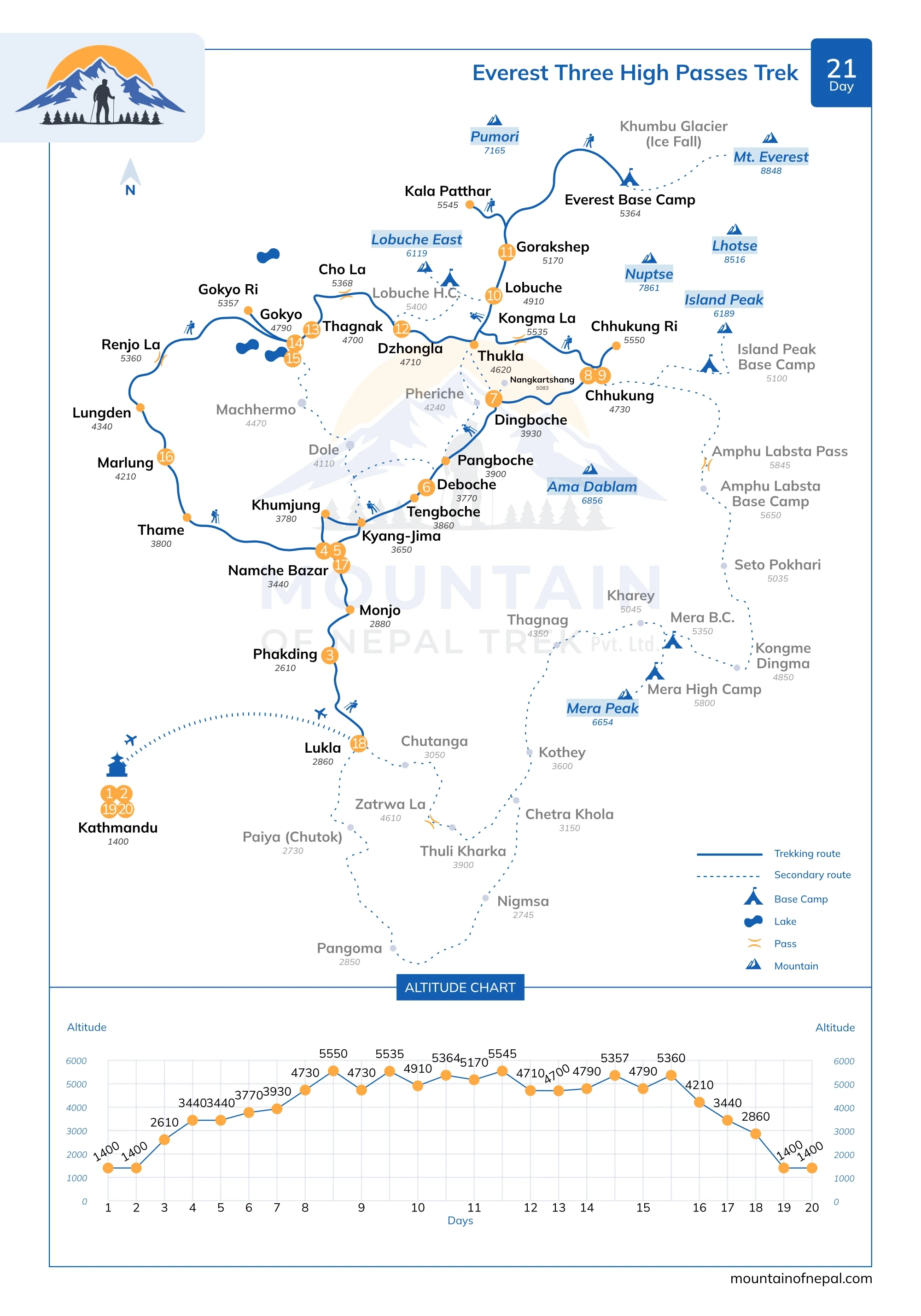
Everest Three High Passes Trek
| Trip code | |
| Package name | Everest Three High Passes Trek |
| Duration | 22 |
| Max. elevation | 5545 m |
| Level | Moderate |
| Transportation | Domestic flight and all ground transportation as per itinerary |
| Accomodation | Hotel in Kathmandu and a Tea House / Lodge during the trek |
| Starts at | Kathmandu |
| Ends at | Kathmandu |
| Trip route | |
| Cost | USD 2,445 per person |
Highlights
- Cross three high Himalayan passes: Kongma La (5,535 m), Cho La (5,420 m), Renjo La (5,360 m)
- Visit iconic Everest Base Camp (5,364 m)
- Witness sunrise from the Kala Patthar viewpoint
- Explore the stunning Gokyo Lakes system
- Climb Gokyo Ri (5,357 m) for panoramic Everest views
- Experience authentic Sherpa culture in Namche Bazaar and villages
- Trek through diverse landscapes: forests, glaciers, and high alpine terrain
- Discover the remote valleys of the Khumbu region circuit route
- Close-up views of peaks like Everest, Lhotse, Makalu, and Cho Oyu
- Adventure-packed high-altitude trekking experience with Mountain of Nepal
Overview
The Everest Three Pass Trek is one of the most challenging and rewarding trekking adventures in the Everest region of Nepal. Operated by Mountain of Nepal, this journey combines high-altitude passes, iconic viewpoints, remote valleys, and cultural Sherpa villages into a single, epic circuit. The trek crosses three major Himalayan passes—Kongma La (5,535 m), Cho La (5,420 m), and Renjo La (5,360 m)—offering panoramic views of Everest, Lhotse, Makalu, and Cho Oyu.
This 22-day itinerary begins in Kathmandu and follows the classic Khumbu trail through Lukla, Phakding, and Namche Bazaar before branching into remote alpine routes. Unlike the standard Everest Base Camp trek, this route circles the entire Khumbu region, giving trekkers a more complete and adventurous Himalayan experience. Highlights include Everest Base Camp, Kala Patthar sunrise view, Gokyo Lakes, and Gokyo Ri summit.
The trek is designed for physically fit trekkers who want both adventure and immersion in Sherpa culture. It is not just a trek but a full alpine expedition that demands endurance, proper acclimatization, and mental resilience.
- Cross 3 high Himalayan passes above 5,300 m
- Visit Everest Base Camp (5,364 m)
- Summit Kala Patthar (5,545 m approx viewpoint)
- Explore Gokyo Lakes and Gokyo Ri
- Experience Sherpa villages and Buddhist monasteries
- Organized support by Mountain of Nepal
Best Season for Everest Three Pass Trek
The best time to undertake the Everest Three Pass Trek with Mountain of Nepal is during the spring (March to May) and autumn (September to November) seasons. These periods provide the most stable weather conditions, clear mountain views, and safer crossing of high-altitude passes. Spring brings blooming rhododendrons and slightly warmer temperatures, while autumn offers crystal-clear skies after the monsoon season.
Winter (December to February) is extremely cold, especially at high passes like Kongma La and Cho La, where heavy snowfall can block trails. Similarly, the monsoon season (June to August) brings rain, landslides, and poor visibility, making trekking risky and less enjoyable.
Mountain of Nepal always recommends planning the trek during peak seasons to ensure safety, better logistics, and the best possible Himalayan views. Weather in the Everest region can still change quickly, so proper preparation is essential even during favorable months.
Best seasonal guide:
- Spring (Mar–May): Flowers, stable weather, good visibility
- Autumn (Sep–Nov): Best mountain views, dry trails
- Winter (Dec–Feb): Very cold, high pass risks
- Monsoon (Jun–Aug): Not recommended
Key points:
- Clear skies = safer pass crossing
- Peak trekking comfort in spring/autumn
- Better flight reliability to Lukla
- Ideal photography conditions
Everest Three Pass Trek Difficulty and Transportation
The Everest Three Pass Trek is considered a strenuous and high-difficulty trek, suitable for experienced trekkers with good physical fitness. The challenge comes from long trekking days, steep ascents and descents, and crossing three high-altitude passes above 5,300 meters. Altitude sickness risk is significant, which is why proper acclimatization days in Namche and Dingboche are included in the itinerary by Mountain of Nepal.
The terrain varies from rocky trails and glaciers to icy mountain passes. Weather conditions can change rapidly, and trekkers must be prepared for snow, wind, and freezing temperatures at higher elevations. Despite its difficulty, the trek is non-technical, meaning no climbing equipment is required, but endurance and stamina are essential.
Transportation begins with a scenic flight from Kathmandu to Lukla, one of the world’s most famous mountain airports. From Lukla onward, all travel is on foot. Return flights from Lukla to Kathmandu complete the journey. Mountain of Nepal manages all logistics, ensuring safe flights, experienced guides, and porter support.
Difficulty highlights:
- Very strenuous high-altitude trek
- 3 passes above 5,300 m
- 6–8 hours walking daily
- Risk of altitude sickness
- Requires a good fitness level
Transportation details:
- Kathmandu → Lukla: 30–35 min mountain flight
- Trekking: Entirely on foot after Lukla
- Lukla → Kathmandu return flight
- Porter and guide support included
Food and Accommodation for Everest Three Pass Trek
During the Everest Three Pass Trek, accommodation is mainly in teahouses and mountain lodges, which are simple but comfortable enough for trekkers. Managed through Mountain of Nepal, these lodges provide basic rooms with twin beds, blankets, and shared bathroom facilities in most locations. In lower regions like Namche Bazaar, facilities are more developed, while higher areas like Gokyo or Lobuche are more basic due to remoteness.
Food is prepared fresh in local teahouses and includes a mix of Nepali, Tibetan, and limited international dishes. The most common meal is Dal Bhat (rice, lentils, vegetables), which provides high energy for trekking. Other options include noodles, soups, pasta, potatoes, and eggs. As altitude increases, food options become more limited and expensive due to transportation challenges.
Hydration is extremely important, and trekkers are advised to drink boiled or purified water. Mountain of Nepal guides ensure safe food choices and hygienic accommodation throughout the journey.
Accommodation highlights:
- Teahouse lodges throughout the route
- Basic twin-sharing rooms
- Hot showers (extra cost in higher regions)
- Limited Wi-Fi in the lower villages
Food highlights:
- Dal Bhat (energy-rich staple)
- Noodles, pasta, soups
- Tibetan bread, eggs, potatoes
- Hot drinks (tea, coffee, ginger tea)
Key points:
- Simple but sufficient mountain lodging
- Freshly cooked meals daily
- Higher altitude = limited variety
- Hydration is critical for acclimatization
Everest Three Pass Trek Permits
To complete the Everest Three Pass Trek, several trekking permits are required, all of which are arranged by Mountain of Nepal for a hassle-free experience. These permits ensure entry into the protected areas of the Khumbu region and support conservation efforts and local communities.
The main permit is the Sagarmatha National Park Entry Permit, which is required once trekkers enter the Everest region. Additionally, a Khumbu Pasang Lhamu Rural Municipality Permit is mandatory for trekking in the local area. These permits are checked at various checkpoints along the route.
Trekkers flying into Lukla or trekking from Jiri/Salleri (alternative routes) still require these permits before entering restricted zones. Proper documentation is essential, and carrying permits at all times is required.
Mountain of Nepal handles all paperwork in advance, ensuring trekkers do not face delays or confusion during the journey.
Required permits:
- Sagarmatha National Park Entry Permit
- Khumbu Pasang Lhamu Rural Municipality Permit
- TIMS Card (depending on regulations at the time)
Key points:
- Mandatory for all Everest region trekkers
- Checked at multiple trail checkpoints
- Arranged fully by Mountain of Nepal
- Supports conservation and local development
Why Choose Everest Three Pass Trek with Mountain of Nepal
Choosing Mountain of Nepal for the Everest Three Pass Trek ensures a safe, well-organized, and professionally guided Himalayan adventure. This trek is physically demanding and logistically complex, and having an experienced local operator significantly improves safety, comfort, and overall experience.
Mountain of Nepal provides expert licensed guides, experienced porters, and carefully planned itineraries with proper acclimatization days. Safety is the top priority, especially when crossing high passes like Cho La, Kongma La, and Renjo La, where weather conditions can change rapidly. The company also offers emergency support and flexible itinerary management when needed.
Beyond logistics, trekkers benefit from deep cultural insight into Sherpa life, Buddhist monasteries, and Himalayan traditions. The journey becomes not just a physical challenge but also a meaningful cultural experience.
Why choose Mountain of Nepal:
- Experienced local trekking guides
- Safe and well-planned itinerary
- Proper acclimatization schedule
- Emergency support system
- Porter supports comfort
- Authentic cultural experience
- Full permit and logistics handling
Key points:
- Professional high-altitude trekking management
- Strong safety and rescue awareness
- Personalized trekking support
- Local expertise in the Everest region
- Smooth airport, flight, and lodge coordination
Trip Preparation
Trip Itinerary
Day 1 : Arrival in Kathmandu (1,400 m) and Transfer to Hotel
Upon arrival at Tribhuvan International Airport, you will be warmly welcomed by a representative from Mountain of Nepal Trek and transferred to your hotel in Kathmandu. After check-in, you can relax and recover from your international journey. If time permits, you may explore the lively streets of Thamel, Kathmandu’s popular tourist district, known for its cafés, restaurants, trekking shops, and local handicrafts. In the evening, attend a pre-trek briefing where your guide will explain the Everest Base Camp itinerary, safety guidelines, and trek preparation. This is also a great opportunity to ask any final questions before your adventure begins. Later, enjoy a welcome dinner at a traditional Nepali restaurant, offering a taste of local cuisine and culture. Accommodation: Hotel , Meals: Welcome Dinner
Day 2 : Kathmandu Sightseeing and Trek Preparation & Briefing
Today is dedicated to final preparations for your Everest Base Camp trek. After breakfast, meet your guide for a detailed briefing covering the route, daily walking distances, altitude awareness, and essential safety procedures for high-altitude trekking. Your guide will check your trekking gear to ensure everything is suitable for the journey. If anything is missing, you can rent or purchase equipment in Thamel, Kathmandu’s main trekking hub. Required permits, including Sagarmatha National Park and TIMS, will also be arranged. The rest of the day is free to relax, explore the cultural highlights of Kathmandu, or organize your gear before the trek begins. Overnight: Hotel
Day 3 : Scenic Flight to Lukla & Trek to Phakding (2,610m) – 3–4 Hours
Start your Everest Base Camp trek with an early morning scenic flight to Lukla, operating either from Kathmandu (approx. 35 minutes) or Manthali Airport in Ramechap (approx. 20 minutes), depending on the season. This short mountain flight offers breathtaking views of the Himalayas, including snow-capped peaks and deep valleys, before landing at the famous Tenzing–Hillary Airport, where your trekking crew will greet you From Lukla, the trek begins with a gradual descent along the Dudh Kosi Valley on a well-marked trail that passes through terraced fields, traditional Sherpa villages, and tea houses. The trail follows the roaring Dudh Koshi River, its milky waters rushing through the valley. As you enter Buddhist land, you’ll encounter prayer wheels, mani walls, and carved stones with Buddhist mantras—all sacred in Sherpa culture. As a sign of respect, trekkers should pass these in a clockwise direction. The trail passes through the small villages of Chaurikharka and Ghat, offering glimpses of local life. Along the way, you will meet fellow trekkers, mountaineers returning to Lukla, and trekking porters. The terrain is moderately easy, with gentle rises and falls, making this a comfortable half-day trek perfect for acclimatization. You will arrive at Phakding, a serene riverside village nestled beside the Dudh Kosi River. Spend the night in comfortable mountain lodges, resting and preparing for the next stage of your journey toward the Everest Base Camp. Note: As Lukla flights are highly weather-dependent, it is recommended to keep two extra days in your itinerary. This provides flexibility for possible delays and allows time to adjust to changes in the departure airport (Kathmandu or Manthali), ensuring a smooth and stress-free trekking experience.
Day 4 : Trek to Namche Bazaar (3,440m), Walk approx. 5-6 hours
Today’s morning section of the trek follows the rushing Dudh Koshi (Milky River) along the classic Everest Base Camp route, crossing and re-crossing it several times via high suspension bridges. The trail winds through beautiful forests of blue pine and rhododendron, especially vibrant in spring when the hillsides burst into bloom. Along the way, you pass through charming Sherpa villages such as Benkar, Monjo, and Jorsale, while enjoying views of the snow peaks Kusum Kangaru and Thamserku.Beyond Monjo, you enter Sagarmatha National Park, where permits are checked before continuing along a pleasant riverside trail toward the confluence of the Dudh Koshi and Bhote Koshi rivers. High above the rushing river, you cross the iconic Hillary Suspension Bridge, adorned with vibrant prayer flags that flutter in the wind. Locals believe these prayer flags carry prayers of peace and blessings across the world on the wind. Beyond the bridge, the trail begins a steep ascent toward Namche Bazaar. This section is one of the most demanding parts of the trek, so a slow and steady pace is both wise and necessary. About halfway up the climb, weather permitting, you are rewarded with your first glimpse of Mount Everest, rising behind the dramatic ridge of Nuptse and Lhotse, along with views of Ama Dablam and Thamserku. After a steady ascent, you reach Namche Bazaar. This lively mountain town is a popular resting and acclimatization point for trekkers at high altitude. It offers comfortable lodges, cafés, bakeries, and trekking shops, making it a welcoming and essential stop in the Himalayas before continuing deeper into the region.
Day 5 : Acclimatization Day in Namche Bazaar (3,440 m)
Today is a crucial rest and acclimatization day, allowing your body to adjust to the high altitude before continuing higher into the Everest region. While Namche Bazaar itself is a comfortable place to relax, we encourage you to take a gentle acclimatization hike to help your body adapt more effectively. A popular option is a walk to the Everest View Hotel, perched on a nearby ridge. From here, you can enjoy breathtaking panoramic views of Mount Everest, Lhotse, Nuptse, and Ama Dablam—an ideal spot for sunrise photography and your first close-up Himalayan vistas. Nearby traditional Sherpa villages, Khumjung and Khunde, are also worth exploring. In Khumjung, you can experience authentic Sherpa culture, while in Khunde, you can visit the Hillary School, founded by Sir Edmund Hillary to provide education for local children. The school has played a vital role in improving literacy and expanding opportunities for Sherpa communities in this remote Himalayan region. Khunde also hosts the Khunde Hospital, a vital healthcare center established with the support of Sir Edmund Hillary, providing essential medical services to both local residents and trekkers in this high-altitude region.Gentle walks along the surrounding ridges follow the “climb high, sleep low” principle, helping your body acclimatize while offering stunning Himalayan scenery. Taking it slow, staying well hydrated, and enjoying the experience will prepare you both physically and mentally for the higher trails ahead. Overnight: Lodge in Namche Bazaar
Day 6 : Trek from Namche Bazaar to Deboche (3,770 m) – Walk approx. 6–7 hours
After breakfast in Namche Bazaar, you begin the trek with a steady climb out of the village, gaining elevation as you leave the amphitheater-shaped settlement behind. Although demanding at the start, this section rewards you with expanding views of the surrounding valleys and Himalayan peaks. From the ridge above Namche Bazaar, the trail follows the well-established Everest Base Camp trekking route, contouring along the mountainside high above the rushing Dudh Koshi River.The path gently traverses the hillside with a few short ascents and descents, offering panoramic views of Mount Everest (8,848 m), Lhotse (8,516 m), Thamserku (6,608 m), and the striking Ama Dablam (6,812 m) on clear days. Continuing along the hillside, you pass through small Sherpa settlements such as Kyangjuma before reaching Sansa, where the trail separates—one route leads toward the Gokyo Valley, while the other follows the classic Everest route. From Sansa, you follow the classic Everest route, descending to the river valley through pine and rhododendron forests and crossing a dramatic suspension bridge before reaching Phunki Tenga, a popular riverside stop for lunch and rest. After the break, the trail climbs steadily uphill through forested terrain for approximately two hours, gaining significant elevation. This is the most physically demanding section of the day, so maintaining a slow and steady pace is essential. At the top lies Tengboche, home to the famous Tengboche Monastery—the largest and most important monastery in the Khumbu region. This spiritual center holds deep significance for the Sherpa community and offers spectacular close-up views of Ama Dablam and surrounding peaks. From Tengboche, the trek continues with a pleasant 20–30 minute descent through a peaceful forest to Deboche, a quieter village nestled among trees. Deboche is an ideal place to rest and recover, offering a calm alpine atmosphere after a rewarding day of trekking. Overnight: Lodge in Deboche
Day 7 : Trek from Deboche to Dingboche (3,930 m) – Walk approx. 5–6 hours
Leaving Deboche, the trail descends gently through a peaceful forest before crossing a suspension bridge over the Imja Khola River.. From here, the route gradually ascends toward Pangboche, one of the oldest Sherpa villages in the region, offering stunning views of Ama Dablam. As you continue, the landscape begins to change noticeably. Trees become sparse, and the terrain opens into wide valleys surrounded by towering Himalayan peaks. The air becomes thinner, and the scenery more rugged and dramatic. Passing through Somare and Orsho, the trail follows a gentle incline along the valley floor, with incredible views of Ama Dablam, Lhotse, and Island Peak. Stone-walled fields and yak pastures line the path, reflecting the traditional lifestyle of the region. Upon reaching Dingboche (4,410 m), you are welcomed by a picturesque village set beneath towering mountains. Known as the “summer valley” of the Khumbu, Dingboche is an important acclimatization stop, offering breathtaking views and a peaceful atmosphere. You can see village is surrounded by stone-walled fields built to protect crops from strong winds and grazing animals.
Day 8 : Trek to Chhukung (4,730m) Walk approx 3 hours
Today’s trek takes you from Dingboche to Chhukung, following the wide and scenic Imja Valley through open alpine terrain. The trail is gradual and easy to follow, making it ideal for acclimatization as you gain altitude.Along the way, you pass stone-walled fields and yak pastures, with impressive views of surrounding Himalayan peaks. Ama Dablam stands prominently to the south, while Lhotse and Island Peak rise ahead, creating a dramatic high-mountain landscape. As you approach Chhukung, the environment becomes more rugged and remote. This small settlement is a base for climbers heading to Island Peak, and you may see expeditions preparing or returning, adding to the high-altitude trekking experience. You will spend two nights in Chhukung, allowing proper acclimatization before crossing Kongma La Pass. An optional hike to Chhukung Ri the next day helps your body adjust to the altitude and rewards you with panoramic views of glaciers and surrounding peaks, preparing you well for the challenging days ahead. In the afternoon, you can take an optional excursion toward the Imja Glacier and nearby glacial lake system, a dramatic high-altitude landscape shaped by ice, moraine, and centuries of glacial movement. This round-trip walk takes around 3.5 hours and offers close-up views of the glacier along with surrounding Himalayan peaks, making it a rewarding expedition-style experience in the Chhukung Valley. O/N lodge in Chhukung
Day 9 : Ascent of Chhukung Ri (5,550 m) – Return to Chhukung (4,730 m), 4–5 hrs total
Today begins with an early morning ascent from Chhukung to Chhukung Ri, one of the finest acclimatization viewpoints in the Everest region. The climb is steep and gradual over rocky alpine terrain, offering continuous views of the Imja Valley as you gain altitude. From the summit, trekkers are rewarded with sweeping Himalayan panoramas, including glaciers, surrounding valleys, and towering peaks. It is an ideal acclimatization hike before crossing the most iconic high passes in the Everest region: Kongma La Pass (5,535 m), Cho La Pass (5,420 m), and Renjo La Pass (5,360 m).After spending time at the top, you descend carefully back to Chhukung for rest and recovery, preparing for the high-pass challenges ahead. Overnight: Lodge in Chhukung
Day 10 : Cross Kongma La Pass (5,535 m) & Trek to Lobuche (4,910 m) – 7–9 hrs
Today is one of the most demanding and dramatic stages of the entire journey as you cross Kongma La Pass (5,535 m), the highest of the three iconic passes in the Everest region. The day begins before sunrise from Chhukung, when the valley is still dark and silent, and the air is thin and cold. The trail climbs steeply out of the Imja Valley over remote alpine terrain, where there are no settlements and only rocky paths, glacial moraines, and scattered cairns guiding the way. As you gain altitude, the landscape becomes increasingly raw and extreme, surrounded by towering Himalayan giants and vast glacial systems. The final ascent to Kongma La is challenging and exposed, requiring steady pacing and focus in high altitude conditions. From the top, you are rewarded with a breathtaking 360° Himalayan panorama, including views of Everest, Lhotse, Makalu, and surrounding glacier-filled valleys—one of the most remote and powerful viewpoints in the Everest region. From the pass, the trail descends steeply across rocky moraine and glacial terrain toward the Khumbu Glacier valley. The descent is long and demanding on the knees, with shifting scree and uneven paths, before gradually easing into more defined trails. Finally, you rejoin the main Everest Base Camp route and continue with a steady climb toward Lobuche, a small high-altitude settlement beneath dramatic peaks. After a long and challenging day in extreme terrain, you arrive at Lobuche for well-earned rest, reflecting on one of the most adventurous crossings of the entire expedition.
Day 11 : Trek from Lobuche to Gorak Shep (5,170 m) & Everest Base Camp (5,364 m) – Approx. 7–8 hours
Today is one of the most memorable days of the Everest Base Camp trek. Leaving Lobuche, the trail follows the lateral moraine of the Khumbu Glacier, with towering Pumori on your left. The terrain gradually becomes rockier and more alpine as you ascend toward Gorak Shep, the last settlement before Everest Base Camp. Along the way, you’ll notice the stark beauty of high-altitude landscapes, including glacial moraines, scattered boulders, and distant snow-capped peaks. After a short rest and lunch at Gorak Shep, you continue on a rocky trail toward Everest Base Camp (5,364 m). This final stretch offers close-up views of the Khumbu Icefall, massive glaciers, and the surrounding Himalayan giants like Nuptse, Lhotse, and Pumori. At base camp, trekkers can witness expedition teams preparing for their summit attempts, giving a unique glimpse into mountaineering life on Everest. This is a perfect spot for photos and to soak in the grandeur of the Himalayas. After exploring base camp, you retrace your steps back to Gorak Shep for an overnight stay, allowing your body to recover at a slightly lower altitude. From the lodge, enjoy views of the surrounding peaks and the setting sun over the Khumbu Valley, reflecting on an unforgettable day in the world’s highest mountains. Overnight: Lodge in Gorak Shep
Day 12 : Ascend Kala Patthar (5,545 m) & Trek to Dzongla (4,710 m) – Approx. 7–8 hours
Today begins with an early morning hike from Gorak Shep to Kala Patthar, one of the highest and most iconic viewpoints on the Everest Base Camp trek. The trail is steep but immensely rewarding, offering spectacular panoramic views of Mount Everest, Lhotse, Nuptse, Pumori, and surrounding Himalayan peaks. Sunrise from Kala Patthar provides an unforgettable photographic opportunity as the first light illuminates Everest’s towering summit. After spending time at the viewpoint and capturing the majestic scenery, you descend back to Gorak Shep for breakfast. From there, the trek continues downhill toward Lobuche. From Lobuche, you continue your hike toward Dzongla via the approach route to Cho La Pass. The trail traverses rugged alpine terrain with a mix of gradual ascents and descents, moving away from the main Everest Base Camp route into a more remote section of the Khumbu region. With dramatic views of Ama Dablam, Cholatse, and surrounding glacier-fed peaks, the landscape becomes increasingly wild, silent, and isolated. By late afternoon, you arrive at Dzongla, a small and quiet settlement beneath towering cliffs—an important overnight stop before crossing Cho La Pass (5,420 m). Here, you rest and recover after one of the most rewarding and visually powerful days of the trek Over night in Dzongla
Day 13 : Trek from Dzongla to Thagnak via Cho La Pass (5,368 m) – 7–8 Hours
Today is one of the most challenging and dramatic days of the trek as you cross Cho La Pass, a high-altitude gateway connecting the Everest and Gokyo valleys.The day begins early from Dzongla, as you gradually ascend over rocky alpine terrain toward the pass. The trail is steep, rugged, and often icy, requiring steady footing and careful pacing in thin air. As you climb higher, the landscape becomes increasingly wild and glacial, with expansive views of surrounding Himalayan peaks and frozen terrain. The final approach to Cho La Pass is demanding, but the summit rewards you with a breathtaking 360° Himalayan panorama of snow-covered mountains, glaciers, and deep valleys on both sides of the Khumbu region. From the pass, you begin a careful descent over steep and sometimes icy terrain into the western valley, following marked cairn routes across glacier and moraine. The trail drops steadily over rocky and glacial sections before gradually easing into more stable ground. The route then continues toward Thagnak, a remote high-altitude settlement near the edge of the Ngozumpa Glacier. By late afternoon, you arrive in Thagnak, where you can rest and recover after a long and demanding crossing of one of the most iconic high passes in the Himalayas. Over night in Thagnak
Day 14 : Trek from Thagnak to Gokyo (4,790 m) – Approx. 3–4 Hours
Today’s trek takes you from Thagnak to Gokyo, following the edge of the spectacular Ngozumpa Glacier, the largest glacier in Nepal.
The trail begins with a gradual walk over rocky and glacial moraine terrain, offering dramatic views of ice formations, turquoise glacial streams, and surrounding Himalayan peaks. As you continue, the route becomes more defined and gently ascends toward the Gokyo Valley. Along the way, you pass the pristine Gokyo Lakes system, where the landscape opens into a stunning high-altitude basin of turquoise waters framed by snow-covered mountains. The scenery becomes increasingly striking as you approach the main settlement. By late morning or early afternoon, you arrive at Gokyo, a beautiful high-altitude settlement beside the third lake, Dudh Pokhari. Here, you will have lunch and time to rest while enjoying the peaceful alpine setting. After lunch, you can explore the surrounding valley and lakes. If you feel strong, you may also take an optional round-trip hike to the Fifth Gokyo Lake, which takes approximately 4–5 hours depending on pace, route, and weather conditions. This excursion offers dramatic glacier views and a deeper perspective of the Gokyo Valley. O/N in Gokyo Lake
Day 15 : Summit of Gokyo Ri (5,357 m) – Return to Gokyo (4,790 m), 2.5–4 Hours
The day begins early with a pre-dawn hike to Gokyo Ri (5,357 m), usually starting around 5:00–5:30 AM. An early start is important for clear mountain views, calm weather, and the best chance to experience sunrise over the Himalaya before clouds develop later in the day. From the summit, trekkers can enjoy panoramic views of major peaks including Mount Everest, Lhotse ,Makalu and Cho Oyu. After spending time at the summit, you carefully descend back to Gokyo, where the trail is easier but still requires caution on the steep sections. Once back in the settlement, you can rest and enjoy the dramatic alpine setting of the Gokyo valley. The round-trip hike to Gokyo Ri (ascent and descent) takes approximately 2.5–3.5 hours. Over night in Gokhyo
Day 16 : Cross Renjo La Pass (5,360 m) & Trek to Marlung (4,210 m) – Approx. 7–8 Hours
Today’s trek begins early from Gokyo (4,790 m), leaving behind the Gokyo Lakes as we enter one of the most remote sections of the Everest region. Compared to the busy Gokyo Valley, this route is quiet and less traveled, offering a strong sense of isolation in the high Himalaya.The trail ascends steadily on stone steps and alpine paths toward Renjo La Pass (5,360 m). As altitude increases, wide views open over the Gokyo Lakes and the vast Ngozumpa Glacier stretching below. The final climb to the pass is steep and demanding, but the summit rewards us with a breathtaking panorama of Everest, Lhotse, Makalu, and Cho Oyu, along with a sweeping view back into the Gokyo Valley. From the pass, we descend into the Bhote Koshi valley. The upper section is steep and may be snow-covered, requiring careful footing. Gradually, the trail becomes more defined with stone steps and easier terrain.The landscape becomes increasingly remote, with scattered seasonal shelters and abandoned yak herder huts along the route. Human activity is minimal, and the trail feels quiet and wild compared to the Gokyo side.Occasional sightings of Himalayan tahr may be seen on rocky slopes, while yaks are more common in lower sections near the valley floor. We continue the long descent through this isolated Himalayan landscape and arrive at Marlung after approximately 7–8 hours of trekking. O/N in Marlung
Day 17 : Trek from Marlung to Namche Bazaar (3,440 m) via Thame – Approx. 6–7 Hours
Today’s trek takes you from Marlung to Namche Bazaar, following a quiet and scenic route through the Bhote Koshi valley. This is one of the less-traveled sections of the Everest region, offering a peaceful walking experience with fewer trekkers compared to the main Everest Base Camp trail. The trail begins with a gradual walk along the Bhote Koshi River, passing stone houses, yak pastures, and traditional Sherpa settlements. The terrain is steady and natural, with strong Himalayan views and a calm mountain atmosphere throughout the day. Midway, you reach Thame, a historic Sherpa village and an important cultural landmark. Thame is known as the birthplace region of legendary climber Tenzing Norgay, one of the first two climbers to summit Mount Everest in 1953. The village is also home to a centuries-old monastery and strong Buddhist heritage. Here, you stop for lunch and explore the village surroundings. From Thame, the trail continues with a gradual ascent through pine forests and hillside paths. The landscape becomes greener and more populated as you approach Namche Bazaar, with mani walls, suspension bridges, and small settlements along the way. By late afternoon, you arrive at Namche Bazaar], the main trading hub of the Everest region. Namche offers comfortable lodges, bakeries, and wide mountain views—marking your return to the main Everest trekking route after a remote valley journey.
Day 18 : Trek to Lukla (2,860 m) – 6–7 Hours
Your final day in the Everest region begins with a gentle descent from Khumjung to Namche Bazaar, following the familiar trail you explored during your acclimatization day. Walking this route again brings a sense of familiarity, allowing you to notice details and views you may have missed earlier. From Namche Bazaar, you retrace the main trail toward Lukla, descending through lush pine and rhododendron forests, crossing the Dudh Koshi River on a series of suspension bridges, and passing lively villages such as Phakding. As you descend, take time to enjoy the scenery you may have missed earlier—the changing landscapes, flowing rivers, and distant peaks now feel more familiar, yet just as inspiring. Arriving in Lukla, there’s a mix of pride, relief, and reflection. It’s the perfect moment to celebrate the successful completion of your Everest adventure and look back on an unforgettable journey through the Himalayas. Overnight: Lodge in Lukla
Day 19 : Fly from Lukla to Kathmandu / Manthali & Drive to Kathmandu
Your return flight from Lukla operates either to Kathmandu or Manthali (Ramechhap Airport), with the destination usually decided on the day of your flight or sometimes just before boarding, depending on the season, weather and flight schedules. During peak trekking seasons, flights are often redirected to Manthali instead of Kathmandu. This is mainly due to air traffic congestion at Tribhuvan International Airport in Kathmandu, as well as better flight management and on-time operations from Manthali, which helps reduce delays in the busy Everest trekking period. If your flight lands in Manthali, you will continue with a 4–5 hour scenic drive back to Kathmandu on the same day. This option is often more reliable during peak seasons and ensures smoother logistics for your return.
Day 20 : Reserve days
Kathmandu Buffer Days (Post-Trek Safety & Flexibility)
To ensure a safe and stress-free conclusion of the trek, two buffer days are kept in Kathmandu before the international departure. This is especially important for itineraries crossing multiple high passes such as Cho La, Kongma La, and Renjo La, where conditions can change rapidly.In the high Himalayas, sudden weather shifts are common. Heavy snowfall, strong winds, or low visibility can temporarily block high passes or make crossings unsafe. In such cases, trekkers may need to wait an extra day for conditions to improve before continuing. These delays are unpredictable and are a normal part of high-altitude trekking. Buffer days also help manage any potential delays from Lukla flights, which are frequently affected by weather. Combined with possible trail slowdowns due to altitude fatigue or recovery needs, having extra time in Kathmandu ensures flexibility and safety throughout the journey. If all flights operate as scheduled and the trek proceeds as planned, this day becomes a bonus—you can relax at your hotel, explore Kathmandu’s cultural highlights, do some last-minute shopping in Thamel, or simply rest after your trek. Overall, the reserve day adds security, flexibility, and peace of mind, making your Everest adventure safer, smoother, and more enjoyable.
Day 22 : Departure
- 1 - 1 pax US$ 2,645
- 2 - 4 pax US$ 2,445
- 5 - 8 pax US$ 2,375
- 9 - 12 pax US$ 2,275
Inclusions
What is included?
- Airport transfers in Kathmandu.
- Domestic flight and all ground transportation as per itinerary
- Hotel accommodation in Kathmandu with breakfast.
- Teahouse accommodations during the trek.
- All meals (breakfast, lunch, dinner) during the trek.
- Sagarmatha National Park entry permit.
- TIMS (Trekkers' Information Management System) card.
- Experienced English-speaking trek guide.
- Porter(s) for luggage (1 per 2 trekkers).
- Trekking map and group medical kit
- Welcome and farewell dinners in Kathmandu.
What isn't included?
- International flights to/from Kathmandu.
- Nepal entry visa fee.
- Mandatory travel insurance (including emergency rescue).
- Personal trekking equipment.
- Personal expenses (laundry, calls, internet, etc.).
- Alcoholic beverages and bottled water.
- Additional meals and beverages not specified.
- Tips for trekking staff
Complimentary