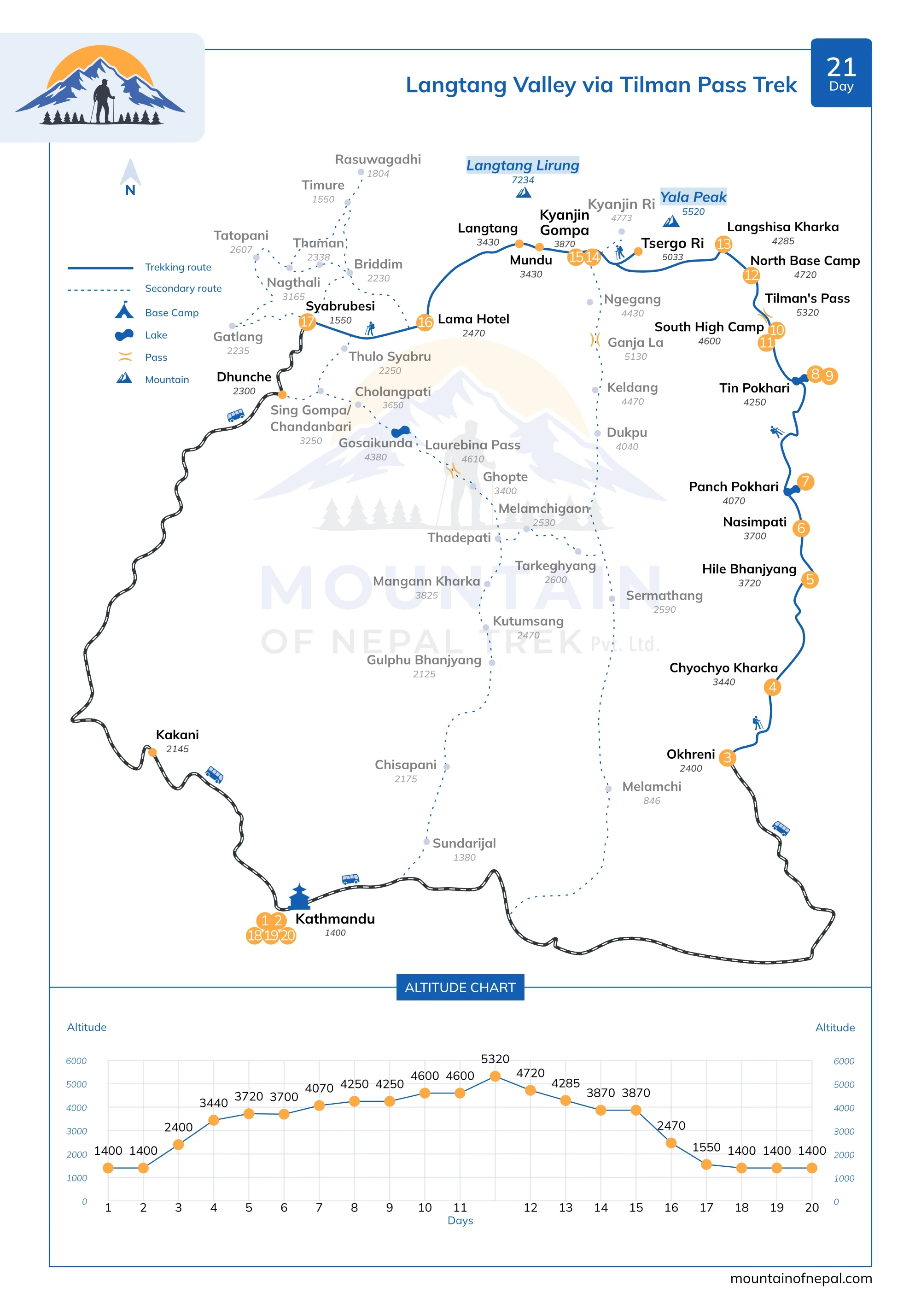
Langtang Valley via Tilman Pass Trek
| Trip code | |
| Package name | Langtang Valley via Tilman Pass Trek |
| Duration | 21 |
| Max. elevation | 5320 m |
| Level | Moderate |
| Transportation | All ground transportation as per the itinerary |
| Accomodation | Hotel in Kathmandu and Lodge / Tea House / Camps during trek |
| Starts at | Kathmandu |
| Ends at | Kathmandu |
| Trip route | |
| Cost | USD 0 per person |
Highlights
- Cross one of the most remote and glaciated high passes in the Langtang region – Tilman Pass (5,320 m), a true Himalayan expedition challenge.
- Marvel at towering Himalayan peaks, with Langtang Lirung (7,227 m) dominating the skyline throughout the journey.
- Visit sacred alpine lakes, including the holy Panch Pokhari, a significant pilgrimage site for Hindu and Buddhist devotees.
- Trek through dramatic alpine landscapes of glaciers, rocky ridges, moraine fields, and high-altitude meadows (kharkas).
- Experience authentic local culture, traditional Tamang villages, and seasonal yak herding settlements along the trail.
- Explore remote wilderness areas with minimal tourist traffic, offering pure solitude and raw Himalayan beauty.
- Witness diverse biodiversity inside protected zones, including Himalayan blue sheep, musk deer, and high-altitude bird species.
- Enjoy breathtaking sunrise and sunset views over snow-capped peaks from high camps and ridge viewpoints.
- Walk through culturally rich valleys influenced by Tibetan Buddhism, ancient monasteries, and prayer flag corridors.
- Challenge yourself with a once-in-a-lifetime high-altitude adventure combining technical trekking, scenery, and spiritual significance.
- Discover hidden valleys connecting Langtang with remote northern Himalayan landscapes rarely visited by trekkers.
- Experience full expedition-style trekking with camping support in high alpine zones above 4,000 meters.
Overview
The Langtang Valley via Tilman Pass Trek is one of the most adventurous and less-crowded high-altitude trekking routes in Nepal, combining the natural beauty of the Langtang region with a challenging Himalayan crossing. Operated by Mountain of Nepal, this expedition links cultural villages, alpine valleys, glaciers, and high mountain passes, making it ideal for trekkers seeking both cultural depth and technical adventure. The journey passes through the famous Langtang Valley, reaches the sacred alpine landscapes near Gosaikunda Lake, and continues toward remote high camps before crossing the demanding Tilman Pass (5,320 m).
This trek also integrates cultural extensions such as the Tamang Heritage Trail, where trekkers experience authentic Tamang villages, monasteries, and traditional lifestyles. On the western side, optional extensions toward the Ganesh Himal region provide raw wilderness experiences with fewer tourists and pristine landscapes.
- Cross the technical Tilman Pass (5,320 m)
- Explore Langtang Valley and glacier landscapes
- Visit the sacred Gosaikunda lakes
- Experience the Tamang culture and heritage villages
- Optional extension toward the Ganesh Himal region
Best Season for Langtang Valley via Tilman Pass Trek
The best seasons for the Langtang Valley via Tilman Pass Trek are spring (March–May) and autumn (September–November). During these months, weather conditions are relatively stable, skies are clearer, and mountain views are at their best. Spring offers blooming rhododendron forests in lower Langtang and Tamang villages, while autumn provides crisp air and excellent visibility across high passes like Tilman Pass.
Winter trekking is possible but extremely challenging due to heavy snowfall at high camps and glacier sections. Monsoon season (June–August) is generally not recommended because of landslides, slippery trails, and limited visibility, especially in the lower Langtang and Ganesh Himal approaches.
Seasonal breakdown:
- Spring: Best for flowers, stable weather, photography
- Autumn: Best visibility, safest trekking conditions
- Winter: High risk, snow-covered passes
- Monsoon: Not recommended due to rain and landslides
Mountain of Nepal carefully schedules departures to match optimal weather windows, ensuring safety during high-altitude crossings.
Langtang Valley via Tilman Pass Trek: Difficulty and Transportation
The Langtang Valley via Tilman Pass Trek is classified as strenuous to very challenging, primarily due to the high-altitude crossing of Tilman Pass and long trekking days above 4,000 meters. Proper acclimatization, good physical fitness, and prior trekking experience are highly recommended. Technical sections may include glacier travel, snow slopes, and unpredictable weather conditions.
Transportation begins from Kathmandu, where travelers drive to Syabrubesi or Okhreni, depending on the itinerary. The drive takes 6–8 hours through winding Himalayan roads. From there, the trekking route progresses through Langtang Valley and ascends gradually toward high camps before crossing into the remote northern valleys.
Difficulty and logistics highlights:
- Long trekking days (5–9 hours average)
- High altitude above 5,000 m
- Glacier and pass crossing required
- Remote and limited rescue access
- Drive access from Kathmandu to the trailheads
Mountain of Nepal provides experienced guides, safety equipment, and acclimatization planning to reduce altitude risks and ensure a safe crossing.
Langtang Valley via Tilman Pass Trek Food and Accommodation
Accommodation along the Langtang Valley via Tilman Pass Trek ranges from basic tea houses in lower villages to camping setups in higher alpine zones. In areas like Langtang Village and Kyanjin Gompa, trekkers can expect simple lodges with twin-sharing rooms, communal dining areas, and limited but warm hospitality. Above 4,000 meters, especially near Tilman Pass, camping becomes necessary due to the absence of permanent settlements.
Meals are typically freshly prepared Nepali and Tibetan-style dishes, including dal bhat (rice and lentils), noodles, soups, potatoes, and seasonal vegetables. Higher elevations offer simpler menus due to supply limitations, but calorie intake is carefully managed to support high-altitude energy needs.
Food & accommodation summary:
- Tea houses in the lower and mid regions
- Camping above South High Camp
- Freshly cooked local meals
- High-calorie trekking diet
- Limited luxury, focus on comfort and safety
Mountain of Nepal ensures hygienic food preparation and provides full camping logistics in remote sections, including tents, kitchen support, and high-altitude cooking arrangements.
Permits for Langtang Valley via Tilman Pass Trek
Several trekking permits are required for this expedition due to its location inside protected and restricted areas. Trekkers must obtain the Langtang National Park Entry Permit, a TIMS (Trekkers’ Information Management System) Card, and additional special permits for restricted border and high-pass regions when applicable.
Since the route passes through remote zones near the Tibetan border and high alpine conservation areas, permit regulations are strictly enforced. Mountain of Nepal handles all documentation and coordination to ensure smooth entry and compliance with government rules.
Required permits:
- Langtang National Park Entry Permit
- TIMS Card (Trekkers Information Management System)
- Special restricted area permits (if extended routes are used)
- Conservation and local municipality fees
All permits are arranged in Kathmandu before departure, ensuring trekkers can focus entirely on the journey without administrative delays.
Why Choose Langtang Valley via Tilman Pass Trek
The Langtang Valley via Tilman Pass Trek is ideal for trekkers seeking a blend of cultural immersion, remote wilderness, and technical Himalayan adventure. Unlike standard treks, this route combines the beauty of Langtang with challenging high-altitude exploration, making it one of Nepal’s most rewarding trekking experiences.
With Mountain of Nepal, trekkers benefit from experienced mountain guides, safety-first planning, and well-organized logistics across remote terrain. The inclusion of cultural regions like the Tamang Heritage Trail, spiritual Gosaikunda lakes, and wilderness zones toward Ganesh Himal ensures a diverse trekking experience.
Why choose this trek:
- Unique crossing of Tilman Pass (5,320 m)
- Cultural + adventure combination
- Less crowded compared to the Everest/Annapurna routes
- Expert-led expedition support
- Rich biodiversity and Himalayan scenery
Trip Preparation
Trip Itinerary
Day 1 : Arrival in Kathmandu (1,400 m)
Upon your arrival in Kathmandu, a representative from Mountain of Nepal will warmly welcome you at the airport and transfer you to your hotel. This vibrant capital city introduces you to Nepal’s rich culture, chaotic charm, and historical depth. After check-in, you can rest or take a short walk around the nearby streets of Thamel, a popular tourist hub filled with trekking shops and cafés. In the evening, there will be a brief pre-trek meeting where your guide will explain the itinerary, safety protocols, and last-minute preparations. This day is essential for jet lag recovery and mental preparation for the adventure ahead.
Day 2 : Preparation and briefing in Kathmandu – Gear check, trek questions, and cultural welcome dinner
After breakfast, you’ll meet your guide for a detailed Tilman Pass trek briefing, covering the route, safety tips, and strategies for high-altitude trekking. This day is also an important opportunity to ask any questions about the trek, including altitude concerns, pacing, gear, or the trail conditions, ensuring you feel confident and well-prepared.
Your guide will check your trekking gear, including boots, backpacks, poles, and clothing. If you missed any essential equipment, you can buy or rent gear in Thamel, Kathmandu’s trekking hub, which offers a wide range of outdoor supplies suitable for Himalayan trekking. In the evening, enjoy a traditional Nepali welcome dinner, complete with local cuisine, music, and the chance to connect with fellow trekkers. This day combines practical preparation with cultural immersion, ensuring a smooth start to your Himalayan adventure. Overnight: Hotel in Kathmandu.
Day 3 : Drive to Okhreni (2,400 m) – Drive: approx. 6–7 hrs
You begin your journey with a scenic drive from Kathmandu to Okhreni in a private 4WD vehicle (jeep or similar), ideal for navigating the winding mountain roads of Nepal. The route passes through hillside villages, terraced farmlands, and forested sections, offering a glimpse of rural life in the Himalayan region. After a few hours, you reach Melamchi Bazaar, a lively town located along the Melamchi River, where you stop for lunch and a short rest. From here, the drive continues through small mountain settlements, waterfalls, and increasingly remote terrain, making the journey both scenic and adventurous. By late afternoon, you arrive at Okhreni, a quiet and less-visited mountain area. It serves as a peaceful starting point for your trek, offering an off-the-beaten-path experience in Nepal away from the busier trekking routes. Overnight: Tented camp in Okhreni.
Day 4 : Trek to Chyochyo Kharka (3,440 m) – Walk: approx. 6–7 hrs
You begin your trek from Okhreni along a well-defined forest trail, surrounded by tall trees and fresh mountain air. After a few hours, you reach a forest clearing, a perfect place to stop for lunch, rest, and enjoy the peaceful surroundings. After lunch, the trail continues mostly uphill for another two hours, gradually leaving the forest behind. You then arrive at a prominent treeless ridge, offering wide panoramic views of the surrounding hills and distant mountains—often your first real glimpse of the high Himalayan landscape. At around 3,400 m, you’ll notice chortens and prayer flags marking a small pass. These sacred symbols are placed along trails to protect travelers and bring blessings. Chortens represent peace and protection, while prayer flags spread goodwill as they flutter in the wind. It is customary to walk clockwise, keeping them on your right side, as a sign of respect. From the pass, the trail descends gently to Chyochyo Kharka, a high-altitude grazing meadow ideal for camping. Surrounded by open landscapes and mountain views, it’s a tranquil place to spend your first night on the trek. Overnight: Tented camp in Chyochyo Kharka.
Day 5 : Trek to Hile Bhanjyang (3,720 m) – Walk: approx. 6 hrs
You start your day with a long descent through alpine meadows and forested trails, enjoying the peaceful mountain surroundings. The trail gradually winds downhill, offering a mix of open landscapes and shaded forest sections. You will stop for lunch at a suitable location, depending on water availability along the trail, so it’s important to carry enough water for the morning walk. After lunch, the trail ascends steadily to a ridge, where you are rewarded with scenic mountain views, before descending gently to Hile Bhanjyang, a quiet high-altitude campsite surrounded by rolling hills and open pastures. Overnight: Tented camp in Hile Bhanjyang.
Day 6 : Trek to Nasimpati (3,700 m) – Walk: approx. 4 hrs – Optional short acclimatization hike
Begin your day with a gentle uphill trek from Hile Bhanjyang, passing through rocky slopes and rhododendron groves. The trail is relatively straightforward, offering beautiful views of the surrounding hills and valleys along the way. The trek leads to Nasimpati, a high-altitude resting spot or camping area, ideal for a break or overnight stay. Today is a short trekking day, allowing your body to acclimatize properly to the increasing altitude. While it is technically possible to push further, gaining altitude too quickly can be dangerous, potentially causing altitude sickness and disrupting your holiday plans. By around lunchtime, you will arrive at Nasimpati, where meals are prepared and your camp will be set up. In the afternoon, you are encouraged to do a short acclimatization hike, following the mountaineering principle of “climb high, sleep low.” This involves hiking to a slightly higher point during the day to stimulate acclimatization, then returning to a lower altitude to sleep, helping your body adjust safely to the high altitude
Day 7 : Trek to Panch Pokhari (4,070 m) – Walk: approx. 2–3 hrs
From Nasimpati, you ascend toward the sacred Panch Pokhari (Five Lakes), a revered pilgrimage site for both Hindus and Buddhists. The trail follows a spiritual route used by pilgrims, especially during the monsoon season when many devotees visit the holy lakes.At Panch Pokhari, you will find the Mahadev Temple, dedicated to Lord Shiva, where Hindu pilgrims perform ritual bathing for spiritual purification. The area is also significant for Buddhist and Bön practitioners, who come here to meditate, chant mantras, and make offerings to nature spirits. Surrounded by a peaceful alpine landscape, Panch Pokhari offers stunning panoramic views of the Jugal Himal and Rolwaling ranges, making it a unique destination that blends natural beauty with deep spiritual significance. Overnight: Tented camp at Panch Pokhari
Day 8 : Trek to Tin Pokhari (4,250 m) – Walk: approx. 5–6 hrs
Today, you trek toward Tin Pokhari (Three Lakes), passing through rocky terrain and high-altitude alpine vegetation. The trail is remote and pristine, with no settlements along the way, offering a true wilderness experience and uninterrupted mountain views. Tin Pokhari is a high-altitude alpine campsite, where the lakes are completely frozen throughout the winter, creating a dramatic and serene landscape. This spot is ideal for camping, allowing trekkers to soak in the breathtaking beauty of the lakes and enjoy panoramic views of the surrounding towering Himalayan peaks. Camping: Overnight stay at a tented camp in Tin Pokhari, surrounded by tranquil alpine scenery and clear mountain skies—perfect for stargazing and experiencing the quiet of the high Himalayas.
Day 9 : Rest & acclimatization day at Tin Pokhari – Optional short walks
Today is a vital rest and acclimatization day to help your body adjust to the high altitude. Moving too quickly at this elevation can cause altitude sickness, leading to headaches, nausea, fatigue, or more serious complications, so taking it slow is essential for a safe trek. You can spend the day gently exploring the Three Lakes, taking short walks to nearby ridges or viewpoints for breathtaking panoramic views of the surrounding Himalayan peaks. These light hikes follow the principle of “climb high, sleep low”, allowing your body to adapt safely. Alternatively, you can simply relax at camp, enjoy the crisp mountain air, and observe alpine wildlife while giving your body time to recover before continuing your trek. Overnight: Tented camp at Tin Pokhari.
Day 10 : Trek to South High Camp (4,600 m) – Walk: approx. 5–6 hrs
Today’s journey begins at Tin Pokhari (Three Lakes), where you may take some time to explore the serene alpine lakes and enjoy the surrounding mountain views before setting off. The trail then leads across rugged high-altitude terrain, with sections of icy slopes and loose scree (pebbles), requiring careful footing and a steady pace. The route involves a mix of gradual ascents and descents, as you make your way deeper into this remote Himalayan landscape. As you gain elevation, the environment becomes more barren and dramatic, with fewer signs of vegetation and increasingly expansive mountain views. The final stretch is a steady climb leading to South High Camp (4,600 m), a key staging point before crossing the high pass.Upon arrival, you are rewarded with your first close view of Tilman Pass, an impressive high mountain pass that lies ahead, giving a real sense of the adventure to come. Due to the altitude, it’s important to move slowly, stay hydrated, and rest well. Overnight: Tented camp at South High Camp.
Day 11 : Acclimatization day at South High Camp – Gear check, technical briefing, short acclimatization walks
Today is another acclimatization day before you tackle the challenging Tilman Pass, one of the highest and most remote passes on the Langtang trek. You can relax at camp or take short acclimatization walks to nearby ridges and rocky outcrops. These gentle hikes help your body adjust to the high altitude and lower the risk of altitude sickness.Your guide will check and prepare your trekking gear, including crampons, ropes, poles, and layered clothing for icy, windy, or snowy conditions. They will demonstrate how to use crampons and ropes safely on ascents and descents, ensuring you feel confident and ready.This careful preparation ensures you are physically and mentally ready for the demanding Tilman Pass crossing tomorrow, maximizing both safety and success on this high-altitude adventure. Overnight: Tented camp at South High Camp.
Day 12 : Cross Tilman Pass (5,320 m) and trek to North Base Camp – Walk: approx. 7–9 hrs
Today is the most challenging and rewarding day of the trek, as you attempt to cross the high and remote Tilman Pass (5,320 m). You start early in the morning, often before sunrise, to take advantage of more stable weather and firmer snow conditions. The ascent begins from South High Camp, gradually climbing over steep rocky terrain, loose scree, and icy sections. As you gain altitude, the air becomes thinner, making the climb physically demanding and requiring a slow, steady pace. In some sections, you may need to navigate snowfields or glacier-like terrain, depending on conditions. Reaching the top of Tilman Pass is a truly remarkable achievement. From the summit, you are rewarded with breathtaking panoramic views of surrounding Himalayan peaks and remote valleys—an unforgettable highlight of the entire journey. After taking time to rest and enjoy the views, the descent begins toward the North Base Camp. This section can be steep and technical, often involving loose rocks, snow, and uneven terrain, so extra caution is required. Trekking poles and proper footing are essential here. This is a long and demanding day at high altitude, so it’s important to stay hydrated, listen to your body, and maintain a steady pace. Team support and guidance from your trekking crew are crucial throughout the day.Overnight: Tented camp at North Base Camp.
Day 13 : Trek to Langshisa Kharka – Walk: approx. 5–6 hrs
From North High Camp, the trail begins with a steep descent over rocky moraine and rugged alpine terrain, following the edge of the Langshisa Glacier. The path can be challenging and uneven, requiring careful footing as you navigate loose rocks and glacial debris. As you descend, the landscape gradually opens up, revealing vast high-altitude valleys and dramatic Himalyan scenery, with towering peaks surrounding you. The route offers a true sense of remoteness and wilderness, far from any settlements. After several hours of descent, you reach Langshisa Kharka, a beautiful alpine meadow (kharka) surrounded by mountains. This peaceful grazing area provides a welcome contrast to the harsh glacial terrain and is an ideal place to rest and recover after the demanding previous days. Overnight: Tented camp at Langshisa Kharka.
Day 14 : Trek to Kyanjin Gompa (3,870 m) – Walk: approx. 5–6 hrs
Leaving Langshisa Kharka, the trail follows a gradual descent along the Langtang Valley, with the landscape opening into wide alpine plains surrounded by towering Himalayan peaks. Compared to previous days, the terrain feels more gentle and spacious, making for a pleasant walk after the challenging high pass. As you continue, you begin to see signs of civilization again, passing yak pastures and seasonal herders’ shelters. The trail follows the river downstream, with stunning views of peaks such as Langtang Lirung dominating the skyline. After several hours, you arrive at Kyanjin Gompa, a beautiful high-altitude village and spiritual center of the region. The village is home to an ancient Buddhist monastery and a well-known cheese factory, where you can sample locally made yak cheese. This is a perfect place to rest, recover, and reflect after crossing Tilman Pass, while enjoying the surrounding mountain scenery. Overnight: Lodge or teahouse in Kyanjin Gompa.
Day 15 : Rest day at Kyanjin Gompa – Optional hike to Tserko Ri (4,984 m)
After the challenging Tilman Pass crossing two days ago, today is a well-earned rest and recovery day at Kyanjin Gompa. You can take the morning to relax, enjoy a leisurely breakfast, and recover from the high-altitude trek. If you’re feeling strong, you have the option to hike to Tserko Ri (4,984 m). This trek offers breathtaking panoramic views of Langtang Lirung, Langtang Ri, and the surrounding Himalayan peaks. The round-trip takes about 3–5 hours and is moderately strenuous, so only attempt it if you feel physically ready. Alternatively, you can explore Kyanjin Gompa village, visit the ancient monastery, sample local yak cheese at the cheese factory, or take gentle walks around the nearby alpine pastures to soak in the stunning mountain scenery.
Overnight: Lodge or teahouse at Kyanjin Gompa.
Day 16 : Trek to Lama Hotel – Walk: approx. 6–7 hrs
After breakfast, begin your descent from Kyanjin Gompa, following the trail down the Langtang Valley. The walk is mostly gradual downhill, passing through yak pastures, alpine landscapes, and scattered settlements. By midday, you will reach Langtang Village, where you will stop for lunch. Langtang Village, a traditional settlement that was rebuilt after the 2015 earthquake, stands as a symbol of resilience and community strength. After lunch, continue descending through lush pine and rhododendron forests, eventually reaching Lama Hotel, a peaceful stop nestled in the forest. Overnight: Lodge at Lama Hotel.
Day 17 : Trek to Syabrubesi (1,550 m) – Walk: approx. 5–6 hrs
On your final trekking day, you descend through dense pine and rhododendron forests, following the Langtang River. The trail is mostly gradual downhill, passing through small riverside clearings and scattered settlements. As you continue, the valley opens up into lush lower-elevation forests and terraced hillsides, offering scenic views all along the way. By afternoon, you arrive at Syabrubesi, the gateway to the Langtang region, marking the completion of your trekking adventure. Overnight: Lodge in Syabrubesi.
Day 18 : Drive to Kathmandu – Drive: approx. 6–7 hrs
Today marks the completion of your unforgettable Tilman Pass -Langtang Valley trek. After breakfast, begin your scenic drive back to Kathmandu by private bus or jeep, depending on the group size. The journey takes approximately 6–7 hours, following the Trishuli River and passing through picturesque hills, terraced fields, and small settlements. Enjoy the changing landscapes as you leave the mountains behind and return to the bustling capital city. Upon arrival in Kathmandu, transfer to your hotel and relax. Enjoy a hot shower and a nice dinner or take a short evening stroll around Thamel. Overnight in Kathmandu
Day 19 : Reserve days in Kathmandu – Rest, sightseeing, or adjustment for trek delays
These reserve days are kept in the itinerary to provide flexibility and ensure safety on the Tilman Pass trek. They allow for rest, acclimatization, or adjustments if any participant experiences fatigue or altitude-related issues. If the trek schedule goes smoothly and all participants are fit, these extra days can be used to explore the rich cultural and historical heritage of Kathmandu Valley, including its UNESCO World Heritage sites, temples, and local markets. This approach ensures that every trekker can enjoy the adventure at a safe pace while also experiencing the unique culture and traditions of Nepal.
Day 21 : Departure from Kathmandu
Your Himalayan journey concludes today. A representative from Mountain of Nepal will transfer you to Tribhuvan International Airport in Kathmandu for your departure flight. You leave Nepal with unforgettable memories of the Tilman Pass crossing, Langtang Valley landscapes, and rich Himalayan culture. The adventure marks not just a trek but a life-changing experience shaped by mountains, people, and resilience.
Inclusions
What is included?
- Airport transfers in Kathmandu
- All ground transportation as per the itinerary
- Hotel accommodation in Kathmandu
- Teahouse accommodations during the trek.
- All meals (breakfast, lunch, dinner) during the trek.
- Langtang National Park permit & TIMS Card
- Restricted area permit (if applicable)
- Experienced, English-speaking trek guide.
- Porters to carry luggage (1 per 2 trekkers).
- Trekking map and group medical kit.
- Welcome and farewell dinners in Kathmandu.
What isn't included?
- International flights to/from Kathmandu.
- Personal Expenses (Snacks, Drinks, etc.)
- Travel Insurance
- Nepal entry visa fee.
- Personal Trekking Gear
- Tips for Guides and Porters
Complimentary