Lower Dolpo Trek
| Trip code | |
| Package name | Lower Dolpo Trek |
| Duration | 16 |
| Max. elevation | 5309 m |
| Level | Moderate |
| Transportation | All ground transportation and Domestic flight as per itinerary |
| Accomodation | Hotel in Kathmandu and Tea House / Lodge during the trek |
| Starts at | Kathmandu |
| Ends at | Kathmandu |
| Trip route | |
| Cost | USD 0 per person |
Highlights
- Remote and untouched Himalayan wilderness in western Nepal
- Trek through Shey Phoksundo National Park
- Stunning Phoksundo Lake (3,630 m) with turquoise waters
- Cross high Himalayan passes: Baga-La (5,169 m) and Numa-La (5,309 m)
- Experience ancient Tibetan-influenced and Bon culture
- Explore traditional villages like Dho-Tarap, Tarakot, and Dunai
- Dramatic landscapes: alpine deserts, deep valleys, and glaciers
- Less crowded and highly authentic trekking route
- Camping experience in remote high-altitude regions
- Adventure-filled journey operated by Mountain of Nepal
Overview
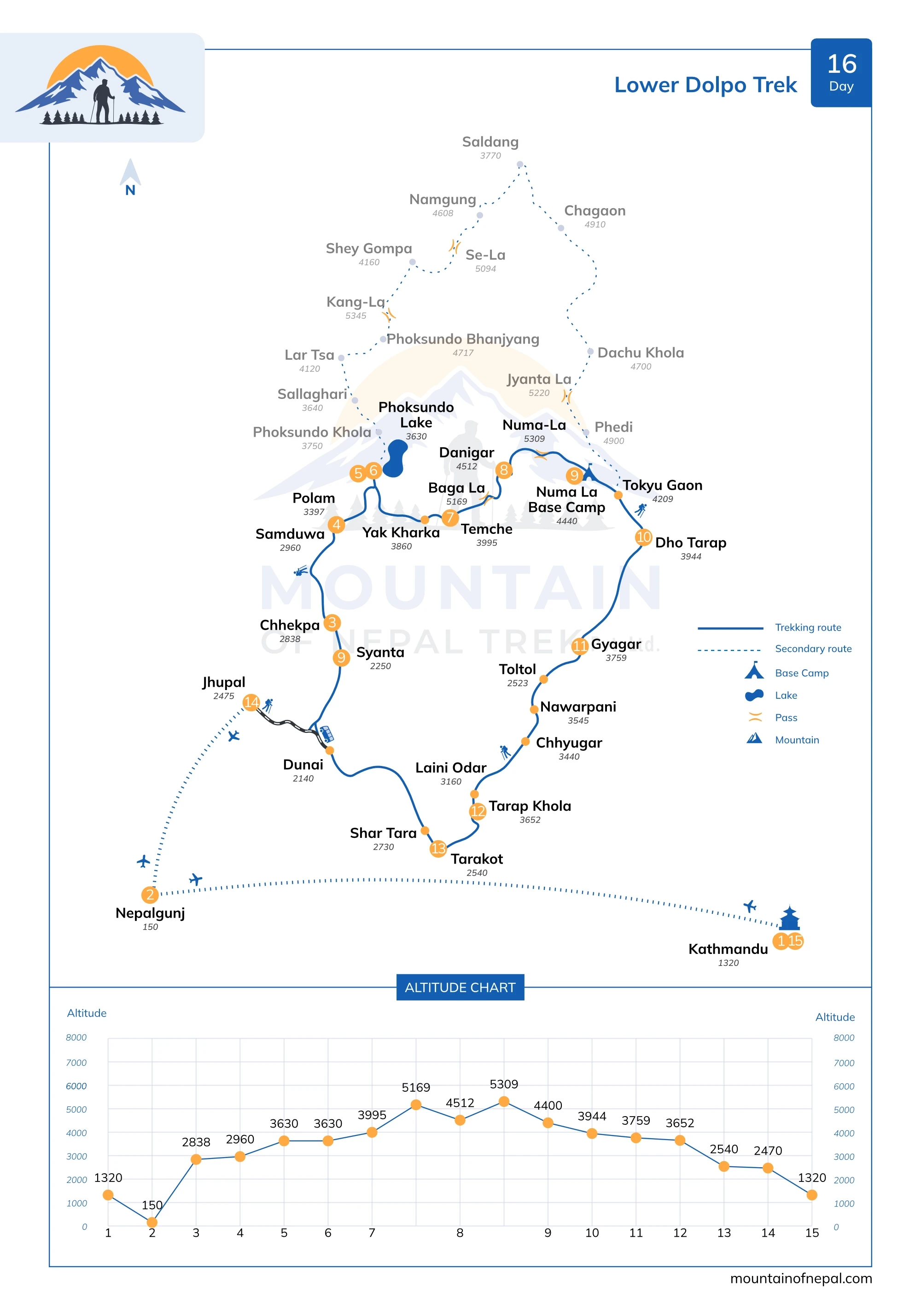
The Lower Dolpo Trek is one of Nepal’s most remote, culturally rich, and physically demanding trekking routes, located in the rain-shadow region of the Dhaulagiri massif in western Nepal. Operated by Mountain of Nepal, this 17-day journey follows a spectacular route from Kathmandu to Nepalgunj, then into the isolated landscapes of Dolpo via Jhupal, Chepkpa, Phoksundo Lake, and high Himalayan passes like Baga-La (5,169 m) and Numa-La (5,309 m). The trek ultimately descends through ancient villages such as Dho-Tarap, Tarakot, and Dunai before returning to Kathmandu.
This region is strongly influenced by Tibetan culture and Bon Buddhism, making it not just a trekking adventure but also a deep cultural exploration. The highlight of the trek is the turquoise Phoksundo Lake (3,630 m), one of the deepest and most beautiful alpine lakes in Nepal, surrounded by dramatic cliffs and untouched wilderness. The trail passes through isolated settlements where traditional lifestyles have remained unchanged for centuries.
Lower Dolpo is less commercialized compared to other trekking regions, offering a raw Himalayan experience. Trekkers pass through high alpine deserts, glacier-fed rivers, yak pastures, and ancient trade routes that once connected Nepal with Tibet.
- Remote Himalayan wilderness experience
- Phoksundo Lake and Shey Phoksundo National Park
- High passes: Baga-La and Numa-La
- Tibetan-influenced culture and villages
- Less crowded, authentic trekking route
Best Season for Lower Dolpo Trek
The best time for the Lower Dolpo Trek is during spring (April–June) and autumn (September–November). These seasons provide the most stable weather conditions, clear mountain views, and safer trail conditions for crossing high passes above 5,000 meters. Since Dolpo lies in a rain-shadow area, it is also one of the few trekking regions in Nepal that remains accessible even during the monsoon season. However, spring and autumn are still preferred for comfort and visibility.
In spring, the landscapes come alive with blooming wildflowers, and temperatures are moderate, making long trekking days more comfortable. Autumn, on the other hand, offers crystal-clear skies, dry trails, and excellent visibility of the Himalayan ranges. Winter is extremely cold and snow-bound at higher elevations, while the early monsoon (June–August) may bring occasional rain in lower sections.
Because of its remote geography, the weather can change quickly in Dolpo. Proper planning with Mountain of Nepal ensures safe timing, acclimatization, and weather-adapted itineraries.
Best Season Highlights:
- Spring: Blooming landscapes, moderate temperatures
- Autumn: Best visibility, stable weather
- Monsoon: Possible but less ideal for comfort
- Winter: Extremely harsh, high passes closed
Lower Dolpo Trek Difficulty and Transportation
The Lower Dolpo Trek is classified as a strenuous and high-altitude trekking route, requiring excellent physical fitness and mental endurance. Trekkers must cross two major passes above 5,000 meters, including Baga-La and Numa-La, which involve steep ascents, snow sections, and long trekking hours (5–7 hours daily on average). Altitude sickness is a potential risk, so proper acclimatization is essential.
The journey also includes multiple days of remote camping or basic lodge stays, with limited infrastructure. Unlike popular trekking regions like Everest or Annapurna, Lower Dolpo has minimal facilities, meaning trekkers must be self-sufficient in many areas. However, Mountain of Nepal provides experienced guides, porters, camping equipment, and logistical support to ensure safety and comfort.
Transportation is a combination of domestic flights and trekking. The route begins with a flight from Kathmandu to Nepalgunj, followed by another flight to Jhupal. From there, trekking begins. At the end of the trek, trekkers return the same way via Jhupal and Nepalgunj back to Kathmandu.
Difficulty & Transport Highlights:
- Strenuous trekking with high altitude passes
- Daily trekking: 4–7 hours average
- Requires good fitness and stamina
- Flights: Kathmandu → Nepalgunj → Jhupal
- Remote trails with limited infrastructure
- Guided support essential for safety
Food and Accommodation for Lower Dolpo Trek
Food and accommodation during the Lower Dolpo Trek are basic but sufficient for high-altitude trekking. In lower villages like Dunai and Tarakot, small teahouses offer simple Nepali meals such as dal bhat (rice, lentils, vegetables), noodles, potatoes, and seasonal local dishes. As the trek ascends toward Phoksundo Lake and high passes, accommodation becomes more limited, and camping is often required.
Mountain of Nepal provides fully organized camping services in remote sections, including tents, sleeping mats, cooking equipment, and experienced cooks. Meals are prepared fresh daily and typically include carbohydrate-rich foods designed to support energy levels at altitude. Hygiene standards are maintained as much as possible, given the remote conditions.
Accommodation varies from basic lodges in villages to fully supported camping in wilderness areas. Electricity, internet, and modern facilities are very limited or unavailable in most parts of the trek. Trekkers should be prepared for rustic living conditions, which are part of the authentic Dolpo experience.
Food & Accommodation Highlights:
- Basic teahouses in lower villages
- Camping in high and remote regions
- Traditional Nepali meals (dal bhat, noodles, soups)
- Fully supported camping by Mountain of Nepal
- Limited electricity and communication facilities
- Simple but culturally authentic experience
Lower Dolpo Trek Permits
The Lower Dolpo Trek requires several special permits due to its location in a restricted and protected region. Since Dolpo lies within Shey Phoksundo National Park and is classified as a restricted trekking area, all trekkers must obtain official permissions arranged through a registered trekking agency like Mountain of Nepal.
The main permits include the Restricted Area Permit (RAP), Shey Phoksundo National Park Entry Permit, and TIMS (Trekkers’ Information Management System) card. The restricted permit is the most important and must be issued for a minimum number of days,s depending on the itinerary. Foreign trekkers cannot obtain this permit individually; it must be processed through a licensed Nepal trekking company.
These permits ensure regulated tourism, environmental protection, and cultural preservation of the Dolpo region. The cost varies depending on the season and duration of the trek. Mountain of Nepal handles all paperwork, ensuring a smooth entry process without delays.
Permit Highlights:
- Restricted Area Permit (mandatory)
- Shey Phoksundo National Park entry fee
- TIMS card registration
- Must be arranged via a registered agency
- Government-controlled region for conservation
- Required for all foreign trekkers
Why Choose Lower Dolpo Trek with Mountain of Nepal
Choosing the Lower Dolpo Trek with Mountain of Nepal ensures a safe, well-organized, and deeply immersive Himalayan experience. The region is remote and logistically complex, so having an experienced local operator is essential for navigation, permits, accommodation, and emergency support.
Mountain of Nepal specializes in remote trekking expeditions and provides experienced guides who are familiar with Dolpo’s terrain, weather patterns, and cultural heritage. Their team ensures proper acclimatization schedules, safety protocols, and full camping support in high-altitude areas where infrastructure is minimal or nonexistent.
Beyond logistics, trekking with Mountain of Nepal enhances cultural understanding, as guides often come from Himalayan backgrounds and can explain local traditions, Buddhist monasteries, and Bon culture in detail. The company also prioritizes responsible tourism, minimizing environmental impact while supporting local communities.
Why Choose Us Highlights:
- Experienced remote trekking specialists
- Full camping and logistics support
- Professional, safety-focused guides
- Proper acclimatization planning
- Local cultural insight and storytelling
- Responsible and sustainable tourism approach
Trip Preparation
Trip Itinerary
Day 1 : Arrival in Kathmandu (1,320 m) and Transfer to Hotel
Upon your arrival at the international airport in Kathmandu, a representative from Mountain of Nepal will warmly welcome you and assist with your transfer to the hotel. After check-in, you can relax and recover from your journey or take a short stroll around the vibrant streets of Thamel. This bustling tourist hub offers shops, cafes, and trekking gear stores, giving you a first glimpse of Nepal’s lively culture. In the evening, there will be a short briefing about the Lower Dolpo Trek itinerary, preparation guidelines, and final gear checks to ensure you are fully ready for the adventure ahead.
Day 2 : Kathmandu Sightseeing and Fly to Nepalgunj
Today begins with a guided sightseeing tour of Kathmandu Valley, exploring UNESCO World Heritage Sites such as Pashupatinath Temple, Boudhanath Stupa, and Swayambhunath. These sites offer deep cultural and spiritual insights into Nepal’s heritage. After the tour, you will prepare for an afternoon flight to Nepalgunj, a lowland city near the Indian border. The flight offers scenic views of hills gradually transitioning into flat Terai landscapes. Upon arrival, you will check into your hotel and rest, as Nepalgunj serves as a key transit point before entering the remote Dolpo region.
Day 3 : Fly to Jhupal (2,475 m) and Trek to Chepkpa (2,838 m) (4 hrs)
Early morning flight takes you from Nepalgunj to Jhupal, offering spectacular aerial views of the western Himalayas. Upon landing, the trek officially begins as you head toward Chepkpa. The trail passes through terraced fields, small villages, and pine forests, gradually introducing you to the rugged terrain of Dolpo. The walk is moderate and takes around four hours, allowing proper acclimatization. You will encounter friendly locals and traditional stone houses along the way. Overnight stay is arranged in Chepkpa, where you will experience the peaceful lifestyle of this remote mountain region.
Day 4 : Trek to Samduwa Village (2,960 m – 6 hrs)
The journey today leads you further into the heart of Lower Dolpo, passing through narrow trails, deep valleys, and suspension bridges over small rivers. The trek is moderately long, taking approximately six hours, but the changing scenery keeps the journey engaging. You will pass isolated settlements and encounter yak caravans carrying supplies. The landscape becomes increasingly rugged and remote. Samduwa village welcomes you with traditional stone houses and stunning mountain views. This is a great opportunity to experience authentic Dolpo lifestyle, which remains largely untouched by modern development.
Day 5 : Trek to Phoksundo Lake (3,630 m – 6 hrs)
Today is one of the most scenic days of the trek as you approach the legendary Phoksundo Lake. The trail gradually ascends through pine forests, cliffs, and waterfalls, eventually revealing the mesmerizing turquoise waters of the lake. The six-hour trek is rewarding, with breathtaking Himalayan views throughout. Phoksundo Lake, located within Dolpo region, is known for its spiritual significance and dramatic landscape. Upon arrival, you will feel a strong sense of peace as the crystal-clear lake reflects surrounding peaks. Overnight camping or lodge stay is arranged near the lake.
Day 6 : Rest Day at Phoksundo Lake
This is an important acclimatization and rest day at Phoksundo Lake. You may explore nearby villages such as Ringmo, where traditional Tibetan-style homes and Bon monasteries can be visited. The day allows for photography, meditation, and short hikes around the lake’s perimeter. The deep blue waters and surrounding cliffs create one of the most breathtaking environments in Nepal. Guides from Mountain of Nepal will share insights into local culture, religious practices, and the ecological importance of the region. This rest day helps your body adjust before crossing high mountain passes ahead.
Day 7 : Trek to Timche (3,995 m – 5 hrs)
Today’s trek leads away from Phoksundo Lake, ascending toward Timche, near the base of Baga-La Pass. The trail becomes more rugged and remote, with fewer settlements and increasingly alpine terrain. You will pass through rocky paths, glacial streams, and open valleys. The five-hour trek is steady but demanding due to altitude gain. Timche serves as a strategic camping location for preparing the upcoming high pass crossing. The environment is cold and isolated, offering stunning views of surrounding peaks and dramatic landscapes that define the wilderness of Dolpo.
Day 8 : Cross Baga-La Pass (5,169 m) to Danigar (4,512 m – 6 hrs)
This is one of the most challenging yet rewarding days of the trek as you cross Baga-La Pass at 5,169 meters. The ascent is steep and demanding, requiring careful pacing and strong endurance. From the top, you are rewarded with panoramic Himalayan views. After a short break, the trail descends toward Danigar at 4,512 meters. The descent is long and technical in sections, but the changing scenery keeps spirits high. Overnight camping at Danigar provides rest after a physically intense but unforgettable mountain crossing.
Day 9 : Cross Numa-La Pass (5,309 m) and Camp – 5 hrs
Today involves crossing another major high pass, Numa-La Pass, one of the highest points of the trek at 5,309 meters. The climb is steep, and early morning start is essential to avoid weather challenges. From the summit, the views of snow-covered peaks are extraordinary. The descent leads to a designated camping site where you will rest for the night. The terrain is remote and alpine, with yak grazing areas and dramatic ridgelines. This day tests endurance but offers one of the most rewarding experiences of the entire Lower Dolpo Trek.
Day 10 : Trek to Dho-Tarap (3,944 m – 5 hrs)
The trail descends gradually into the beautiful valley of Dho-Tarap, one of the highest human settlements in the world. The landscape softens slightly, with green patches and scattered villages. Dho-Tarap is culturally rich, influenced by both Bon and Tibetan Buddhism. You will notice ancient monasteries, chortens, and prayer flags throughout the valley. The five-hour trek is more comfortable after previous high-altitude challenges. Upon arrival, you can explore the village and interact with locals who maintain traditional lifestyles passed down for generations.
Day 11 : Trek to Gyagar (3,759 m – 7 hrs)
Today’s journey takes you through wide valleys, river crossings, and high pastures as you trek toward Gyagar. The trail is longer, around seven hours, but less steep compared to previous days. You will pass nomadic herders and yak caravans, gaining insight into their seasonal migration lifestyle. The scenery remains spectacular, with snow-capped peaks in the distance and rugged cliffs surrounding the valley. Gyagar is a peaceful camping area, ideal for rest and reflection after a long trekking day in the remote wilderness.
Day 12 : Trek to Tarap Khola via Chyugar (3,440 m – 6 hrs)
The trail today follows the Tarap River, gradually descending toward Tarap Khola. You will pass through Chyugar village, a small settlement surrounded by dramatic canyon-like landscapes. The route is scenic, with waterfalls and narrow gorges adding variety to the journey. The six-hour trek is moderately easy compared to previous high passes. Tarap Khola offers a beautiful riverside camping spot where you can relax and enjoy the peaceful sound of flowing water in a remote Himalayan setting.
Day 13 : Trek to Tarakot (2,540 m – 6 hrs)
Today’s trek descends further into greener valleys, reaching Tarakot, an ancient fortress village with historical significance. The trail follows riverbanks, suspension bridges, and terraced farmlands. The six-hour walk is relatively easier, allowing you to enjoy the changing landscape as altitude decreases. Tarakot features old monasteries and traditional houses that reflect its rich cultural heritage. This is one of the more inhabited sections of the trek, offering a glimpse of rural Himalayan life in contrast to earlier remote wilderness days.
Day 14 : Trek to Dunai (2,140 m – 5 hrs) and Drive to Jhupal (2 hrs)
The final trekking day leads you to Dunai, the district headquarters of Dolpa. The trail is pleasant and follows the Bheri River valley, passing through villages and cultivated fields. After reaching Dunai, you will take a scenic two-hour drive to Jhupal. The transition from trekking to road travel marks the nearing end of your adventure. Jhupal offers basic facilities and a chance to relax before your return flight. The team from Mountain of Nepal ensures a comfortable transition and proper rest.
Day 15 : Fly to Kathmandu via Nepalgunj and Transfer to Hotel
Early morning flight takes you from Jhupal to Nepalgunj, followed by a connecting flight back to Kathmandu. The aerial journey offers one last view of the remote Dolpo landscapes you have just explored. Upon arrival in Kathmandu, you will be transferred to your hotel. The rest of the day is free for relaxation, shopping, or celebrating the completion of your trek. Mountain of Nepal will host a farewell dinner where you can share experiences and memories with your trekking team.
Day 16 : Final Departure
Today marks the end of your Lower Dolpo Trek adventure. After breakfast, a representative from Mountain of Nepal will transfer you to the international airport for your onward journey. Depending on your flight schedule, you may have some free time for last-minute shopping or relaxation in Kathmandu. You leave Nepal with unforgettable memories of remote Himalayan landscapes, high mountain passes, and rich cultural encounters. The journey through Lower Dolpo remains one of the most extraordinary trekking experiences in the Himalayas.
Inclusions
What is included?
- All airport pick-up and drop-off transfers (arrival and departure)
- Hotel accommodation in Kathmandu with breakfast included
- Guided sightseeing tour in Kathmandu Valley
- All necessary trekking permits and restricted area permits
- Domestic flight as per Itinerary and all-around transportation
- Full board meals during the trek (breakfast, lunch, dinner)
- Experienced trekking guide and porters with wages, insurance, meals, and accommodation
- Group welcome or farewell dinner with trek briefing
- Comprehensive medical kit carried by the guide
What isn't included?
- Nepal visa fees and international travel/medical insurance
- Meals in Kathmandu (except breakfast) and personal expenses (laundry, phone, etc.)
- Single room supplement in Kathmandu or trekking areas (if available)
- Emergency evacuation costs (helicopter or other transport)
- Personal trekking equipment (sleeping bag, down jacket, duffel bag, etc.)
- Extra snacks, drinks, bottled water, and refreshments during trek
- Expenses due to early return from trek due to illness or personal reasons (claimable via insurance)
- Personal medical kit based on doctor’s recommendation
Complimentary