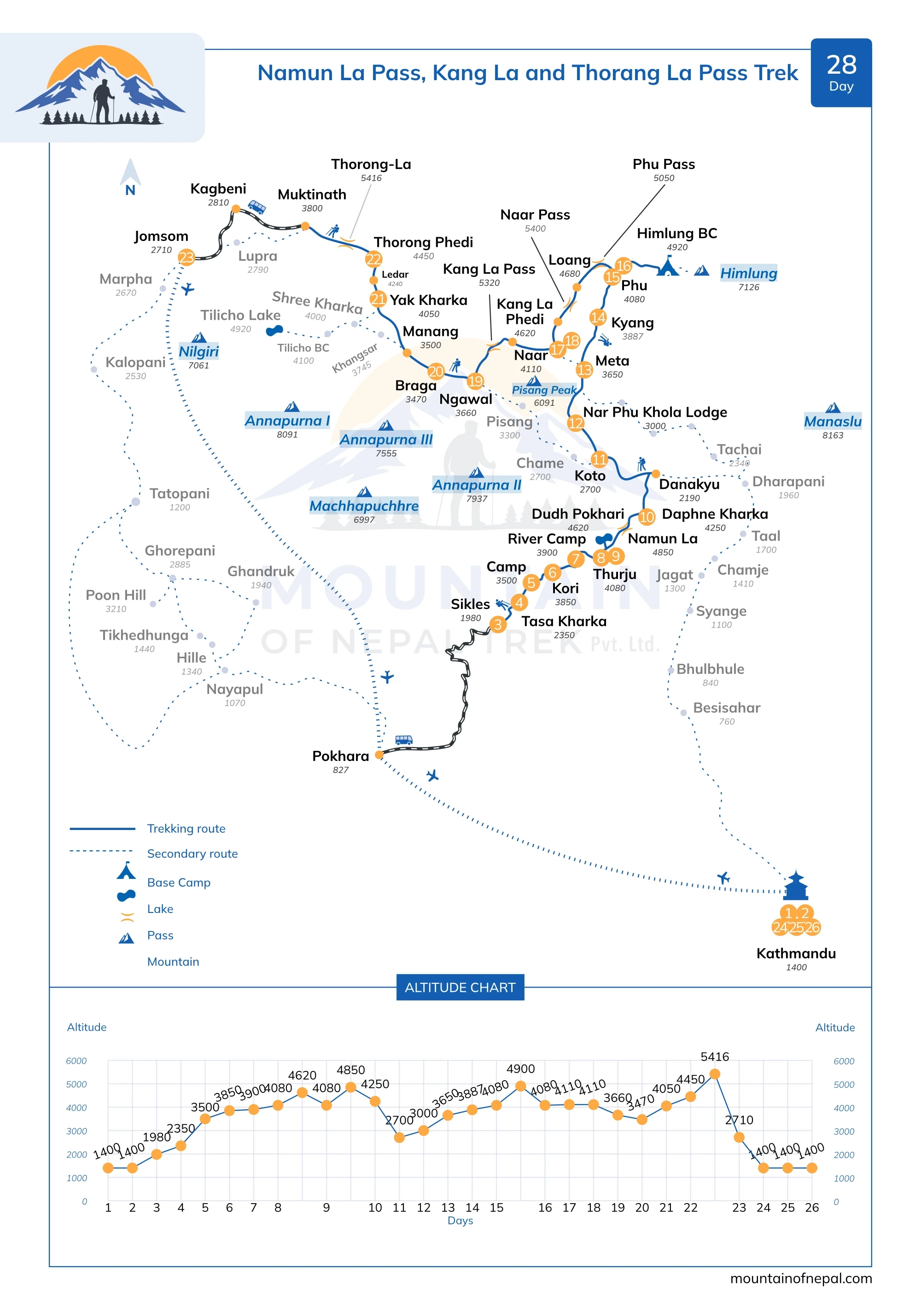
Namun La Pass, Kang La and Thorang La Pass Trek
| Trip code | |
| Package name | Namun La Pass, Kang La and Thorang La Pass Trek |
| Duration | 28 |
| Max. elevation | 5320 m |
| Level | Moderate |
| Transportation | Domestic flight and all ground transportation as per the itinerary |
| Accomodation | Hotel in Kathmandu and Pokhara, and Lodge / Tea House during trek |
| Starts at | Kathmandu |
| Ends at | Kathmandu |
| Trip route | |
| Cost | USD 0 per person |
Highlights
- Stunning Himalayan panoramas, including the Annapurna, Manaslu, and Dhaulagiri ranges
- Remote and rarely explored trails of the Namun La Pass trekking route
- Deep exploration of the hidden Nar–Phu Valley, a preserved Himalayan cultural gem
- Crossing the challenging Kang La Pass (5,320 m) with breathtaking alpine views
- Traditional Tibetan-influenced villages: Nar, Phu, Ngawal, and Kyang
- Adventure-filled high-pass trekking via Thulo Lekh, Rambrong, Furju Deurali, and Thorong La Pass
- Scenic alpine lake excursion to Dudh Pokhari (4,620 m)
- Spiritual and cultural experience at the sacred Muktinath Temple
- Spectacular scenic flight from Jomsom to Pokhara, offering aerial Himalayan views
- Excellent opportunities for wildlife spotting and Himalayan photography
- Unique combination of three major high passes in one expedition
- Remote camping experience in untouched alpine wilderness
- Rich biodiversity, including Himalayan blue sheep, musk deer, and high-altitude birds
- Dramatic landscapes transitioning from lush hills to arid trans-Himalayan valleys
Overview
This combined trekking route organized by Mountain of Nepal is one of the most adventurous high-pass journeys in Nepal, linking the remote Nar–Phu Valley, Annapurna region, and upper Manang landscapes. The trek begins from the quiet villages near Siklis and gradually ascends through alpine forests, high yak pastures, and isolated Himalayan settlements before crossing three major high passes: Namun La Pass, Kang La Pass, and Thorong La Pass.
The journey offers a rare mix of cultural immersion and extreme wilderness trekking. Early sections explore traditional Gurung villages like Siklis, while later sections enter the restricted Nar and Phu valleys, home to Tibetan-influenced communities. The route continues through iconic high-altitude terrain near Phu Village and Nar Village, eventually connecting to the famous Annapurna Circuit via Thorong La Pass.
- Crossing 3 major Himalayan passes over 4,800–5,300 m
- Remote wilderness trekking in Nar–Phu Valley
- Ancient Tibetan Buddhist culture and monasteries
- Panoramic views of the Annapurna and Himlung ranges
- A blend of camping and lodge trekking experience
Best Season for Namun La Pass, Kang La, and Thorong La Pass Trek
The ideal seasons for this expedition are spring (March–May) and autumn (September–November) when weather conditions are stable, skies are clear, and mountain visibility is at its best. These months offer safer crossing conditions for high passes like Kang La (5,320 m) and Thorong La (5,416 m), where snow and wind can otherwise become dangerous.
Spring brings blooming rhododendrons in lower regions, such as around Pokhara, and lush greenery along trekking trails. Autumn, however, is considered the most reliable season due to post-monsoon clarity and stable temperatures in high-altitude areas like Ngawal and the Muktinath region.
Seasonal advantages:
- Spring: Flowers, moderate weather, fewer crowds
- Autumn: Best visibility, stable weather, safer passes
- Winter: Extreme cold, snow blockages in passes
- Monsoon: Landslides and poor trail conditions
Namun La Pass, Kang La, and Thorong La Pass Trek Difficulty and Transportation
This trek is classified as strenuous to extremely challenging, primarily due to long walking days, remote terrain, and multiple high-altitude passes above 5,000 meters. Trekkers must be physically fit and acclimatized, especially for crossings like Namun La and Kang La Pass. Altitude sickness risk is significant due to rapid elevation gain in regions such as Koto and Yak Kharka.
Transportation includes a combination of domestic flights, off-road jeep drives, and full trekking segments. The journey typically begins with a flight from Kathmandu to Pokhara, followed by road travel to Siklis. The return includes a scenic flight from Jomsom back to Kathmandu via Pokhara.
Difficulty & logistics:
- Long trekking days (6–9 hours average)
- High passes above 4,800–5,300 m
- Remote camping sections in the Nar–Phu region
- Limited rescue access in upper valleys
- A mix of lodge trekking and camping is required
Food and Accommodation for Namun La Pass, Kang La, and Thorong La Pass Trek
Accommodation varies from basic teahouses to tented camps, especially in remote sections like Namun La and Nar–Phu regions. In established trekking areas such as Ngawal, Braga, and Muktinath, trekkers can find comfortable lodges with warm meals and basic facilities.
Food options are simple but energy-rich, designed for high-altitude trekking. Typical meals include dal bhat (rice and lentils), noodles, soups, potatoes, and seasonal vegetables. In remote camps, the expedition team from Mountain of Nepal provides freshly cooked meals to maintain nutrition and energy levels.
Accommodation & food highlights:
- Teahouses in Annapurna region villages
- Camping in the remote Nar–Phu and Namun La sections
- Hot meals prepared by the support crew
- High-calorie vegetarian and non-vegetarian options
- Limited but safe drinking water supply (filtered/boiled)
Namun La Pass, Kang La, and Thorong La Pass Trek Permits
Since the route passes through restricted and conservation zones, multiple permits are required. The Nar–Phu Valley section and Kang La Pass area require special permits, while the Annapurna Circuit sections require conservation permits. All permits are usually arranged by Mountain of Nepal as part of the trekking package.
Key permit requirements include restricted area authorization for Nar–Phu Valley, Annapurna Conservation Area Permit (ACAP), and TIMS (Trekkers’ Information Management System) card. These ensure controlled tourism and environmental protection in fragile Himalayan ecosystems.
Required permits:
- Restricted Area Permit (Nar–Phu Valley)
- Annapurna Conservation Area Permit (ACAP)
- TIMS Card (Trekkers Information System)
- Local municipality entry fees (if applicable)
- Passport and visa copy registration
Why Choose Namun La Pass, Kang La, and Thorong La Pass Trek
This combined high-pass expedition offers one of the most complete Himalayan trekking experiences in Nepal, blending adventure, culture, and isolation. Organized by Mountain of Nepal, it is designed for experienced trekkers seeking a challenging but rewarding journey across three iconic passes.
Unlike standard Annapurna Circuit treks, this route includes remote and less-traveled paths such as Namun La and Kang La, offering a deeper wilderness experience. The cultural diversity—from Gurung villages like Siklis to Tibetan-influenced settlements like Phu and Nar—adds immense richness to the journey.
Reasons to choose this trek:
- Three major Himalayan passes in one expedition
- Remote and less crowded trekking route
- Authentic cultural immersion in Nar–Phu Valley
- Professional support from Mountain of Nepal
- Scenic transition from green hills to alpine desert
- A combination of adventure, heritage, and high-altitude challenge
Trip Preparation
Trip Itinerary
Day 1 : Arrival in Kathmandu
Upon arrival in Kathmandu, travelers are warmly welcomed by a representative from Mountain of Nepal and transferred to the hotel. This day is reserved for rest after international travel and adjustment to the local environment. In the evening, a short briefing introduces the overall trekking plan, safety protocols, and cultural expectations. Participants can explore the vibrant streets of Thamel, known for trekking shops and a cultural atmosphere. Final document checks are completed, and any last-minute gear needs are addressed. An overnight stay in Kathmandu allows proper acclimatization before the journey into the mountains begins.
Day 2 : Trip briefing & gear check, Kathmandu
A detailed expedition briefing is conducted in Kathmandu by Mountain of Nepal guides, covering the full route from Siklis to Thorong La Pass. Equipment inspection ensures every trekker is properly equipped for high-altitude conditions. Maps, safety protocols, altitude sickness awareness, and emergency evacuation procedures are explained thoroughly. This is also a day for final gear rental or purchase. Participants may explore cultural sites in Kathmandu or rest. The team emphasizes teamwork, pacing, and hydration strategies for upcoming high passes such as Thorong La Pass and Kang La Pass.
Day 3 : Fly to Pokhara → Drive to Siklis (1,980 m)
The journey begins with a scenic flight to Pokhara, offering stunning Himalayan views, followed by a drive to the traditional Gurung village of Siklis. Organized by Mountain of Nepal, this transition marks the entry into rural trekking landscapes. Siklis is one of the largest and oldest Gurung settlements, offering rich cultural immersion and views of the Annapurna ranges. The day is relatively relaxed to adjust after travel. Trekkers explore stone houses, terraced fields, and local traditions. An overnight stay in a lodge prepares the body for a gradual ascent into higher alpine terrain.
Day 4 : Trek to Tasa Kharka (2,350 m)
The trek begins properly as the trail ascends through rhododendron forests, small settlements, and river crossings toward Tasa Kharka. Led by Mountain of Nepal guides, trekkers experience gradual altitude gain and increasing wilderness. The route offers panoramic views of surrounding hills and distant Himalayan peaks. Local wildlife such as Himalayan birds may be spotted along the trail. The walking pace is steady to ensure acclimatization. Tasa Kharka is a peaceful grazing area where basic camping or lodge accommodation is arranged, allowing trekkers to enjoy quiet mountain surroundings and prepare for higher elevation days ahead.
Day 5 : Trek to 3,500 m
Today’s ascent is more challenging as the trail climbs steadily into higher alpine zones above 3,000 meters. Mountains of Nepal ensure a controlled pace with frequent rest stops to prevent altitude stress. Vegetation becomes sparse, replaced by rugged terrain and open ridgelines. The air grows noticeably thinner, and trekkers are advised to hydrate frequently. The camp is set in a scenic high pasture area surrounded by snow-capped peaks in the distance. This is an important acclimatization stage before reaching Kori Danda. Evening briefing covers altitude awareness and preparation for the next major ascent.
Day 6 : Trek to Kori Danda (3,850 m)
The trail ascends toward Kori Danda, one of the most spectacular viewpoints in the region. Organized by Mountain of Nepal, the route passes through alpine meadows and ridgelines with expansive Himalayan views. Upon arrival, trekkers are rewarded with panoramic vistas of the Annapurna and Lamjung ranges. The campsite at Kori Danda is often above cloud level, offering breathtaking sunrise and sunset experiences. Due to the higher altitude, movement is slow and controlled. The team emphasizes rest, hydration, and monitoring of any altitude symptoms to ensure safe acclimatization.
Day 7 : Trek to River Camp (3,900 m) via Thulo Lekh (4,100 m)
This demanding day includes crossing the ridge of Thulo Lekh before descending to River Camp. Guided by the Mountain of Nepal, trekkers experience dramatic terrain transitions from high ridges to river valleys. The climb to Thulo Lekh provides wide mountain panoramas, while the descent requires careful footing. River Camp is located near a glacial-fed stream, offering fresh water and a peaceful environment. The altitude gain and loss make this a physically engaging day. Evening discussions focus on recovery techniques and preparation for the upcoming pass crossing section of the trek.
Day 8 : Trek to Thurju (4,080 m) via Rambrong & Furju Deurali Pass
Today’s route traverses remote alpine trails toward Thurju, crossing high points including Furju Deurali Pass. The mountain of Nepal leads through rugged landscapes, prayer flags, and isolated grazing zones. The terrain becomes more barren and dramatic as altitude increases. Trekkers must maintain steady pacing due to thinner air. The descent into Thurju reveals hidden valleys and ancient herding shelters. This region is culturally rich yet extremely remote, offering a sense of isolation and wilderness rarely found elsewhere in Nepal. Overnight camp provides basic but safe accommodation in alpine conditions.
Day 9 : Excursion to Dudh Pokhari (4,620 m), return to Thurju
A challenging acclimatization hike leads to Dudh Pokhari, a sacred high-altitude lake. Organized by Mountain of Nepal, this day supports adaptation before crossing Namun La. The trail ascends steeply through rocky terrain and glacial landscapes. At the lake, trekkers experience spiritual serenity and panoramic Himalayan views. After spending time at the lake for rest and photography, the group descends carefully back to Thurju. This up-and-down movement is essential for altitude conditioning. Evening rest is prioritized, with warm meals and health monitoring to prepare for the upcoming high pass crossing.
Day 10 : Cross Namun Pass (4,850 m) → descend to Dafne Kharka (4,250 m)
A major highlight of the trek, crossing Namun La Pass, begins early under the guidance of Mountain of Nepal. The ascent is steep and physically demanding, requiring careful pacing and determination. At the summit, trekkers are rewarded with dramatic Himalayan views and prayer flag-adorned ridges. After celebrating the crossing, a long descent leads to Dafne Kharka. The descent tests endurance due to loose terrain and altitude fatigue. The campsite offers relief after a strenuous day, with recovery focused on hydration, nutrition, and rest.
Day 11 : Trek to Koto (2,700 m)
The trail descends through changing landscapes toward Koto, marking a transition into the Nar-Phu gateway region. Mountain of Nepal guides lead trekkers through pine forests, river valleys, and small settlements. Oxygen levels improve as altitude decreases, allowing faster walking. Koto is a key checkpoint before entering restricted trekking areas. Here, permits are often verified, and logistics are reviewed. The village offers basic tea houses and cultural interaction with locals. After days of remote camping, this stop provides comfort and a chance to recover energy for the Nar-Phu Valley section ahead.
Day 12 : Trek to Nar Phu Khola Lodge (3,000 m)
The route follows the Nar-Phu river valley into increasingly remote terrain toward Nar Phu Khola. Led by Mountain of Nepal, trekkers begin entering restricted Himalayan regions with strong Tibetan cultural influence. Stone pathways, narrow gorges, and suspension bridges define the trail. The lodge at Nar Phu Khola offers basic accommodation but essential warmth and food. The environment feels isolated and raw, with towering cliffs surrounding the valley. Evening discussions focus on cultural sensitivity and preparation for the deeper Nar-Phu wilderness ahead.
Day 13 : Trek to Meta (3,650 m)
Today’s ascent leads to Meta, a windswept plateau village surrounded by barren cliffs. Mountain of Nepal guides ensure a steady pace through steep canyon trails and rocky paths. The landscape becomes increasingly Tibetan in character, with ancient chortens and prayer walls. Meta serves as a key acclimatization stop before higher villages. The air is colder and drier, signaling entry into true trans-Himalayan terrain. Overnight accommodation is basic but comfortable enough for rest and recovery. The evening is spent preparing mentally and physically for deeper valley exploration.
Day 14 : Trek to Kyang (3,800 m)
The trek continues deeper into Nar-Phu Valley toward Kyang. Organized by Mountain of Nepal, the route passes ancient monasteries, eroded cliffs, and yak pastures. The trail is remote and quiet, with minimal human settlement. Trekkers experience a strong cultural presence through mani walls and prayer flags. The altitude gain is gradual but noticeable, requiring controlled breathing and pacing. Kyang is a small seasonal settlement offering basic shelter. The isolation of this region enhances the sense of adventure, with dramatic Himalayan scenery dominating every direction.
Day 15 : Trek to Phu (4,080 m)
The trail climbs toward the historic village of Phu, one of the most culturally preserved settlements in the Himalayas. The mountain of Nepal leads trekkers through narrow gorges and ancient stone gates before reaching the fortified village. Phu is rich in Tibetan Buddhist heritage, with monasteries perched above the valley. The altitude is high, so acclimatization is crucial. Trekkers explore the village and interact with locals practicing traditional lifestyles. The dramatic landscape and spiritual atmosphere make this one of the most memorable stops of the entire expedition.
Day 16 : Acclimatization hike to Himlung Base Camp (4,900 m)
A demanding acclimatization hike takes trekkers toward Himlung Himal Base Camp. Guided by Mountain of Nepal, the route climbs steep glacial terrain with breathtaking views of Himlung Himal. This excursion is critical for preparing the body for Kang La Pass. The thin air at nearly 5,000 meters requires slow movement and careful monitoring. After spending time at base camp, the group returns to Phu for rest. The experience provides both physical adaptation and psychological preparation for upcoming extreme altitude crossings.
Day 17 : Trek to Nar Village (4,110 m)
The route descends slightly and then traverses toward Nar Village. Mountain of Nepal guides lead across high desert-like terrain and glacial valleys. Nar is another culturally rich settlement with traditional stone houses and monasteries. The village offers a different perspective of the Nar-Phu region. The trail may involve river crossings and windy ridges. Arrival at Nar allows trekkers to rest and prepare for one of the most challenging days ahead: crossing Kang La Pass at over 5,300 meters.
Day 18 : Contingency / rest day, Nar
This buffer day in Nar Village is essential for acclimatization and weather adjustment. Mountain of Nepal uses this time to monitor health conditions and finalize plans for Kang La Pass. Trekkers may explore the village, visit monasteries, or take short hikes around surrounding ridges. Resting helps reduce altitude stress and improves safety for the upcoming crossing. Weather in this region can change rapidly, so flexibility is important. This day ensures the entire group is physically and mentally prepared for the high-altitude challenge ahead.
Day 19 : Cross Kang La Pass (5,320 m) → trek to Ngawal (3,660 m)
A major alpine crossing over Kang La Pass is undertaken with support from Mountain of Nepal. The ascent begins early in darkness, climbing steep snow and rock sections. At the summit, trekkers witness stunning Himalayan panoramas before descending toward the Annapurna region. The descent to Ngawal is long but scenic. Ngawal offers more developed lodges and easier terrain compared to Nar-Phu. This transition marks a shift from remote wilderness back into the classic Annapurna trekking corridor.
Day 20 : Trek to Braga (3,470 m)
The trail continues through the scenic Annapurna Valley toward Braga. The mountain of Nepal leads trekkers through monasteries, mani walls, and traditional villages. Braga is known for its ancient monastery overlooking the valley. The terrain is significantly easier compared to the previous high passes, allowing recovery. Trekkers enjoy cultural interaction and more comfortable accommodation. The descent in altitude improves oxygen levels and overall energy. This is a relaxing day before beginning the final approach toward Thorong La Pass.
Day 21 : Trek to Yak Kharka (4,050 m)
The route climbs gradually toward Yak Kharka. The mountain of Nepal ensures a steady ascent through alpine meadows and yak grazing areas. The landscape becomes more open and windswept. Trekkers may experience mild altitude effects again due to rising elevation. Yak Kharka is a well-known stop for trekkers heading toward Thorong Phedi. The environment is rugged yet beautiful, with wide Himalayan views. Evening rest and hydration are emphasized to prepare for the final pass crossing.
Day 22 : Trek to Thorong Phedi / High Camp (4,450–4,880 m)
The trek ascends to Thorong Phedi or higher to High Camp, depending on conditions. Mountain of Nepal guides carefully assess the weather and health before finalizing the overnight point. The trail is steep and demanding, with thinning air. Trekkers prepare equipment, warm clothing, and hydration for the next day’s pass crossing. The landscape is stark and high alpine, with minimal vegetation. Early rest is essential, as the next day involves one of the highest trekking passes in the world.
Day 23 : Cross Thorong La Pass → Muktinath (3,800 m) → drive to Jomsom (2,710 m)
An early morning ascent leads to Thorong La Pass, the highest point of the trek. Guided by Mountain of Nepal, trekkers ascend in freezing pre-dawn conditions. The summit offers breathtaking Himalayan views and a sense of achievement. After descent, the group reaches Muktinath, a sacred pilgrimage site. From here, a drive continues to Jomsom for an overnight stay. The transition from high mountains to lower valleys marks the successful completion of all major passes.
Day 24 : Flight Jomsom → Pokhara → Kathmandu
A scenic mountain flight takes trekkers from Jomsom to Pokhara and then onward to Kathmandu. Mountain of Nepal manages all logistics to ensure smooth travel. Aerial views of the Annapurna and Dhaulagiri ranges provide a final visual reward of the journey. Upon arrival in Kathmandu, trekkers return to their hotel for rest and celebration. The day is relaxed, allowing reflection on the completed high-pass expedition.
Day 25 : Free / contingency days in Kathmandu
A flexible day in Kathmandu allows for rest, shopping, cultural exploration, or buffer time in case of flight delays. The mountain of Nepal remains available for assistance, souvenir shopping guidance, or optional city tours. Many trekkers visit heritage sites, cafes, or markets in Thamel. This day also serves as a recovery period after long trekking days. It is an opportunity to celebrate the successful completion of the Himalayan journey across Namun La, Kang La, and Thorong La passes.
Day 27 : Departure from Kathmandu
On the final day, travelers depart from Kathmandu with assistance from Mountain of Nepal for airport transfer and check-out. The expedition concludes with memories of remote valleys, high passes, and cultural encounters across the Himalayas. Trekkers leave with a strong sense of achievement after crossing some of Nepal’s most challenging routes, including Namun La Pass, Kang La Pass, and Thorong La Pass. The Mountain of Nepal team bids farewell, hoping to welcome adventurers again for future Himalayan expeditions.
Inclusions
What is included?
- Airport transfers in Kathmandu.
- Domestic flight and all ground transportation as per the itinerary.
- Hotel accommodation in Kathmandu with breakfast.
- Teahouse accommodations during the trek.
- All meals (breakfast, lunch, dinner) during the trek.
- Annapurna Conservation Area entry permit.
- Restricted Area Permit (Nar–Phu Valley)
- Annapurna Conservation Area Permit (ACAP)
- Local municipality entry fees (if applicable)
- TIMS (Trekkers' Information Management System) card.
- Experienced, English-speaking trek guide.
- Porters to carry luggage (1 per 2 trekkers).
- Trekking map and group medical kit
- Welcome and farewell dinners in Kathmandu.
What isn't included?
- International flights to/from Kathmandu.
- Nepal entry visa fee.
- Mandatory travel insurance (including emergency rescue).
- Personal trekking equipment.
- Personal expenses (laundry, calls, internet, etc.).
- Alcoholic beverages and bottled water.
- Additional meals and beverages not specified.
- Tips for trekking staff
Complimentary