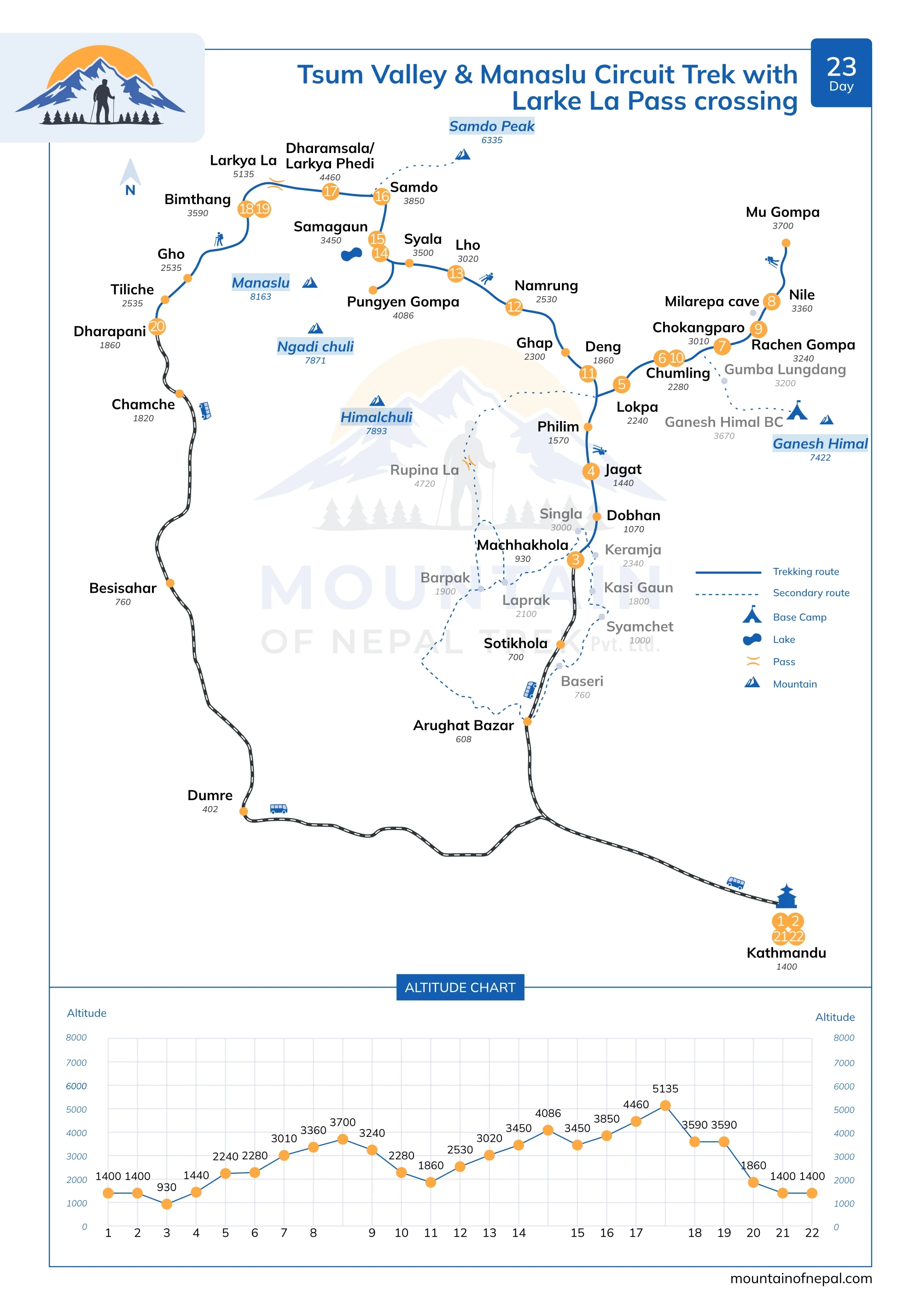
Tsum Valley & Manaslu Circuit Trek with Larke La Pass crossing
| Trip code | |
| Package name | Tsum Valley & Manaslu Circuit Trek with Larke La Pass crossing |
| Duration | 23 |
| Max. elevation | 5135 m |
| Level | Moderate |
| Transportation | All ground transportation as per the itinerary |
| Accomodation | Cozy guesthouses and homestays for a comfortable trekking experience |
| Starts at | Kathmandu |
| Ends at | Kathmandu |
| Trip route | |
| Cost | USD 0 per person |
Highlights
- Location: Nepal-Tibet border, north of Manaslu
- Cultural Exploration: Ancient Tibetan culture, art, and traditions
- Non-Violence Zones: Upper Tsum (protected since 1920) and Lower Tsum (sacrifice-free since 2012)
- Scenic Delights: Tibetan-style villages, monasteries, caves, gorges, glacier-fed rivers
- Wildlife Sanctuary: Home to blue sheep, Himalayan Thar, and more
- Trek Extensions: Options to combine with Manaslu Circuit or extend to Annapurna Circuit
- Accommodation: Cozy guesthouses and homestays for a comfortable trekking experience
Overview
Discover the hidden gem of Tsum Valley, nestled in the northern part of Manaslu along the Nepal-Tibet border. Immerse yourself in the colorful and diverse world of Tibetan culture, ancient traditions, and captivating art. This sacred land opened its doors to trekkers in 2008, providing a rare chance to explore a world still untouched by mainstream tourism. Since 1920, the upper Tsum region has been protected as a Shyakya (non-sacrificing area) by local Buddhist communities, strictly forbidding activities like hunting, wildlife disturbance, and honey collection. Following this admirable tradition, the lower Tsum region was declared a non-sacrificing area, establishing a tranquil sanctuary in 2012. The valley is inhabited by nuns, monks, and the indigenous Tsum people, offering a unique cultural experience. Discover Tibetan-style villages , numerous monasteries, sacred caves, breathtaking landscapes, deep gorges, and rivers fed by glaciers. Observe the enduring practice of polyandry marriage, a tradition that maintains economic stability by keeping land and property undivided among brothers. This serene valley provides a safe refuge for wildlife, including the renowned blue sheep, Himalayan Thar, and various other animals. The Tsum Valley trek offers awe-inspiring vistas of Manaslu, Ganesh Himal, Sringi Himal, Himal Chuli, and Boudha Himal ranges for a magical mountain experience. If you're seeking an extraordinary adventure, consider combining the Tsum Valley trek with the renowned Manaslu Circuit, crossing Larkya pass starting from Macchakhola and concluding in Dharapani, or extend your adventure to the Annapurna Circuit, crossing the world-famous Thorang La or Mesokanta La pass before reaching your ending point in Jomsom. The trek meanders through low land of Hindu villages, lush greenery, pine and rhododendron forests and and up into the picturesque Tsum Valley. Along the journey, we find welcoming guesthouses or unique homestays, ensuring a comfortable trek without the need for camping. Come, be a part of this extraordinary journey in the heart of the Himalayas
Trip Preparation
Trip Itinerary
Day 1 : Arrival in Kathmandu (1,400 m)
Upon arrival at Tribhuvan International Airport, you will be warmly welcomed by a representative from Mountain of Nepal Trek and transferred to your hotel in Kathmandu. After check-in, take time to rest and recover from your international journey. If time permits, explore Thamel, a lively area known for trekking shops, cafés, restaurants, and local handicrafts. In the evening, enjoy a welcome dinner at a traditional Nepali restaurant, where you will meet your guide and fellow trekkers and receive a briefing about your upcoming journey. Accommodation: Hotel Meals: Welcome Dinner
Day 2 : Kathmandu – Trek Preparation & Briefing
Today is set aside for final preparations for your trek in Kathmandu, ensuring you are physically, logistically, and mentally ready for high-altitude trekking in the Himalayas. After breakfast, meet your guide for a detailed briefing covering the full route, daily walking distances, altitude awareness, acclimatization strategy, weather conditions, and essential safety guidelines for trekking in mountainous terrain. Your guide will also carefully check your equipment to ensure everything is suitable for the journey, and if anything is missing, you can rent or purchase gear in Thamel, the city’s main trekking hub. During the day, all required permits and documentation for the trek will be arranged. The rest of the day remains flexible for relaxation, last-minute shopping, exploring Kathmandu’s cultural and UNESCO World Heritage sites, or carefully organizing and packing your trekking gear and personal belongings before departure. Overnight stay at a hotel in Kathmandu, marking the final preparation day before your Himalayan adventure begins.
Day 3 : Drive from Kathmandu to Machha Khola (930m) – Gateway to the Manaslu Circuit Trek
Your journey into the remote Himalayas begins with a scenic 145 km drive from Kathmandu to Machhakhola—the starting point of the iconic Manaslu Circuit trek. This 9–10 hour drive offers a perfect introduction to Nepal’s diverse landscapes, combining river valleys, terraced hills, and mountain views.Heading west toward Pokhara, you’ll follow the winding road alongside the Trishuli River, with occasional glimpses of snow-capped Himalayan peaks. After around 1.5 hours, you’ll reach Malekhu, a popular riverside stop, before turning toward Dhading Besi, a bustling local town and gateway to the Manaslu region. From Dhading Besi, the road continues through picturesque hillside villages with stunning views of the Ganesh Himal range. While the section up to Arughat is relatively smooth, the road becomes more rugged and adventurous from Arughat to Machha Khola—adding a sense of excitement to your journey. Choosing this drive allows you to skip the lower trekking section, saving time and energy while gradually adjusting to the region’s altitude—an important step for a successful high-altitude trek. By late afternoon or early evening, you’ll arrive in Machha Khola, where you’ll settle into a welcoming local tea house. Enjoy a warm meal, relax, and soak in the peaceful atmosphere of this riverside village as you prepare for the trekking days ahead. Overnight in Machha Khola.
Day 4 : Trek to Jagat (1440m).Walk approx. 7-8 hours – Entering the Manaslu Conservation Area
Today’s trek follows the scenic trail along the Budhi Gandaki River, marking a gradual and rewarding ascent deeper into the Manaslu region. The journey takes approximately 7–8 hours, with a mix of gentle paths, stone steps, suspension bridges, and riverside walks. After breakfast, you head north through terraced fields and forested sections, gradually reaching the village of Khorlabesi. Along the way, you pass through small settlements and arrive at Tatopani, where you can take a short break and relax in natural hot springs—a refreshing highlight of the day. Continuing the trek, the trail winds through peaceful forests and villages such as Dobhan, with several suspension bridge crossings over the Budhi Gandaki and its tributaries, including the Yaru Khola. The changing landscapes of rivers, forests, and hillside trails make the journey both scenic and engaging. By late afternoon, you reach Jagat, a traditional stone-paved village and the official entry point to the Manaslu Conservation Area. Here, your trekking permits are checked as you enter this protected Himalayan region. Settle into a local teahouse, enjoy the mountain atmosphere, and rest after a fulfilling day on the trail. Overnight in Jagat.
Day 5 : Trek from Jagat to Lokpa (2,240 m) | Approx. 6–7 hours
Leaving Jagat, the trail climbs gradually along stone staircases and forested hillsides toward Salleri, offering early views of the surrounding Himalayan landscape. The route then descends to Sirdibas, a traditional village influenced by Tibetan Buddhist culture. Continuing north, the trail passes through the large settlement of Philim, known for its terraced fields, prayer flags, and scenic mountain surroundings. Beyond Philim, the path enters peaceful pine and rhododendron forest as the valley becomes narrower and more remote. After crossing the Siyar Khola on a suspension bridge, you reach the junction where the trail leaves the main Manaslu Circuit Trek and branches toward the remote Tsum Valley. From here, a steady uphill climb leads to Lokpa, the first village on the Tsum Valley route, situated above the confluence of the Budhi Gandaki and Siyar Khola rivers. Surrounded by forested hills and dramatic landscapes, Lokpa offers a peaceful introduction to the hidden valleys and Tibetan-influenced culture of the Tsum region. Overnight in Lokpa.
Day 6 : Trek from Lokpa to Chumling (2,280 m) | Approx. 4–5 hours
Leaving Lokpa, the trail descends steeply through dense pine and rhododendron forest toward the roaring Siyar Khola far below. In the early morning, mist often lingers across the valley, creating a dramatic atmosphere as you make your way deeper into the hidden Tsum Valley. After crossing a suspension bridge high above the river, the route enters one of Nepal’s most remote Himalayan valleys, where ancient Tibetan Buddhist culture and untouched mountain landscapes remain remarkably preserved. The trail then climbs steadily through quiet forest, narrow hillside paths, waterfalls, and scattered clearings. Continuing onward, the trail ascends steadily to the hilltop village of Ripchet before continuing toward Chumling. Along the way, enjoy occasional glimpses of snow-capped peaks rising above the valley walls and the peaceful atmosphere of this less-traveled Himalayan region. Upon arrival in Chumling, explore the traditional village, visit the local monastery, and enjoy beautiful views of Himalchuli and the surrounding mountain landscape. This rewarding day combines suspension bridges, remote trails, cultural encounters, and dramatic Himalayan scenery. Overnight in Chumling
Day 7 : Trek from Chumling to Chhokangparo (Approx. 3,010 m) | 5–6 hours
After leaving Chumling, cross a suspension bridge and begin a gentle descent through forested terrain and scattered small settlements. The trail offers a peaceful introduction to the upper Tsum Valley, with increasing Tibetan cultural influence along the way. En route, visit the beautiful Dharma Gompa at around 2,365 m, known for its unique Buddhist statues and spiritual atmosphere. From here, the trail descends to the small village of Rainjam before continuing along a short section of hillside path and crossing another suspension bridge. The route then climbs steadily to the hamlet of Gho (2,570 m), before continuing on a well-defined trail through terraced fields and traditional settlements. After a long, continuous uphill climb without major breaks or flat sections, you finally reach the spectacular twin village of Chhokangparo, one of the most culturally significant settlements in the region. Chhokangparo is known as a “village of wisdom,” offering wide Himalayan views and a strong Tibetan Buddhist heritage. Overnight in Chhokangparo.
Day 8 : Trek from Chhokangparo to Nile (3,360 m) | 4–5 hours
Leaving Chhokangparo, the trail continues deeper into the upper Tsum Valley, following the northern bank of the Siyar Khola through a wide and open Himalayan valley.The route passes through fertile fields, traditional stone pathways, and sacred Buddhist landmarks including ancient chortens and mani walls carved with prayer inscriptions. Along the way, you pass several small settlements such as Lamagaon, Phurbe, Pangdun, and Chhule, each reflecting the strong Tibetan-influenced culture of the region. After crossing a suspension bridge, the trail makes a final gentle ascent to Nile, one of the last permanent settlements in the upper valley. Surrounded by dramatic mountain scenery and a deeply spiritual atmosphere, Nile offers a peaceful overnight stop in the high Himalaya. Overnight in Nile.
Day 9 : Trek to Mu Gompa (3,700 m) & descend to Rachen Gompa (3,240 m) | Approx. 7–8 hours
From Nile, begin the day with a light ascent to the remote Mu Gompa, one of the highest and most significant monasteries in the upper Tsum Valley near the Tibetan border, surrounded by majestic mountains, Mu Gompa was established under the spiritual guidance of Drupa Rinpoche, who meditated in nearby caves. The monastery is affiliated with Kopan Monastery and is home to both novice and senior monks. Explore the peaceful surroundings, prayer halls, mani walls, and chortens before retracing your steps back to Nile. After lunch in Nile, descend through the valley on a gradual trail leading to Rachen Gompa, a serene monastic complex inhabited by Buddhist nuns. The monastery is known for its intricate murals, spiritual atmosphere, and remote mountain setting. Overnight in Rachen Gompa.
Day 10 : Trek from Rachen Gompa to Chumling (2,280 m) | Approx. 6–7 hours
After breakfast at Rachen Gompa, begin your descent back through the upper Tsum Valley, retracing the same scenic trail toward Chumling. Although the route follows familiar paths, the descent offers a new perspective of the valley, with changing light, wider views, and a different appreciation of the surrounding Himalayan landscapes. The trail passes through traditional villages, forested sections, and suspension bridges, gradually losing elevation as you return to the lower valley. This is a long but rewarding trekking day, allowing time to reflect on the cultural richness, remote monasteries, and dramatic scenery experienced in the upper Tsum region. Overnight in Chumling.
Day 11 : Trek from Chumling to Deng (1,860 m) | Approx. 7–8 hours
Leaving Chumling, begin a long and scenic descent back toward the lower valleys of the Tsum Valley. The trail passes through forested slopes and traditional settlements as you gradually make your way toward Lokpa. From Lokpa, cross a suspension bridge over the Budhi Gandaki River and continue along a section that reconnects with the famous Manaslu Circuit Trek. The path then follows a mix of ascents and descents through riverside terrain, forest trails, and small villages before reaching Deng. Approaching Deng, look out for a traditional Buddhist stone archway (Kani), an important cultural gateway symbolizing protection and blessing along the trail. Overnight in Deng.
Day 12 : Trek to Namrung(2530m) Approx.7-8 hours
Today’s journey involves multiple river crossings and a gradual shift in both landscape and culture. The day begins with a bridge crossing, followed by a brief descent and a short but steep 20-minute zigzag climb to the charming village of Rana. From here, a steady ascent of around two hours leads to Bihi Phedi. The trail continues along the Budhi Gandaki River, crossing the Serang Khola and passing through Ghap (2,040m), where another wooden bridge takes you across the river once again. As you move beyond Ghap, Tibetan cultural influences become more visible, with mani walls, monasteries, and prayer flags lining the route. Waterfalls, ancient stone carvings, and seasonal mustard fields add natural and cultural richness to the journey. The path then enters a dense forest of blue pine, oak, and rhododendron. With several crossings of the Budhi Gandaki River and a gradually narrowing valley, the trail leads steadily toward Namrung village. Namrung was heavily affected by the 2015 earthquake but has since been rebuilt. Today, it stands as a warm and welcoming mountain village where trekkers can rest and experience local Himalayan life. Overnight stay in Namrung.
Day 13 : Trek to Lho (3,020m) | Approx. 3–4 Hours
Today’s trek is relatively shorter, taking around 3–4 hours, and offers a gradual ascent as you move deeper into the Manaslu Circuit. This steady climb helps with proper acclimatization to higher altitude. The trail begins from Namrung and steadily rises through a changing landscape. As the valley opens up, you pass barley fields and open pastures around Banjam village, offering wide Himalayan views and a peaceful walking experience. The route then continues upward to Lihi (2,920m), a small and scenic village known for its traditional stone houses and terraced fields. From Lihi, the trail follows a stream originating from the Lidanda Glacier and gradually enters Sho village, where Tibetan culture becomes more visible. Prayer flags, chortens, and traditional architecture reflect the strong cultural heritage of the region. Along this section, you are rewarded with your first clear views of Manaslu North and surrounding Himalayan peaks. By midday, you arrive at Lho (3,020m), a large and culturally rich village and home to the historic Ribung Monastery. The village is decorated with carved wooden details and colorful prayer flags, showcasing strong Tibetan influence. From here, stunning views of Manaslu, Ganesh Himal, Kutang Himal, and Saula (6,235m) dominate the horizon. In the afternoon, you can relax or take a short walk to a nearby viewpoint for panoramic views of Manaslu and Manaslu North—one of the highlights of the entire trek. Overnight stay in Lho.
Day 14 : Trek to Samagaoun (3450m). Walk approx.4 hours.
After breakfast, begin your trek toward Samagaun, one of the most important villages on the Manaslu Circuit and a key acclimatization stop. The trail starts with a steady climb to Shyala, taking around two hours. You walk through pine forests and a mix of gradual and moderately steep sections, with increasingly open landscapes as you gain altitude. The scenery becomes wider and more dramatic, with excellent views of the surrounding Himalayan peaks. From Shyala, the route continues gently toward Samagaun, entering a broad alpine valley beneath Mount Manaslu. By afternoon, you reach Samagaun (3,450m), a large traditional village known for its strong Tibetan culture and spectacular mountain setting. In the afternoon, you may visit the nearby Pungyen Monastery, located on a ridge with panoramic views of Manaslu and surrounding peaks—offering both cultural experience and one of the best viewpoints of the trek. Overnight stay in Samagaun.
Day 15 : Acclimatization Day in Samagauon: Your Gateway to Altitude Adaptation
Spending two nights in Samagaun is an important part of proper acclimatization on the Manaslu Circuit, allowing your body to gradually adjust to higher altitude before continuing the trek. Today is a flexible exploration day, with several options depending on your energy level and interest:
Option 1: Village Viewpoint Hike
A short and relaxed hike above Samagaun offers excellent views of Mount Manaslu and the surrounding peaks. This easy option is ideal for acclimatization, photography, and a gentle walk.
Option 2: Pungyen Monastery Hike
A moderate day hike to Pungyen Monastery, located on a ridge above the valley. The trail rewards you with wide alpine scenery, cultural insight, and panoramic mountain views.
Option 3: Manaslu Base Camp (4,500m)
A longer and more demanding full-day trek to Manaslu Base Camp, passing through rugged terrain, glacier zones, and seasonal snow. This route offers dramatic views of Mount Manaslu, glaciers, and high-altitude landscapes. It is a physically challenging full-day hike and best suited for well-acclimatized trekkers seeking a more strenuous adventure. After your chosen excursion, return to Samagaun for rest and recovery. Overnight stay in Samagaun.
Day 16 : Trek to Samdo (3,850m) | Approx. 3 Hours
Today’s trek continues north from Samagaun, following the Budhi Gandaki River as it gradually becomes smaller and more alpine in character within the Manaslu Circuit. Leaving Samagaun, the trail offers stunning mountain views, with Mount Manaslu gradually fading behind as you walk toward Kermo Kharka, a scenic viewpoint along the route. The landscape becomes more open and rugged, with wide valleys and high-altitude terrain. After crossing the river, you continue on a steady uphill path to Samdo (3,850m), a remote village close to the Tibet border. This is the last permanent settlement in the valley and is historically home to Tibetan refugee communities who settled here in the 1950s due to its proximity and safety. Samdo is a quiet, windswept mountain village surrounded by dramatic Himalayan scenery and offers a true sense of high-altitude life near the border region. Overnight stay in Samdo.
Day 17 : Trek to Larke Phedi (Dharmasala) (4,460m) | Approx. 3–4 Hours
Today’s short but important trek takes you deeper into the high Himalayas toward Larke Phedi, also known as Dharmasala, along the Manaslu Circuit. The trail begins with a steady ascent from Samdo, gradually entering a wide, open alpine landscape with dramatic mountain views and a noticeably harsher high-altitude environment. Vegetation becomes sparse, and the terrain more rugged as you approach the upper valley. Along the way, you pass an ancient mani wall and a stone arch, as well as yak pastures, and cross glacial-fed streams, with increasing views of surrounding peaks and wind-swept valleys. The walk is relatively short in distance but feels more demanding due to the altitude gain. By afternoon, you arrive at Larke Phedi (4,460m), the final stop before crossing the Larke La Pass. This basic high-altitude settlement serves as a crucial resting point for trekkers preparing for the long, challenging pass crossing the next day. Overnight stay at Larke Phedi (Dharmasala).
Day 18 : Cross Larkya La (5135m) & trek to Bhimtang (3590m) Walk approx. 9-10 hours
Today is the most challenging and rewarding day of the Manaslu Circuit. An early start is essential as you leave Larke Phedi (Dharmasala) in cold, high-altitude conditions and begin the gradual ascent toward Larke La Pass. The trail follows a rugged route across moraine, rocky terrain, and occasional snow or ice depending on the season. As you gain elevation, the landscape becomes more dramatic, with expansive views of surrounding Himalayan peaks. Reaching the summit of Larke La Pass (5,106m) is a major milestone. From the top, you are rewarded with stunning panoramic views of Himlung Himal, Cheo Himal, Kang Guru, and Annapurna II—one of the most memorable highlights of the entire trek. Prayer flags flutter at the pass, making it a perfect spot for photos and a short rest. After spending some time at the top, the descent toward Bhimtang begins. The trail can be long and physically demanding, with steep sections, glacial terrain, and potentially icy paths, so careful footing is important. Trekking poles and micro crampons can be useful, especially in colder conditions. As you descend, the landscape gradually changes from a high alpine environment to greener valleys. Following the route along the glacial basin and into the Burdin Khola valley, you eventually reach Bhimtang (3,720m), a beautiful alpine meadow surrounded by snow-capped peaks. After a long and rewarding day, you can relax and enjoy a well-earned rest in Bhimtang. Overnight stay in Bhimtang.
Day 19 : Rest Day / Contingency Day in Bhimtang (3,720m)
This day is kept flexible as a rest or contingency day in Bhimtang, following the demanding crossing of Larke La Pass. It provides a buffer in case of delays due to weather, trail conditions, or acclimatization needs. If the schedule is on track, the day can be used to rest and recover in the peaceful alpine surroundings of Bhimtang. Surrounded by snow-capped peaks and open meadows, it’s an ideal place to relax, rehydrate, and regain energy after the toughest day of the Manaslu Circuit. For those feeling active, short acclimatization walks around the valley offer beautiful views of the surrounding mountains and glacial landscapes. You can also take a short hike to Pongkar Lake. This extra day adds flexibility and enhances safety in high-altitude trekking conditions. Overnight stay in Bhimtang.
Day 20 : Trek to Dharapani (1860m).Walk approx.8 hours
After a restful night in Bhimtang, the trail descends through a stunning alpine landscape along the Manaslu Circuit. You begin by crossing open meadows with impressive mountain views before entering a dense forest of rhododendron, pine, and oak. The route follows the Dudh Khola River, crossing several wooden bridges as you steadily lose altitude. As you descend, the scenery gradually shifts from high alpine terrain to lush green valleys and warmer surroundings. Passing through villages such as Gho and Tilije, you’ll notice a return to mixed cultural influences and traditional agricultural landscapes. The trail eventually joins the Annapurna Circuit route near Dharapani. Arriving at Dharapani (1,960m), you enter a lively village with better facilities, marking your return to more accessible trekking regions and the successful completion of this remarkable journey. At the end of the trek, it is customary to show appreciation to your guide and porters. While tipping is optional, it is a thoughtful way to acknowledge their support and dedication throughout the journey. Overnight stay in Dharapani.
Day 21 : Drive to Kathmandu
The distance from Dharapani to Kathmandu is approximately 180 kilometers. From Dharapani, the journey begins with a drive to Besisahar in a 4WD vehicle, as the road is rough and unpaved in sections. Travel conditions may vary depending on the season and weather. Upon reaching Besisahar, you continue the journey to Kathmandu by private vehicle. From here, the road is paved and more comfortable, offering a smoother drive back to the capital.
Optional Extension (Trekking Route):
For those who wish to extend the adventure, it is also possible to trek for 2–3 additional days from Dharapani to Besisahar via the lower Annapurna region trails. This offers a more gradual transition out of the mountains and a deeper cultural experience through rural villages.
Day 22 : Kathmandu Buffer Day (Post-Trek Safety & Flexibility – Larke La Pass Trek)
To ensure a safe and stress-free conclusion of the Tsum Valley & Manaslu Circuit Trek with Larke La Pass crossing, a buffer day is included in Kathmandu before your onward travel. This is especially important for itineraries crossing high mountain passes such as Larkya La Pass, where weather conditions in the high Himalaya can change rapidly. Heavy snowfall, strong winds, or low visibility may temporarily affect trail safety and require trekkers to adjust their pace or wait an additional day for improved conditions. Such delays are unpredictable and are a normal part of high-altitude trekking. The buffer day also provides flexibility in case of slower progress due to altitude, fatigue, or recovery needs during the trek. This extra time ensures the journey remains safe, well-paced, and stress-free throughout. If not required for delays, the day becomes a valuable opportunity to rest and recover after the trek, explore the cultural highlights of Kathmandu, enjoy optional sightseeing, or do last-minute shopping in Thamel. Overall, this added flexibility enhances safety, comfort, and peace of mind, making your Himalayan adventure smoother and more enjoyable.
Day 23 : Departure
Inclusions
What is included?
What isn't included?
Complimentary