Upper Mustang to Narphu valley via Saribung climb
| Trip code | |
| Package name | Upper Mustang to Narphu valley via Saribung climb |
| Duration | 24 |
| Max. elevation | 6328 m |
| Level | Difficult |
| Transportation | All ground transportation as per the itinerary |
| Accomodation | Hotel in Kathmandu and Lodge / Tea House / camp during trek |
| Starts at | Kathmandu |
| Ends at | Kathmandu |
| Trip route | |
| Cost | USD 0 per person |
Highlights
- Official expedition briefing with the Mountain of Nepal team
- Permit processing for restricted regions and peak climbing
- Equipment checking, packing, and final gear preparation
- Safety orientation, altitude awareness, and route overview
- Scenic off-road 4WD drive through Pokhara and Kali Gandaki Gorge
- Journey through arid Himalayan desert landscapes and traditional Mustang villages
- Visit to the sacred Muktinath temple (pilgrimage site for Hindus and Buddhists)
- Exploration of ancient Tibetan-style monasteries and cliffside settlements
- Walk through wind-swept canyons, red cliffs, and fossil-rich valleys
- Visit to the historic walled city of Lo Manthang
- Exploration of King’s Palace and royal heritage sites
- Monasteries: Thupchen, Chode, and Jampa Gompas with ancient murals
- Interaction with the Loba community and the Tibetan-influenced culture
- Traditional architecture, prayer wheels, and centuries-old heritage
- Cave exploration with ancient Buddhist paintings and meditation chambers
- Remote cliff caves used by monks for centuries
- Dramatic red rock formations and hidden valleys
- Spiritual atmosphere with prayer flags and sacred sites
- Entry into isolated Himalayan valleys: Phu Gaun, Yara, Meta
- Authentic Tibetan-influenced mountain lifestyle and stone villages
- Visit to Luri Gompa cave monastery (14th–15th century)
- Narrow gorges, icy rivers, suspension bridges, and high cliffs
- Rare wildlife sightings in untouched alpine ecosystems
- Exploration of the Damodar Kunda holy lake system
- High-altitude pilgrimage site with deep spiritual significance
- Glacial basins, turquoise lakes, and barren high plateau terrain
- Wind-carved landscapes and dramatic Himalayan desert scenery
- Summit of Saribung Peak (6,328 m)
- 360° panoramic views of Annapurna, Dhaulagiri, Damodar Himal, and Tibet Plateau
- Glacier walking, crevasse navigation, and icy ridge ascent
- High Camp and Base Camp alpine tented experience
- Technical climbing with ropes, crampons, and ice axe use
- Deep Tibetan Buddhist traditions, rituals, and monasteries
- Colorful prayer flags, mani walls, and ancient rock carvings
- Interaction with remote Himalayan communities
- Local festivals, yak herding culture, and traditional farming
- Transition from arid Mustang desert to lush alpine Nar Phu valleys
- Dramatic cliffs, deep gorges, glacial rivers, and snowy peaks
- Vast Himalayan panoramas and remote wilderness beauty
- High passes above 5,000 m with surreal landscapes
- Multi-day remote trekking across isolated Himalayan terrain
- High-altitude camping in pristine wilderness zones
- River crossings, moraine walking, and glacier navigation
- Long expedition-style journey with full camping support
- One of Nepal’s most challenging and remote trans-Himalayan routes
Kathmandu (Expedition Hub):
Upper Mustang Exploration:
Lo Manthang Cultural Zone:
Choser (Shija Jhong) Region:
Nar–Phu Hidden Valley Experience:
Damodar Region & Sacred Lakes:
Saribung Peak (6,328 m) Climbing Experience:
Cultural Immersion:
Scenic Diversity:
Adventure & Expedition Experience:
Overview
The Upper Mustang to Nar Phu Valley via Saribung Peak expedition is a rare trans-Himalayan journey that connects two of Nepal’s most restricted and culturally preserved regions—Upper Mustang and Nar Phu Valley—through the challenging high-altitude pass and summit of Saribung Peak (6,328 m). Organised by Mountain of Nepal, this expedition blends cultural exploration, remote trekking, and technical alpine climbing into one continuous adventure across the rain-shadow region of the Himalayas.
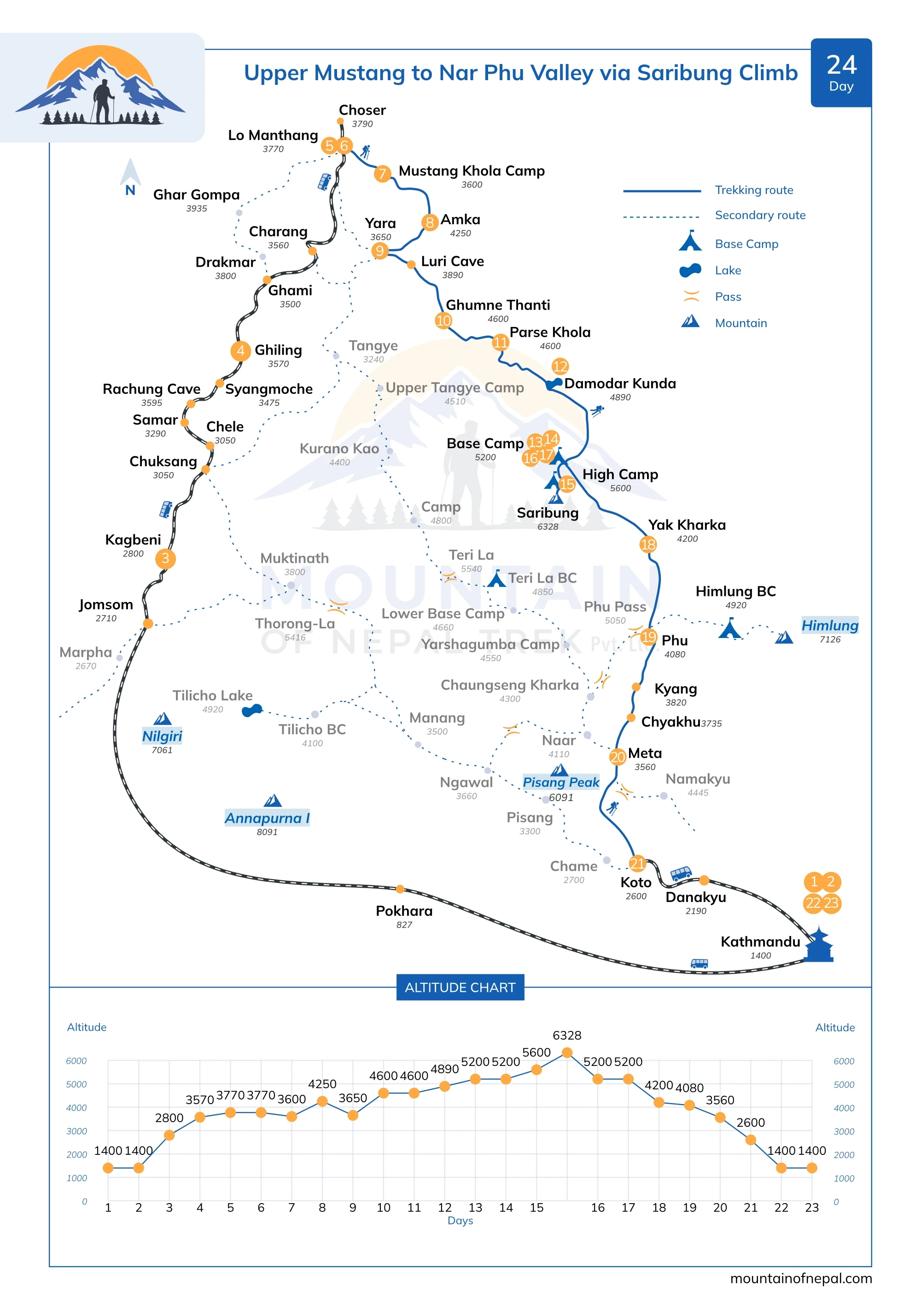
The journey begins in Kathmandu with expedition preparation and permit formalities, followed by a long drive through Pokhara to reach Kagbeni and onward into the barren landscapes of Upper Mustang. From ancient walled cities like Lo Manthang to high alpine valleys near Damodar Kunda, the route gradually ascends into extreme altitude terrain before reaching Saribung Base Camp and the summit push. After the peak, the route descends into Nar Phu Valley, exiting near Koto.
This expedition is both physically demanding and culturally enriching, offering rare access to Tibetan-influenced villages, high desert plateaus, glacial basins, and untouched Himalayan wilderness. The 24-day itinerary is carefully designed for acclimatisation and safety while maintaining a strong exploratory spirit.
- Crossing two restricted regions in one expedition
- Summit of Saribung Peak (6,328 m)
- Cultural immersion in Upper Mustang and Nar Phu
- Remote camping in high-altitude wilderness
- Operated by Mountain of Nepal with expert guides
Best Season for Upper Mustang to Nar Phu Valley via Saribung Climb
The best time to attempt the Upper Mustang to Nar Phu Valley via Saribung Peak expedition is during the pre-monsoon (spring) and post-monsoon (autumn) seasons. These windows offer the most stable weather conditions, clear skies, and safer glacier conditions for high-altitude climbing.
The spring season (April to June) is ideal for climbing Saribung Peak. During this period, temperatures are moderate at lower elevations, and the high Himalayan weather is relatively stable. Snow conditions are generally predictable, making glacier travel safer. This is also a period when the high passes between Upper Mustang and Nar Phu Valley are more accessible.
Autumn season (September to November) is equally popular, especially for trekkers who prefer crystal-clear mountain views after the monsoon. Visibility is excellent, and the landscapes of Upper Mustang appear more vibrant after seasonal rains. However, nights at higher camps like Saribung Base Camp and High Camp can be significantly colder.
Seasonal considerations:
- Spring: Stable snow conditions, warmer temperatures
- Autumn: Best visibility, dry trails, colder nights
- Winter: Extremely harsh, not recommended
- Monsoon: Risk of landslides in lower regions
The expedition avoids deep winter due to heavy snowfall and summer monsoon due to trail instability in the lower valleys. Mountain of Nepal schedules departures strategically in these optimal seasons to maximise safety and summit success rates.
Upper Mustang to Nar Phu Valley via Saribung Climb: Difficulty and Transportation
This expedition is considered very challenging to extreme difficulty, combining long-distance trekking, high-altitude acclimatisation, and technical glacier climbing. The ascent of Saribung Peak (6,328 m) requires basic mountaineering skills such as rope handling, crampon use, and ice axe techniques.
The route involves continuous elevation gain from Kagbeni (2,800 m) through Ghiling, Lo Manthang, and onward to remote wilderness zones like Damodar Kunda before reaching Base Camp (5,200 m). The summit push from High Camp (5,600 m) involves 10–11 hours of climbing and descent, making it physically and mentally demanding.
Transportation is a mix of long overland drives and trekking:
- Kathmandu to Pokhara: paved highway travel
- Pokhara to Kagbeni: rough mountainous roads
- Mustang road section: off-road 4WD jeep tracks
- Entire high-altitude section: fully trekking and camping based
Difficulty factors:
- Altitude above 6,000 m with thin oxygen
- Long walking days (6–8 hours average)
- Remote terrain with no rescue access nearby
- Glacier travel and crevasse risk
- Cold nighttime temperatures (-10°C to -25°C at high camps)
Key preparation points:
- Prior trekking experience above 4,000 m
- Physical endurance training (cardio + strength)
- Basic mountaineering skills are recommended
- Mental resilience for remote isolation
Mountain of Nepal provides experienced climbing guides, porters, oxygen support, and emergency protocols to ensure safety throughout the journey.
Food and Accommodation for Upper Mustang to Nar Phu Valley via Saribung Climb
Accommodation during the expedition varies from hotels in Kathmandu to basic teahouses in lower Mustang and full tented camping in high-altitude wilderness areas. In cities like Kathmandu and Pokhara, travellers stay in comfortable tourist-standard hotels with modern amenities. However, once the journey enters Upper Mustang and higher elevations, accommodation becomes simpler and more traditional.
In villages such as Kagbeni, Ghiling, and Lo Manthang, trekkers stay in local lodges or teahouses offering basic rooms with shared bathrooms. As the route progresses beyond Lo Manthang toward Saribung Base Camp and Nar Phu Valley, there are no permanent settlements, so Mountain of Nepal sets up fully equipped camping systems.
Food services include:
- Freshly cooked Nepali meals (dal bhat, vegetables, rice)
- Pasta, noodles, soups, and Tibetan bread in lodges
- High-calorie camping meals at high camps
- Tea, coffee, and hydration support at all stages
At higher altitudes, food is carefully planned to provide sufficient calories for energy expenditure. Cooking is handled by trained expedition cooks who prepare hygienic meals even in extreme conditions.
Accommodation types:
- Hotels: Kathmandu & Pokhara
- Teahouses: Lower Mustang villages
- Tented camps: Remote trekking & climbing sections
- High camp shelters: Fixed alpine tents with insulation
Mountain of Nepal ensures all logistics, including sleeping tents, dining tents, and kitchen setups, are fully managed to support safety and comfort in remote environments.
Upper Mustang to Nar Phu Valley via Saribung Climb Permits
Since this expedition passes through restricted and protected regions, multiple permits are required. Both Upper Mustang and Nar Phu Valley are classified as restricted areas by the Government of Nepal, requiring special documentation and licensed guide support. Additionally, Saribung Peak climbing requires a mountaineering permit issued by the Nepal Mountaineering Association (NMA).
Required permits include:
- Restricted Area Permit for Upper Mustang
- Restricted Area Permit for Nar Phu Valley
- Saribung Peak Climbing Permit (NMA)
- Annapurna Conservation Area Permit (ACAP)
- TIMS (Trekkers Information Management System) card
All permits must be arranged through a registered trekking agency such as Mountain of Nepal, as independent trekking is not allowed in these regions. The permits also help regulate tourism, preserve local culture, and ensure environmental protection in fragile Himalayan ecosystems.
Important regulations:
- Minimum two trekkers required for restricted area entry
- Mandatory licensed guide accompaniment
- Fixed entry and exit checkpoints
- Strict adherence to approved trekking routes
The permit system ensures safety and controlled access to these remote regions while supporting sustainable tourism and local communities.
Why Choose Upper Mustang to Nar Phu Valley via Saribung Climb with Mountain of Nepal
Choosing the Upper Mustang to Nar Phu Valley via Saribung Peak expedition with Mountain of Nepal ensures a professionally guided, well-supported, and safe Himalayan adventure. This expedition is not just a trek but a full-scale high-altitude mountaineering journey requiring logistics expertise, weather knowledge, and emergency preparedness.
Mountain of Nepal specialises in remote Himalayan expeditions and provides experienced climbing guides, Sherpa support, and carefully planned acclimatisation schedules. The company prioritises safety, environmental responsibility, and authentic cultural experiences throughout the journey.
Why this expedition stands out:
- Rare trans-Himalayan route linking Mustang and Nar Phu
- Summit experience of Saribung Peak (6,328 m)
- Professionally managed logistics and camping system
- Expert climbing and trekking guides
- Strong acclimatisation and safety planning
Additional advantages:
- Full support from arrival to departure in Kathmandu
- Emergency evacuation and communication systems
- High-quality camping equipment provided
- Cultural immersion in isolated Tibetan-influenced regions
- Personalised expedition management by Mountain of Nepal
This expedition is ideal for experienced trekkers and climbers seeking a remote, challenging, and culturally rich Himalayan adventure. With its combination of high-altitude climbing, desert-like landscapes of Upper Mustang, and pristine valleys of Nar Phu, it is considered one of Nepal’s most extraordinary expedition routes.
Trip Preparation
Trip Itinerary
Day 1 : Arrival in Kathmandu
Upon arrival at Tribhuvan International Airport in Kathmandu, a representative from Mountain of Nepal will welcome you and transfer you to your hotel in the city. After check-in, you can rest after your international flight or explore the vibrant streets of Thamel, known for trekking shops and cultural atmosphere. In the evening, there will be a short briefing about the upcoming expedition, including an overview of Upper Mustang, Saribung Peak, and Nar Phu Valley logistics. The team will also verify your equipment list and provide suggestions for any missing gear. Overnight stay in a comfortable hotel in Kathmandu.
Day 2 : Permits and expedition briefing in Kathmandu
Today is dedicated to official preparations with the Mountain of Nepal. Your climbing and trekking permits for Upper Mustang, Nar Phu Valley, and Saribung Peak will be processed, including restricted area permits and Annapurna Conservation Area entry permits. A detailed expedition briefing will take place with your guide, covering route overview, altitude challenges, safety protocols, and emergency procedures. You will also meet your climbing and trekking team. Final gear checks and shopping for any missing supplies will be completed. The rest of the day is free for relaxation or exploring cultural landmarks in Kathmandu.
Day 3 : Drive to Kagbeni (2,800 m) via Pokhara – approx. 10–12 hrs drive
The journey begins with a long scenic drive from Kathmandu to Kagbeni via Pokhara. You will travel along winding highways, rivers, terraced hills, and rural settlements, gradually entering the Himalayan region. After Pokhara, the road continues towards the Kali Gandaki Valley, one of the deepest gorges in the world. Kagbeni, the gateway to Upper Mustang, is a beautiful medieval-style village with Tibetan influence and strong winds. Upon arrival, you will check into a local teahouse and explore the village monastery. Overnight stay in Kagbeni, preparing for entry into the restricted Mustang region.
Day 4 : Drive to Ghiling (3,570 m) – approx. 7–8 hrs drive
After completing permit checks at the Upper Mustang entry point, you drive deeper into the restricted region towards Ghiling. The landscape gradually transforms into a barren, desert-like terrain with red cliffs, ancient caves, and dry riverbeds. You will pass through traditional villages like Tangbe and Chhusang, experiencing authentic Tibetan-influenced culture. Ghiling is a peaceful settlement surrounded by wide open valleys and distant snow peaks. On arrival, you will rest in a local lodge and acclimatize to increasing altitude. The evening is spent exploring the village and preparing for the journey toward Lo Manthang.
Day 5 : Drive to Lo Manthang (3,810 m) – approx. 6–7 hrs drive
Today’s drive takes you to the legendary walled city of Lo Manthang, the cultural capital of Upper Mustang. The road passes through dramatic desert landscapes, monasteries perched on cliffs, and ancient chortens. Upon arrival in Lo Manthang, you will immediately feel its unique Tibetan heritage, with narrow alleys, whitewashed walls, and centuries-old palaces. After check-in, there is time to rest and adjust to the altitude. The team from Mountain of Nepal will brief you about exploration routes around Choser Valley and upcoming trekking sections toward Mustang Khola.
Day 6 : Explore Lo Manthang & Choser – approx. 3–4 hrs walk/drive
This day is reserved for exploration and acclimatization. You will visit the ancient monasteries of Lo Manthang, the royal palace, and the surrounding villages. A short excursion to the Choser Cave area reveals ancient meditation caves carved into cliffs, believed to have been used by Buddhist monks for centuries. The unique desert landscape, prayer flags, and traditional Tibetan lifestyle make this day culturally enriching. Light walking and short drives help your body adjust to altitude. In the evening, your guide will prepare you for the trekking phase into more remote wilderness areas.
Day 7 : Trek to Mustang Khola Camp (3,600 m) – approx. 5 hrs walk
The trekking portion begins as you leave the village settlements behind and head toward Mustang Khola Camp. The trail descends gradually into isolated valleys, crossing dry riverbeds and rocky terrain. The silence of the region becomes more pronounced as you move away from inhabited areas. You will camp in a remote location near Mustang Khola, where the Mountain of Nepal crew will set up tents and prepare meals. This is your first night in a fully expedition-style camping environment, marking the beginning of the wilderness section of the journey.
Day 8 : Trek to Amka (4,250 m) – approx. 4–5 hrs walk
Today’s trail becomes more rugged as you gain altitude steadily toward Amka. The terrain consists of barren hills, loose scree, and occasional glacial streams. You will notice dramatic changes in the landscape, with snow-capped peaks becoming more visible. The climb is gradual but demanding due to thinning air. Amka serves as a remote camping site surrounded by vast open valleys. Upon arrival, the team sets up camp while you rest and hydrate. The evening briefing includes preparation for the upcoming high-altitude trek toward Yara and Ghuma Thanti.
Day 9 : Trek to Yara (3,650 m) – approx. 6 hrs walk
The trail descends slightly before climbing again toward Yara village. The route offers stunning views of eroded cliffs, deep canyons, and ancient fossil-rich formations. Yara is a traditional Mustang village with mud-brick houses and Buddhist shrines. You will experience local hospitality and a glimpse of Himalayan desert life. The trek is moderate but long, requiring steady pacing. Upon arrival, you can rest and explore the village surroundings. The Mountain of Nepal crew ensures comfortable accommodation in a teahouse or tented camp, depending on conditions.
Day 10 : Trek to Ghuma Thanti (4,600 m) – approx. 7–8 hrs walk
This is a challenging ascent into high-altitude wilderness. The trail climbs steeply through barren landscapes with minimal vegetation. You will cross remote ridges and frozen streams, gradually entering a more alpine environment. Ghuma Thanti is a seasonal high camp area used by trekkers and pilgrims heading toward Damodar Kund. The air becomes noticeably thinner, requiring careful pacing and hydration. Camping here provides a dramatic view of the surrounding Himalayan peaks. The expedition team from Mountain of Nepal ensures proper acclimatization support and warm meals.
Day 11 : Trek to Parse Khola (4,500–4,600 m) – approx. 4–5 hrs walk
The trail today follows remote valleys and glacial river systems toward Parse Khola. The route is less steep but still demanding due to altitude and terrain conditions. You will pass through isolated landscapes where only wildlife and occasional yak herders are seen. Parse Khola serves as a quiet camping area with strong winds and cold temperatures at night. The team prepares protective tents and hot meals to ensure recovery. This short trekking day helps the body adjust before reaching the sacred Damodar Kund region.
Day 12 : Trek to Damodar Kunda (4,890 m) – approx. 7 hrs walk
Today, you reach the sacred Damodar Kund, a high-altitude holy lake considered extremely important in Hindu and Buddhist traditions. The trail is spiritually significant and physically demanding, crossing rocky terrain and glacial moraines. Pilgrims often visit during specific seasons, but the region remains largely isolated. Upon arrival, you will witness stunning turquoise lakes surrounded by snow peaks. Camping near Damodar Kund is a memorable experience due to its spiritual energy and extreme remoteness. The Mountain of Nepal team ensures safety and comfort in this high-altitude sacred zone.
Day 13 : Trek to Base Camp (5,200 m) – approx. 3–4 hrs walk
A relatively short but steep ascent leads you to Saribung Base Camp. The landscape becomes fully alpine with glaciers, ice formations, and rugged rock fields. Upon arrival, you will see the towering Saribung Peak for the first time. The base camp is strategically set up with tents, a dining area, and safety equipment. The climbing guide conducts a full briefing for the summit push, including rope techniques and weather assessment. Rest and hydration are critical at this stage as oxygen levels are significantly lower.
Day 14 : Acclimatization at Base Camp
This day is reserved for acclimatization and technical preparation. You may take short hikes around base camp to adjust to altitude while practicing climbing skills such as rope handling, crampon use, and ice axe training. The guides from Mountain of Nepal ensure all climbers are fully prepared for summit day. Weather conditions are closely monitored. Mental and physical rest is emphasized, along with high-calorie meals and hydration. This preparation day is crucial for increasing summit success and minimizing altitude-related risks.
Day 15 : Trek to High Camp (5,600 m) – approx. 4–5 hrs walk
The route to High Camp involves glacier travel and steep ascent over icy terrain. Fixed ropes may be used depending on conditions. The environment becomes extremely cold and exposed, with strong winds and snow-covered landscapes. High Camp is set in a sheltered location near the climbing route to Saribung Peak. After arrival, climbers rest early in preparation for the summit push starting before dawn. The expedition team ensures all safety systems are in place.
Day 16 : Summit Saribung Peak (6,328 m) and return to Base Camp – approx. 10–11 hrs
Summit day begins early, typically around midnight or 1 AM. Climbers ascend through snow slopes, icy ridges, and technical sections using ropes and crampons. Reaching the summit of Saribung Peak offers breathtaking panoramic views of the Himalayas. After a short celebration and photographs, descent begins carefully back to High Camp and eventually Base Camp. This is the most physically demanding and rewarding day of the expedition. The Mountain of Nepal climbing team provides full technical and safety support throughout.
Day 17 : Contingency day (weather/rest)
This day is kept as a buffer for bad weather, delayed summit attempts, or extra rest after the climb. If the summit was already achieved, this day is used for recovery and packing. Weather conditions in high Himalaya are unpredictable, and flexibility is essential. The team evaluates the best route forward toward Nar Phu Valley. Mental relaxation and body recovery are prioritized.
Day 18 : Trek to Yak Kharka (4,200 m) – approx. 6–7 hrs walk
The descent begins toward lower valleys, gradually leaving the icy environment behind. The trail passes through glacial valleys, rocky ridges, and alpine meadows. Yak Kharka is a seasonal grazing area used by herders. The warmer oxygen-rich environment feels refreshing after high-altitude climbing. Camp is set in a scenic open valley surrounded by mountains.
Day 19 : Trek to Phu Gaon (4,080 m) – approx. 5–6 hrs walk
You enter the Nar Phu Valley region, a hidden Himalayan gem. The trail leads to Phu Gaon, a traditional Tibetan-style village with stone houses and ancient monasteries. The cultural richness of the region is striking. You can explore the village and interact with locals. The Mountain of Nepal crew ensures comfortable lodging in a teahouse or camp setup.
Day 20 : Trek to Meta (3,500 m) – approx. 6 hrs walk
The descent continues through dramatic canyon landscapes and narrow gorges. Meta serves as a transitional point between high valleys and lower trekking routes. The trail is scenic and diverse, with changing vegetation and river crossings. Overnight camp is set in Meta with views of the surrounding cliffs and mountains.
Day 21 : Trek to Koto (2,600 m) – approx. 6 hrs walk
Today marks the exit from the Nar Phu restricted area as you reach Koto. The trail becomes greener and more populated. You reconnect with the Annapurna Circuit route. The lower altitude brings relief after weeks of high-altitude exposure. A celebration dinner is organized by Mountain of Nepal to mark the successful completion of the expedition phase.
Day 22 : Drive to Kathmandu – approx. 9–10 hrs drive
A long scenic drive brings you back to Kathmandu through winding mountain roads and river valleys. You can reflect on the incredible journey from Upper Mustang to Saribung Peak and Nar Phu Valley. Upon arrival, transfer to the hotel for rest.
Day 23 : Free day in Kathmandu
A free day is available for rest, sightseeing, or shopping in Kathmandu. You may visit cultural sites, UNESCO heritage monuments, or simply relax after the demanding expedition. An optional celebratory dinner with the Mountain of Nepal team can be arranged in the evening.
Day 24 : Departure
Your journey concludes with a transfer to Tribhuvan International Airport for your onward flight. The Mountain of Nepal team will assist with airport arrangements and final farewells, marking the end of a remarkable Himalayan expedition crossing Upper Mustang, Saribung Peak, and Nar Phu Valley.
Inclusions
What is included?
- Airport transfers in Kathmandu.
- All ground transportation as per the itinerary.
- Hotel accommodation in Kathmandu with breakfast.
- Teahouse accommodations during the trek.
- All meals (breakfast, lunch, dinner) during the trek.
- Annapurna Conservation Area entry permit.
- Upper Mustang Restricted Area Permit
- Nar Phu Restricted Area Permit
- Saribung Peak Climbing Permit
- TIMS (Trekkers' Information Management System) card.
- Experienced, English-speaking trek guide.
- Porters to carry luggage (1 per 2 trekkers).
- Trekking map and group medical kit
- Welcome and farewell dinners in Kathmandu.
What isn't included?
- International flights to/from Kathmandu.
- Nepal entry visa fee.
- Mandatory travel insurance (including emergency rescue).
- Personal trekking equipment.
- Personal expenses (laundry, calls, internet, etc.).
- Alcoholic beverages and bottled water.
- Additional meals and beverages not specified.
- Tips for trekking staff
Complimentary