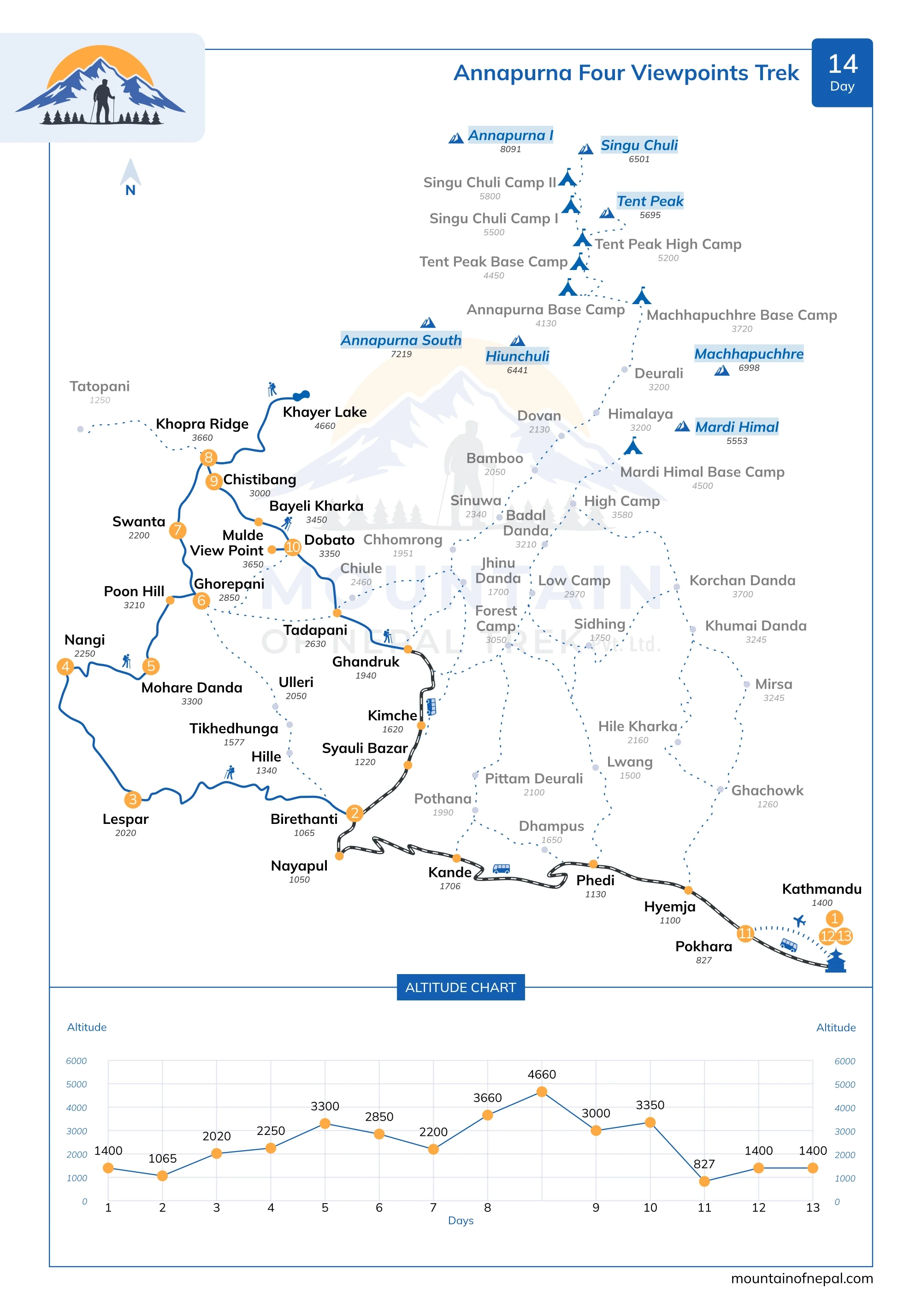
Annapurna Four Viewpoints Trek
| Trip code | |
| Package name | Annapurna Four Viewpoints Trek |
| Duration | 14 |
| Max. elevation | 3650 m |
| Level | Moderate |
| Transportation | Domestic flight and all ground transportation as per the itinerary |
| Accomodation | Hotel in Kathmandu and Pokhara, and Lodge / Tea House during trek |
| Starts at | Kathmandu |
| Ends at | Kathmandu |
| Trip route | |
| Cost | USD 0 per person |
Highlights
- Eco-community trail with sustainable tourism experience
- Rich biodiversity with rhododendron forests and wildlife
- Panoramic sunrise views of the Annapurna and Dhaulagiri ranges
- Peaceful and less crowded alternative viewpoint
- Famous sunrise viewpoint over the Annapurna & Dhaulagiri ranges
- Short hike from Ghorepani, ideal for classic Himalayan photography
- One of the most iconic viewpoints in Nepal
- Remote ridge with dramatic Himalayan panorama
- Optional trek to sacred Khayer Lake (alpine pilgrimage site)
- Quiet, off-the-beaten-path trekking experience
- Surrounded by deep valleys and towering peaks
- One of the widest panoramic viewpoints in the Annapurna region
- Views of 25+ Himalayan peaks, including Annapurna & Dhaulagiri ranges
- Excellent sunrise and sunset photography spot
- Walk through traditional villages like Nangi, Swata, and Ghandruk
- Authentic Gurung and Magar cultural immersion
- Local homestays, traditional meals, and warm hospitality
- Mix of terraced farmlands, alpine meadows, forests, and ridgelines
- Balance of popular trails and quiet, untouched routes
- Constantly changing landscapes throughout the trek
Mohare Danda (3,300 m / 10,827 ft)
Poon Hill (3,210 m / 10,531 ft)
Khopra Danda (3,660 m / 11,811 ft)
Mulde Viewpoint / Dobato (3,650 m / 11,975 ft)
Cultural & Village Experiences
Scenic Diversity
Overview
The Annapurna Four Viewpoints Trek is a scenic trekking journey in the Annapurna region of Nepal that connects four iconic vantage points: Mohare Danda, Poon Hill, Khopra Danda, and Mulde Peak, offering some of the best panoramic Himalayan views. The route passes through traditional villages, dense rhododendron forests, terraced farmlands, and high alpine ridges, creating a perfect blend of culture and nature. The trek is designed to provide multiple sunrise and sunset viewpoints of the Annapurna and Dhaulagiri mountain ranges.
This itinerary starts from the bustling capital city of Kathmandu and travels through Pokhara before entering remote mountain trails. Key destinations like Ghorepani, Poon Hill, Mohare Danda, Khopra Danda, and Mulde Peak form the backbone of the trek.
- Four major Himalayan viewpoints in one trek
- Cultural village experience in the Magar and Gurung communities
- Sunrise views of Annapurna & Dhaulagiri ranges
- Eco-community lodge trekking experience
Best Season for Annapurna Four Viewpoints Trek
The best time to undertake the Annapurna Four Viewpoints Trek is during spring (March–May) and autumn (September–November). In spring, the entire trail blooms with vibrant rhododendron flowers, while autumn offers crystal-clear skies and the most stable weather conditions. These seasons provide the best visibility for Himalayan peaks and comfortable trekking temperatures.
Winter (December–February) is also possible, but it can be cold at higher elevations like Khopra Danda and Mohare Danda. Snow may block trails near viewpoints, but it offers a peaceful, less crowded experience. The monsoon season (June–August) is generally not recommended due to slippery trails, leeches, and limited mountain visibility.
Short Highlights:
- Best seasons: Spring & Autumn
- Clear mountain views and stable weather
- Winter trekking possible with preparation
- Monsoon trekking is not recommended
Annapurna Four Viewpoints Trek Difficulty and Transportation
The Annapurna Four Viewpoints Trek is considered moderate to moderately challenging. It involves daily walking of 5–8 hours through steep ascents, stone steps, and high ridgelines. The highest elevation reaches around 3,650 meters at Mulde Peak, so altitude adaptation is important, though the risk of severe altitude sickness is relatively low compared to higher Himalayan treks.
Transportation begins with a drive from Kathmandu to Pokhara, followed by a journey to Nayapul. From there, trekking starts toward Birethanti and continues through remote villages. The return leg includes a descent to Ghandruk, followed by a drive back to Pokhara and onward transport to Kathmandu.
Short Highlights:
- Moderate difficulty with daily 5–8 hour walks
- Maximum altitude: ~3,650m
- A mix of trekking and road transport
- Requires basic fitness and stamina
Food and Accommodation for Annapurna Four Viewpoints Trek
Accommodation on this trek is primarily in community lodges and teahouses, which are simple but comfortable. Villages like Nangi Village, Khopra Danda, and Ghorepani offer basic rooms with twin beds, shared bathrooms, and warm dining halls. In higher elevations, facilities become more rustic, but hospitality remains warm and welcoming.
Food is freshly prepared and typically includes Nepali staples like dal bhat (rice, lentils, vegetables), noodles, soups, potatoes, and Tibetan bread. In lower villages, menus are more varied, while higher regions focus on energy-rich meals. Hot drinks like tea, coffee, and ginger lemon honey are widely available to keep trekkers warm.
Short Highlights:
- Community-run teahouse accommodation
- Basic but clean and cozy rooms
- Traditional Nepali meals (dal bhat, soups, noodles)
- Hot drinks available throughout the trail
Annapurna Four Viewpoints Trek Permits
To trek in the Annapurna region, trekkers need two essential permits: the Annapurna Conservation Area Permit (ACAP) and the Trekkers’ Information Management System (TIMS) card. These permits help regulate tourism and support conservation efforts in the region.
The trekking agency Mountain of Nepal handles all permit arrangements for travelers, ensuring a smooth and hassle-free process. Permits are checked at multiple entry points along the trail, especially near conservation checkpoints in villages like Birethanti and Ghorepani.
Short Highlights:
- ACAP permit required
- TIMS card mandatory
- Checked at multiple trekking checkpoints
- Arranged by Mountain of Nepal
Why Choose Annapurna Four Viewpoints Trek
The Annapurna Four Viewpoints Trek is unique because it combines four major Himalayan viewpoints in one route, offering diverse perspectives of the Annapurna and Dhaulagiri ranges. Unlike standard treks, this itinerary is less crowded and emphasizes community-based eco-tourism, making it more sustainable and culturally immersive.
Choosing Mountain of Nepal ensures professional guidance, experienced local guides, well-planned logistics, and safety-focused trekking support. The company also promotes responsible tourism by staying in community lodges and supporting local villages throughout the route.
Short Highlights:
- Four iconic viewpoints in one trek
- Less crowded and eco-friendly route
- Rich cultural immersion in mountain villages
- Safe and organized trekking with Mountain of Nepal
- Stunning sunrise and panoramic Himalayan views
Trip Preparation
Trip Itinerary
Day 1 : Arrival in Kathmandu
Upon arrival in Kathmandu, a representative from Mountain of Nepal will welcome you at the airport and transfer you to your hotel in the city center. After check-in, you can rest or take a light walk around the bustling streets of Thamel, known for trekking shops and cultural energy. In the evening, a short briefing session is conducted regarding the Annapurna Four Viewpoints Trek itinerary, safety guidelines, and trekking preparation. This day is important for recovery after travel and for adjusting to Nepal’s atmosphere before the adventure begins.
Day 2 : Drive to Pokhara – Drive to Nayapul and trek to Birethanti
After an early breakfast, you drive from Kathmandu to Pokhara, enjoying scenic highway views of rivers, hills, and rural settlements. From Pokhara, the journey continues by road to Nayapul and then a short trek begins toward Birethanti. The trail follows riverside paths, small bridges, and terraced fields. This gentle hiking introduction helps your body gradually adapt to trekking conditions. Overnight stay in a local teahouse offers a peaceful rural atmosphere, where you experience traditional Nepali hospitality and prepare mentally for the higher elevations ahead.
Day 3 : Trek to Lespar (2,020 m) – approx. 7–8 hrs
Today’s trek takes you deeper into quieter hills as you move toward Lespar. The trail gradually ascends through forests, small Gurung settlements, and farmland. You will notice fewer crowds compared to mainstream trekking routes, making the experience more immersive and natural. The hike usually takes 7–8 hours, depending on pace and weather conditions. Along the way, you can observe daily rural life, yak grazing areas, and panoramic hillside views. Overnight at Lespar offers a calm environment surrounded by nature, ideal for rest and acclimatization.
Day 4 : Trek to Nangi Village (2,250 m) – approx. 5–6 hrs
The trail continues through forested ridges and scenic hill paths toward Nangi Village. This village is known for community tourism initiatives and sustainable living practices. The trek takes approximately 5–6 hours and includes gradual ascents and occasional descents. You will pass through rhododendron forests and enjoy wide views of the surrounding valleys. Upon arrival, you may interact with local villagers involved in eco-projects, schools, and handicrafts. An overnight stay in a community lodge provides a meaningful cultural exchange experience while supporting local development.
Day 5 : Trek to Mohare Danda (3,300 m) – approx. 5–6 hrs
Today’s journey leads to one of the most rewarding viewpoints of the trek, Mohare Danda. The trail becomes steeper, passing through dense forests filled with birds and seasonal flowers. As you ascend, Himalayan views gradually open up, revealing peaks of the Annapurna and Dhaulagiri ranges. The 5–6 hour trek is physically demanding but highly rewarding. At the top, panoramic sunset views create a memorable experience. Overnight at Mohare Danda offers one of the best mountain sunrise and sunset perspectives in the entire region.
Day 6 : Trek to Poon Hill (3,210 m) – approx. 3 hrs, then continue to Ghorepani
Early morning begins with a hike to Poon Hill to witness one of Nepal’s most iconic sunrises over the Annapurna and Dhaulagiri ranges. After spending time at the viewpoint, you descend and continue trekking toward Ghorepani. The trail passes through forests and stone stairways, taking about 3 hours total after the viewpoint visit. Ghorepani is a lively trekking settlement with teahouses and mountain views. The evening is free to relax and recover from the early morning climb.
Day 7 : Trek to Swata Village – approx. 7–8 hrs
Today’s trail moves toward the quieter and less-traveled region of Swata Village. The trek is long, around 7–8 hours, but rewarding in terms of cultural exposure and natural beauty. You walk through forests, terraced farmland, and small hillside communities. The absence of heavy tourist traffic allows a more authentic experience of rural Nepal. You will likely encounter friendly locals engaged in agriculture and livestock farming. Overnight in Swata Village offers a peaceful environment with simple but warm hospitality, surrounded by green hills and fresh mountain air.
Day 8 : Trek to Khopra Danda – approx. 5–6 hrs
The journey continues upward toward Khopra Danda, one of the highlights of the trek. The trail ascends steeply through rhododendron forests and alpine landscapes. Depending on the pace, the trek takes around 5–6 hours. As you reach the ridge, breathtaking panoramic views of Annapurna South, Nilgiri, and Dhaulagiri ranges open up. The isolated setting makes Khopra Danda a peaceful high-altitude retreat. Sunset views here are particularly stunning, and the lodge stay provides a memorable Himalayan experience above the clouds.
Day 9 : Trek to Khayer Lake and return to Chistibung (3,000 m) – approx. 7–8 hrs
Today is a challenging but rewarding excursion toward Khayer Lake. The trail involves steep climbs, rocky terrain, and high-altitude walking. After reaching the sacred lake, you return to Chistibung for an overnight stay. The total trek takes around 7–8 hours. The lake is considered spiritually significant and offers dramatic mountain reflections. Chistibung provides a simple but comfortable resting place surrounded by alpine meadows and grazing animals.
Day 10 : Trek to Dobato / Mulde Peak (3,650 m) – approx. 6–7 hrs
Today’s route ascends toward Dobato and continues toward Mulde Peak. The 6–7 hour trek is filled with forest trails, ridgelines, and occasional steep sections. Mulde Peak is one of the best vantage points in the region, offering 360-degree views of the Annapurna and Dhaulagiri ranges. The sunset and sunrise from here are exceptional, making it a highlight for photography and mountain appreciation. Overnight stay provides a quiet, high-altitude experience surrounded by alpine silence.
Day 11 : Trek to Ghandruk Village (1,940 m) – approx. 7 hrs, then drive to Pokhara (approx. 2.5 hrs)
The trail descends toward Ghandruk Village, a culturally rich settlement known for stone houses and mountain views. The trek takes about 7 hours through forests and terraced landscapes. Upon arrival, you explore the village and enjoy views of Annapurna South and Machhapuchhre. After lunch, you drive approximately 2.5 hours back to Pokhara. The evening in Pokhara allows you to relax near Lakeside, enjoy restaurants, and celebrate the completion of the trekking section.
Day 12 : Drive or fly back to Kathmandu
After breakfast, you either take a scenic drive or a short flight back to Kathmandu. The drive offers countryside views, while the flight provides quick and panoramic Himalayan scenery. Upon arrival, you are transferred to your hotel. The rest of the day is free for rest, souvenir shopping, or optional sightseeing around heritage sites. Mountain of Nepal ensures smooth logistics for your return journey, allowing you to transition comfortably from trekking mode to city life.
Day 13 : Free day in Kathmandu
This day is reserved for rest or optional exploration in Kathmandu. You may visit UNESCO heritage sites like temples, stupas, or local markets. Alternatively, you can enjoy cafes, spa treatments, or cultural shows. This buffer day is important in case of delays or simply to relax after the demanding trek. The Mountain of Nepal team can also arrange guided sightseeing tours if requested. It is a perfect opportunity to reflect on the journey and enjoy Nepal’s cultural richness.
Day 14 : Departure
On the final day, you are transferred to the airport for your international departure. The Mountain of Nepal representative assists with the final check-out and ensures a timely arrival at the terminal. As you leave Nepal, you carry unforgettable memories of the Annapurna Four Viewpoints Trek—ranging from lush forests and remote villages to high Himalayan panoramas. The journey offers both natural beauty and cultural depth, making it one of the most rewarding trekking experiences in the Annapurna region.
Inclusions
What is included?
- Airport transfers in Kathmandu.
- All ground transportation as per the itinerary.
- Hotel accommodation in Pokhara / Kathmandu with breakfast.
- Teahouse accommodations during the trek.
- All meals (breakfast, lunch, dinner) during the trek.
- Annapurna Conservation Area entry permit.
- TIMS (Trekkers' Information Management System) card.
- Experienced, English-speaking trek guide.
- Porters to carry luggage (1 per 2 trekkers).
- Trekking map and group medical kit
- Welcome and farewell dinners in Kathmandu.
What isn't included?
- International flights to/from Kathmandu.
- Nepal entry visa fee.
- Mandatory travel insurance (including emergency rescue).
- Personal trekking equipment.
- Personal expenses (laundry, calls, internet, etc.).
- Alcoholic beverages and bottled water.
- Additional meals and beverages not specified.
- Tips for trekking staff.
Complimentary