The Ama Dablam Expedition (6,856m) is one of the most iconic and technically challenging climbing adventures in the Himalayas, organised professionally by Mountain of Nepal. Known for its striking pyramid-shaped peak, Ama Dablam is often considered one of the most beautiful mountains in the world. The expedition combines trekking through the legendary Everest region with high-altitude mountaineering that demands both physical endurance and technical climbing skills. Climbers experience a gradual ascent through Sherpa villages, alpine forests, and glacial terrain before reaching the advanced base camp and higher camps.
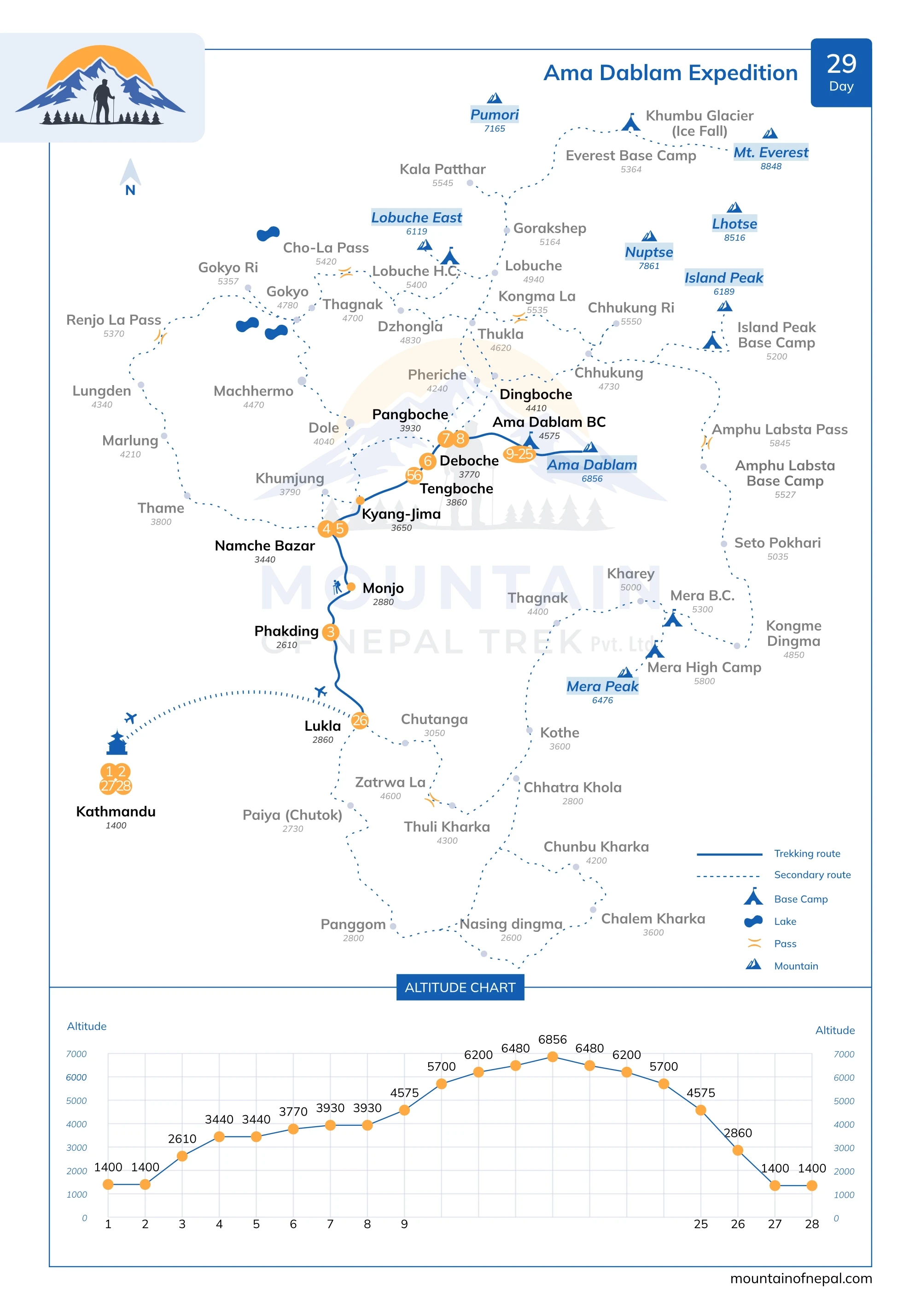
This expedition is not just a climb but a complete Himalayan experience. Participants begin their journey in Kathmandu and gradually move through the Khumbu region, following classic trekking routes like Namche Bazaar, Tengboche, and Pangboche before diverting toward Ama Dablam Base Camp. From there, the real mountaineering phase begins, involving fixed rope climbing, steep ice walls, and exposed ridges. Mountain of Nepal ensures proper acclimatisation, safety protocols, and professional guidance throughout the expedition, making it suitable for experienced climbers aiming for a serious Himalayan challenge.
The best time to attempt the Ama Dablam Expedition is during the pre-monsoon (spring) and post-monsoon (autumn) seasons, when weather conditions in the Himalayas are relatively stable. Spring, from March to May, offers warmer temperatures, longer daylight hours, and excellent visibility of surrounding peaks. This is also when climbers witness blooming rhododendron forests in lower elevations, adding beauty to the trekking portion. Autumn, from September to November, is considered the most stable season with clear skies and minimal precipitation, making it ideal for summit attempts.
During winter and monsoon seasons, climbing becomes highly risky due to heavy snowfall, avalanches, and unpredictable weather patterns. Mountain of Nepal carefully selects expedition windows to maximise safety and summit success rates. Weather plays a critical role in high-altitude climbing, especially on Ama Dablam, where exposed ridges require stable wind conditions and good visibility. Expedition schedules are often flexible to accommodate sudden weather changes, ensuring climbers get the best possible summit opportunity.
Key Highlights:
The Ama Dablam Expedition is classified as a technically demanding climb, suitable only for climbers with prior high-altitude experience. Unlike trekking peaks, Ama Dablam involves exposed ridges, steep ice faces, and fixed rope sections that require strong climbing techniques. The “Dablam” hanging glacier and the Yellow Tower are particularly challenging sections that test both physical strength and mental endurance. Proper acclimatisation and rope skills are essential for safety and success.
Transportation for this expedition begins with a flight from Kathmandu to Lukla, one of the most adventurous airstrips in the world. From Lukla, trekkers move on foot through the Everest region to reach Ama Dablam Base Camp. Mountain of Nepal manages all logistics, including domestic flights, porters, guides, and equipment transport. Helicopter evacuation support is also arranged in case of emergencies. The combination of remote terrain and altitude makes transportation an integral part of expedition planning.
Key Highlights:
Food and accommodation during the Ama Dablam Expedition vary depending on altitude. In Kathmandu and lower trekking regions, climbers stay in comfortable hotels and traditional teahouses offering a wide range of meals. As the trek progresses toward higher altitudes, accommodation becomes simpler, with basic lodges and tented camps providing essential shelter. At Ama Dablam Base Camp, climbers stay in fully equipped expedition tents managed by Mountain of Nepal, ensuring warmth and safety in extreme conditions.
Meals are carefully planned to maintain the high energy levels required for climbing. In lower regions, menus include Nepali, Tibetan, and international dishes such as rice, pasta, soups, and vegetables. At higher camps, food is more simplified but highly nutritious, focusing on carbohydrates and proteins to support endurance. Expedition cooks from Mountain of Nepal ensure hygienic preparation even in remote environments. Hydration and calorie intake are closely monitored by guides to maintain climber health.
Key Highlights:
To climb Ama Dablam, several official permits are required, all of which are managed by Mountain of Nepal to ensure a smooth expedition process. The primary permit is the Ama Dablam Climbing Permit, issued by the Nepal Mountaineering Association (NMA). Additionally, climbers must obtain a Sagarmatha National Park Entry Permit, as the route passes through protected areas of the Everest region. A Khumbu Pasang Lhamu Rural Municipality Permit is also required for trekking in the local region.
These permits are essential not only for legal compliance but also for environmental conservation and safety regulation in the Himalayas. The fees contribute to maintaining trails, protecting wildlife, and supporting local communities. Mountain of Nepal handles all paperwork, documentation, and government coordination, allowing climbers to focus entirely on preparation and training. Proper permit management also ensures access to emergency services and official climbing support systems in the region.
Key Highlights:
Choosing the Ama Dablam Expedition with Mountain of Nepal ensures a professionally organised, safe, and enriching Himalayan experience. The company is known for its experienced Sherpa guides, strong safety standards, and personalised expedition planning. Climbers benefit from detailed acclimatisation schedules, technical training at base camp, and continuous monitoring throughout the climb. This significantly increases summit success rates while reducing risks associated with high-altitude mountaineering.
Beyond climbing, this expedition offers a deep cultural experience in the Everest region. Participants explore ancient monasteries, Sherpa villages, and breathtaking landscapes while learning about Himalayan traditions. Mountain of Nepal focuses on responsible tourism, ensuring minimal environmental impact and fair support to local communities. The combination of adventure, safety, and cultural immersion makes this expedition one of the most rewarding mountaineering journeys in Nepal.
Key Highlights:
Upon arrival in Kathmandu, you will be warmly welcomed by the Mountain of Nepal expedition team and transferred to your hotel. The vibrant capital offers a unique blend of ancient culture and modern energy, visible immediately as you travel through bustling streets filled with temples, markets, and local life. After hotel check-in, you will have time to rest and recover from your journey. In the evening, a welcome briefing is held where you meet your expedition leader, guides, and fellow climbers. This session covers expedition logistics, safety protocols, and an overview of the climb. A traditional Nepali welcome dinner is often arranged, giving you your first taste of local hospitality before your Himalayan adventure begins.
This day is dedicated to cultural immersion and final preparations for the expedition. You will visit UNESCO World Heritage Sites such as Pashupatinath Temple and Boudhanath Stupa, experiencing Nepal’s spiritual heritage firsthand. The sightseeing tour also helps you mentally transition into the journey ahead. Afterward, you’ll return to your hotel for gear inspection and packing. Your guides from Mountain of Nepal will carefully check your climbing equipment, ensuring everything meets safety standards. Any missing or faulty gear can be rented or purchased in Kathmandu. The rest of the day is spent organizing your duffel bags and preparing for the flight to Lukla. A final briefing ensures everyone is fully ready for the trek.
You’ll take an early morning flight to Lukla, one of the most thrilling airstrips in the world. The short yet scenic flight offers breathtaking views of the Himalayan range. Upon landing, you meet your trekking crew and begin your journey toward Phakding. The trail is relatively gentle, passing through small Sherpa villages, mani walls, and suspension bridges over the Dudh Koshi River. This first trekking day allows your body to ease into the rhythm of hiking. The environment is lush with pine forests and mountain streams, offering a peaceful introduction to the Everest region. You’ll spend the night in a comfortable teahouse, enjoying your first experience of mountain hospitality.
Today’s trek takes you deeper into the Khumbu region, following the river and crossing several suspension bridges, including the famous Hillary Bridge. After entering Sagarmatha National Park, the trail begins a steep ascent toward Namche Bazaar. This is one of the most challenging days so far, as you gain significant altitude. Along the way, you may catch your first glimpse of Mount Everest on a clear day. Namche Bazaar is a vibrant mountain town with shops, bakeries, and stunning mountain views. After arrival, you can explore the town or simply relax and acclimatize. Proper hydration and rest are essential to prepare for higher elevations ahead.
Acclimatization is crucial for a successful expedition, and today is designed to help your body adjust to the altitude. Rather than resting completely, you’ll take a short hike to higher elevations such as the Everest View Hotel or nearby ridges, then return to Namche. This “climb high, sleep low” strategy aids in adaptation. You’ll also have time to explore Namche Bazaar further, visiting local museums or cafes. The panoramic views of Himalayan giants, including Everest, Lhotse, and Ama Dablam, are spectacular. Your guides from Mountain of Nepal will monitor your health closely, ensuring you are adapting well before continuing the journey.
Leaving Namche, the trail contours along the mountainside, offering stunning views of peaks including Ama Dablam. You’ll pass through Tengboche, home to the famous monastery, before descending into the forested area of Deboche. The trail includes both gradual paths and steep sections, requiring steady pacing. The serene environment of Deboche, surrounded by rhododendron forests and mountains, provides a peaceful resting place. This day balances physical effort with rewarding scenery, gradually bringing you closer to your expedition destination.
The trek continues through alpine landscapes as you head toward Pangboche, one of the oldest Sherpa settlements in the region. The trail climbs steadily, offering incredible views of Ama Dablam, which now appears closer and more imposing. Pangboche is known for its traditional culture and monastery, giving insight into Sherpa heritage. The altitude gain becomes more noticeable, so maintaining a slow and steady pace is essential. Upon arrival, you’ll settle into your lodge and prepare for further acclimatization.
Another acclimatization day ensures your body adapts properly before heading to base camp. You may take short hikes to nearby ridges or simply rest and hydrate. This is also a great opportunity to observe Ama Dablam up close and mentally prepare for the climb ahead. Your guides will continue monitoring your condition, offering advice on nutrition and hydration. These acclimatization days significantly increase the success rate of high-altitude expeditions.
Today, you leave the main Everest trail and head toward Ama Dablam Base Camp. The route is quieter and more rugged, offering a true expedition feel. As you approach base camp, Ama Dablam dominates the skyline with its striking ridges. Base Camp is set in a spectacular location surrounded by towering peaks. Upon arrival, you’ll settle into tents and begin your climbing phase preparations. The atmosphere here is focused yet exciting, marking the transition from trekking to mountaineering.
This day is dedicated to training and final preparation. Under the guidance of Mountain of Nepal’s experienced climbing team, you’ll practice rope techniques, the use of crampons, ice axes, and safety procedures. This training ensures all climbers are confident with the technical aspects of the climb. You’ll also review the route, discuss weather conditions, and finalize climbing strategies. Adequate rest and nutrition are essential as you prepare for the demanding days ahead.
The climbing phase spans approximately two weeks, involving rotations between camps for acclimatization and summit preparation. You’ll ascend from Base Camp to Camp I (5,700m), navigating technical terrain that requires strength and skill. From Camp I, you move to Camp II using fixed ropes, ensuring safety on steep sections. The route to Camp III involves mixed climbing on rock, snow, and ice, demanding careful technique. From Camp III, you make the final summit push on Ama Dablam. The summit rewards you with breathtaking views of Everest, Lhotse, and the surrounding peaks. After summiting, you descend carefully back to Base Camp, with rest periods and rotations ensuring safety and success.
After completing the Ama Dablam expedition, you begin your long descent back toward Lukla. The trail retraces familiar paths through alpine forests, suspension bridges, and traditional Sherpa villages. Although descending is physically easier due to reduced altitude, it still demands caution as fatigue from the expedition may linger. The journey feels emotionally reflective, as you pass landscapes that witnessed your climbing efforts and challenges. You’ll likely encounter fellow trekkers and locals, sharing smiles and greetings along the way. As you approach Lukla, a sense of achievement builds, marking the transition from high-altitude adventure back toward civilization and comfort.
An early morning flight from Lukla brings you back to the capital city, Kathmandu. This short yet dramatic flight offers one final panoramic view of the Himalayas, including the towering peaks of the Khumbu region you just explored. Weather conditions can influence departure times, so flexibility is essential. Upon landing in Kathmandu, a representative from Mountain of Nepal greets you and transfers you to your hotel. The return to city life feels surreal after weeks in the mountains. A hot shower, comfortable accommodation, and a celebratory dinner provide well-deserved relaxation. The evening is often spent sharing expedition memories and celebrating the successful summit of Ama Dablam.
This optional leisure day allows you to unwind fully after the physically and mentally demanding expedition. Kathmandu offers a vibrant mix of culture, history, and modern attractions. You may choose to explore local markets in Thamel, visit heritage sites, or simply relax at your hotel. Many climbers enjoy souvenir shopping, picking up handmade crafts, prayer flags, or trekking gear as keepsakes. Others prefer visiting cultural landmarks or enjoying traditional Nepali cuisine in local restaurants. This day also provides time to reflect on your journey to Ama Dablam, absorbing the achievement of reaching one of the world’s most iconic peaks with Mountain of Nepal.
Your Himalayan adventure officially concludes today. After breakfast, a representative from Mountain of Nepal will transfer you to Tribhuvan International Airport for your onward journey. As you depart, you carry unforgettable memories of trekking through the Khumbu region, standing at Ama Dablam Base Camp, and experiencing the thrill of a high-altitude expedition. The journey leaves a lasting impression of Nepal’s natural beauty, cultural richness, and mountaineering spirit. Though the expedition ends here, the experience often inspires future adventures in the Himalayas, creating a lifelong connection to the mountains and the people who call them home.
Your Start Date is the day you land in Nepal, and your End Date is when you fly home.
If the set Ama Dablam Expedition group dates don’t suit your schedule, we can offer alternative dates upon request.
The Ama Dablam Expedition is considered a highly technical and challenging climb, suitable only for experienced mountaineers with prior high-altitude climbing background. The route involves steep rock, ice, and mixed terrain requiring proficiency in using ropes, crampons, and ice axes. Although it is not as high as Everest, its technical sections make it more demanding in certain areas. Climbers must have strong physical fitness, mental endurance, and prior experience above 6,000 meters. The Mountain of Nepal ensures proper training and guidance, but participants should be fully prepared for a serious Himalayan mountaineering adventure.
Yes, prior climbing experience is essential for participating in the Ama Dablam Expedition. Climbers should have completed at least one or more peaks above 6,000 meters and be familiar with technical climbing skills. Experience with fixed rope systems, glacier travel, and high-altitude acclimatization is highly recommended. Ama Dablam is not a beginner-friendly mountain due to its steep sections and exposure. Mountain of Nepal evaluates each climber’s experience before confirmation to ensure safety and expedition success, providing additional training at base camp if needed.
The full Ama Dablam Expedition typically lasts around 25 to 30 days, depending on weather conditions and acclimatization needs. This includes arrival in Kathmandu, trekking to base camp, acclimatization rotations, climbing periods, summit attempt, and return. The climbing phase alone usually takes 12 to 15 days, including rotations between Camp I, Camp II, and Camp III. Mountain of Nepal designs the itinerary carefully to ensure proper rest, safety, and acclimatization, which significantly increases the chances of a successful summit while minimizing altitude-related risks.
Yes, altitude sickness is a real risk on Ama Dablam due to its high elevation reaching 6,856 meters. Symptoms can include headache, nausea, dizziness, and fatigue. Proper acclimatization is critical, which is why the itinerary includes multiple rest and rotation days. Climbers are closely monitored by experienced guides from Mountain of Nepal throughout the expedition. Emergency protocols, including descent and oxygen support if necessary, are in place. Following a gradual ascent, staying hydrated, and listening to the body significantly reduces the risk of altitude-related complications.
Choosing Mountain of Nepal ensures a highly professional and well-supported climbing experience in the Himalayas. The company is known for experienced guides, strong safety standards, and personalized expedition planning. Their team provides full logistical support from arrival in Nepal to the summit and return. They emphasize proper acclimatization, high-quality base camp services, and technical training for climbers. With a strong success rate and deep knowledge of Himalayan expeditions, Mountain of Nepal is a trusted choice for climbers aiming to summit Ama Dablam safely and successfully.
The best seasons for the Ama Dablam Expedition are spring (April to May) and autumn (September to November). During these periods, weather conditions are generally stable, skies are clear, and visibility is excellent for climbing and photography. Spring offers warmer temperatures and blooming rhododendrons, while autumn provides crisp air and highly reliable weather windows. Winter and monsoon seasons are not recommended due to heavy snowfall, strong winds, and unstable conditions. Mountain of Nepal carefully schedules expeditions during optimal seasons to maximize safety and summit success rates.
Accommodation varies throughout the expedition. In Kathmandu, climbers stay in comfortable tourist-standard hotels with modern amenities. During the trekking phase, accommodation is provided in teahouses or lodges offering basic but warm facilities. At Ama Dablam Base Camp and higher camps, climbers stay in high-quality expedition tents equipped with sleeping mats, dining tents, and kitchen support. Mountain of Nepal ensures all camps are well-organized, clean, and safe, with experienced staff managing food preparation and logistics to maintain comfort in extremely high-altitude conditions.
Meals are fully provided during trekking and climbing phases. The menu typically includes nutritious and high-energy foods such as rice, pasta, noodles, vegetables, soups, eggs, and local Nepali dishes like dal bhat. At higher camps, meals are specially prepared to support altitude performance, focusing on calories, hydration, and digestion-friendly foods. Fresh food is supplied whenever possible, and hygiene is strictly maintained by the expedition kitchen team. Mountain of Nepal prioritizes balanced nutrition to ensure climbers remain strong and energized throughout the demanding ascent.
Climbers are required to bring personal high-altitude gear such as insulated clothing, mountaineering boots, crampons, harness, helmet, down jacket, sleeping bag, and gloves. Technical climbing equipment like ropes, ice screws, and ladders is generally provided by the expedition team. Mountain of Nepal provides a detailed equipment checklist before departure to ensure every climber is fully prepared. Proper gear is essential for safety and performance in harsh mountain conditions. Rental options are also available in Kathmandu for those who need additional equipment.
Safety is the highest priority during the Ama Dablam Expedition. Mountain of Nepal employs experienced certified climbing guides and Sherpa teams who are highly familiar with the mountain’s terrain and risks. Safety systems such as fixed ropes, weather monitoring, and emergency evacuation plans are strictly followed. Regular health checks are conducted to monitor climbers’ condition. While high-altitude climbing always carries inherent risks, careful planning, proper acclimatization, and professional support significantly reduce dangers and increase the chances of a safe and successful summit.


 (2)
(2)  100% recommend (0)
 (0)
(0)