The Kanchenjunga Circuit Trek is one of the most remote, adventurous, and culturally rich trekking experiences in eastern Nepal. Organised by Mountain of Nepal, this journey explores the majestic landscapes surrounding the world’s third-highest peak, Mt. Kanchenjunga (8,586m). The route combines both the North Base Camp (Pangpema) and South Base Camp (Oktang), offering a complete circuit of the Kanchenjunga Conservation Area.
This 23-day itinerary begins with your arrival in Kathmandu, followed by a scenic flight to Bhadrapur and a drive to Ilam and Taplejung—the gateway to the eastern Himalayas. From Taplejung, the trekking route gradually ascends through lush forests, traditional Limbu and Rai villages, river valleys, and high alpine terrain before reaching the glacier-filled base camps.
Throughout the journey, trekkers experience untouched natural beauty, rare wildlife such as red pandas and Himalayan black bears, and deep cultural immersion in isolated mountain communities.
This trek is ideal for adventure seekers looking for a raw and authentic Himalayan experience far from commercial trekking routes.
The best time to undertake the Kanchenjunga Circuit Trek is during the pre-monsoon (spring) and post-monsoon (autumn) seasons. These periods provide the most stable weather conditions, clear mountain views, and safe trekking trails. Mountain of Nepal recommends planning the journey between March and May, and September and November.
During spring, the trail becomes vibrant with blooming rhododendrons, lush greenery, and moderate temperatures, making it ideal for photography and comfortable trekking. Autumn, on the other hand, offers crystal-clear skies, excellent visibility of Mt. Kanchenjunga, and stable weather conditions after the monsoon rains.
Winter trekking is possible but extremely challenging due to heavy snowfall at higher elevations like Ghunsa, Lhonak, and Sele La. Similarly, the monsoon season (June to August) brings heavy rainfall, landslides, and slippery trails, making trekking difficult and risky.
Seasonal breakdown:
Choosing the right season ensures safety, comfort, and the best Himalayan experience on this remote trekking route.
The Kanchenjunga Circuit Trek is considered a challenging and physically demanding expedition, suitable for experienced trekkers with good fitness levels. The itinerary involves long walking days, high altitude ascents, and remote trail conditions where modern infrastructure is extremely limited.
Trekkers walk for 5–8 hours daily through steep ascents, rocky terrain, suspension bridges, and isolated mountain paths. Altitudes exceed 5,100 meters at Kanchenjunga North Base Camp, increasing the risk of altitude sickness if proper acclimatisation is not followed. That is why rest and acclimatisation days in Ghunsa and Kambachen are included in the itinerary.
Transportation is a combination of flights, drives, and trekking:
Key difficulty factors:
Despite its difficulty, the trek is well-managed by Mountain of Nepal, ensuring safety through experienced guides, proper acclimatisation planning, and emergency preparedness.
Food and accommodation during the Kanchenjunga Circuit Trek are basic but sufficient for maintaining energy and comfort throughout the journey. Since the route passes through remote villages, lodging is primarily in tea houses and local homestays operated by mountain communities.
Rooms are usually twin-sharing with simple bedding facilities such as blankets and mattresses. As altitude increases, especially in places like Ghunsa, Kambachen, and Lhonak, accommodations become more basic due to limited infrastructure.
Meals are freshly prepared by local tea houses and typically include Nepali and Tibetan-inspired dishes. The mountain of Nepal ensures hygienic food arrangements throughout the trek.
Common food options include:
Important notes:
Although simple, the hospitality of local communities adds warmth and authenticity to the trekking experience.
The Kanchenjunga region is a restricted trekking area, requiring special permits issued by the Government of Nepal. Mountain of Nepal handles all necessary documentation to ensure a smooth trekking process.
To complete the trek legally, the following permits are required:
Important regulations:
These permits help preserve the biodiversity of the Kanchenjunga Conservation Area, which is home to rare species such as snow leopards, red pandas, and Himalayan pheasants.
Proper permit management ensures:
Without proper permits, trekking in this region is strictly prohibited.
The Kanchenjunga Circuit Trek stands out as one of Nepal’s most rewarding yet least crowded trekking experiences. Choosing this route with Mountain of Nepal guarantees a professionally guided, safe, and deeply immersive Himalayan adventure.
Unlike popular routes such as Everest or Annapurna, Kanchenjunga offers raw wilderness, fewer tourists, and authentic cultural encounters. It is perfect for trekkers seeking solitude, challenge, and untouched natural beauty.
Reasons to choose this trek:
Additional benefits:
This trek is not just a journey—it is a full expedition into one of the most remote and majestic corners of Nepal.
Upon arrival at the international airport in Kathmandu, you will be warmly welcomed by a representative from Mountain of Nepal. After completing immigration and visa procedures, you will be transferred to your hotel in a private vehicle. Kathmandu, the vibrant capital of Nepal, offers a fascinating blend of ancient heritage and modern culture. After check-in, you can relax and recover from your journey or explore nearby streets filled with traditional shops and local eateries. In the evening, a short briefing session will be conducted by your trekking guide regarding the Kanchenjunga Circuit Trek, including preparation tips, gear checks, and a general overview of the adventure ahead.
Early in the morning, you will take a scenic flight from Kathmandu to Bhadrapur, located in eastern Nepal. From Bhadrapur, the journey continues by road toward the beautiful tea-growing region of Ilam. The drive passes through lush hills, terraced farms, and charming rural settlements. Ilam is known for its peaceful atmosphere and rolling tea gardens, offering a refreshing introduction to eastern Nepal. Upon arrival, you will check into a local lodge and rest. The trekking team from Mountain of Nepal will ensure all logistics are well-managed while you enjoy the scenic transition from urban Kathmandu to the green landscapes of eastern Nepal.
After breakfast, you will begin a long but scenic drive toward Taplejung, the gateway to the Kanchenjunga region. The road gradually ascends through winding mountain paths, passing small villages, rivers, and dense forests. As you move closer to Taplejung, the landscape becomes more rugged and remote, offering your first real taste of the Himalayan wilderness. Taplejung is a culturally rich town inhabited by diverse ethnic communities, including Limbu and Rai people. Upon arrival, you will settle into a local guesthouse. Mountain of Nepal will ensure proper acclimatization preparation and trek briefing for the days ahead.
Today marks the beginning of your trekking adventure. You will descend through lush forests, suspension bridges, and terraced farmland en route to Chirwa. The trail follows the Tamor River valley, offering peaceful surroundings and natural beauty. Along the way, you may encounter small settlements and friendly locals engaged in traditional farming. The trek is moderately long but rewarding, as it introduces you to the rural Himalayan lifestyle. Upon reaching Chirwa, you will stay in a teahouse arranged by Mountain of Nepal, where you can rest and enjoy a warm meal after your first trekking day.
The trail from Chirwa to Lelep gradually ascends through dense subtropical forests filled with bamboo, rhododendron, and oak trees. You will cross several suspension bridges over rushing rivers, adding excitement to the journey. The region becomes increasingly remote, and the number of settlements decreases as you move deeper into the Kanchenjunga Conservation Area. Lelep is a small village surrounded by natural beauty and tranquility. The trekking pace will be steady, allowing proper adjustment to elevation gain. Overnight accommodation will be arranged by Mountain of Nepal in a comfortable local teahouse.
Today’s trek leads from Lelep to Amjilosa, involving a steady ascent through dense forested terrain. The trail becomes narrower and more rugged, with stone steps and occasional waterfalls along the way. You will experience the increasing remoteness of the region, with fewer human settlements and more pristine wilderness. Birdsong and natural sounds dominate the environment, enhancing the trekking experience. Amjilosa is a small settlement inhabited mainly by Tibetan-origin communities. After a long day of trekking, you will stay in a basic but cozy lodge arranged by Mountain of Nepal, enjoying warm hospitality and local meals.
Leaving Amjilosa, the trail continues through dense bamboo forests and steep uphill sections toward Gyabla. The path is quiet and remote, offering a deep sense of wilderness and isolation. You may encounter waterfalls and occasional wildlife along the way. The altitude gradually increases, and the air becomes noticeably cooler. Gyabla is a small settlement surrounded by thick forests and mountains, providing a peaceful resting place. Upon arrival, you will stay in a teahouse organized by Mountain of Nepal, where you can relax and prepare for higher altitude trekking ahead.
Today’s journey from Gyabla to Ghunsa introduces dramatic changes in landscape. The trail climbs steadily through alpine forests, crossing wooden bridges and rocky paths. As you approach Ghunsa, Tibetan cultural influence becomes more visible in architecture, prayer flags, and monasteries. Ghunsa is one of the largest settlements in the region and a key acclimatization point for trekkers. Upon arrival, you will stay in a well-established teahouse arranged by Mountain of Nepal, enjoying improved facilities and preparing for higher altitude sections of the trek.
This rest day in Ghunsa is essential for proper acclimatization before ascending further into the Kanchenjunga region. You may take short hikes around the village to nearby ridges or monasteries to help your body adjust to altitude. Ghunsa offers beautiful views of surrounding snow-capped peaks and alpine valleys. The village reflects strong Tibetan Buddhist culture, providing a peaceful and spiritual environment. Mountain of Nepal ensures guided acclimatization walks and health monitoring throughout the day. This rest day helps reduce the risk of altitude sickness and prepares you for the challenging terrain ahead.
Leaving Ghunsa, the trail ascends through rugged alpine terrain toward Kambachen. The landscape becomes increasingly dramatic, with glaciers, rocky cliffs, and panoramic mountain views. The trail is physically demanding but incredibly rewarding. You may spot Himalayan wildlife such as blue sheep and snow pigeons. Kambachen is a remote settlement located beneath towering peaks, offering breathtaking scenery. After arrival, you will rest in a basic mountain lodge arranged by Mountain of Nepal, where warm meals and a peaceful atmosphere help you recover from the strenuous trek.
This important rest day in Kambachen allows further acclimatization before heading toward higher elevations. You may take short exploratory hikes to nearby viewpoints or glacier areas under the guidance of your trekking leader from Mountain of Nepal. The surroundings offer spectacular views of snow-covered peaks and rugged Himalayan terrain. The air is thinner, so rest and hydration are essential. This day is crucial for preparing your body for the upcoming ascent to Lhonak and the base camp region.
The trail from Kambachen to Lhonak passes through barren landscapes, glacial moraines, and high-altitude deserts. The scenery becomes stark yet stunning, with towering peaks dominating the horizon. The walk is challenging due to altitude, but the views are unforgettable. Lhonak is a remote settlement near the northern side of Kanchenjunga, offering dramatic Himalayan surroundings. Upon arrival, you will rest in a simple lodge organized by Mountain of Nepal, preparing for the exciting excursion to the North Base Camp.
From Lhonak, you will take a day hike to Kanchenjunga North Base Camp, one of the most breathtaking highlights of the trek. The trail follows glacial terrain with panoramic views of Kanchenjunga massif. Reaching the base camp offers a profound sense of achievement and awe-inspiring scenery. After spending time exploring and capturing views, you will return to Lhonak. Mountain of Nepal ensures safety and proper guidance throughout this high-altitude excursion.
You will retrace your steps from Lhonak back to Ghunsa. The descent feels easier on the body while still offering magnificent views of the Himalayas. The return journey allows you to reflect on the incredible experience of reaching the North Base Camp. Upon arrival in Ghunsa, you will rest and recover in a comfortable teahouse arranged by Mountain of Nepal.
Leaving Ghunsa, you ascend toward Sele Le, crossing alpine ridges and high mountain passes. The trail is steep and demanding, offering panoramic views of the Kanchenjunga range. This remote area is exposed and windy, requiring careful pacing. Sele Le is a high campsite used by trekkers crossing between northern and southern sections. Mountain of Nepal ensures safe accommodation in a tented or basic lodge setup.
From Sele Le, the trail descends toward Cheram, transitioning into lush valleys and forested areas. The landscape changes dramatically from alpine ridges to greener surroundings. Cheram is a key village in the southern Kanchenjunga region and serves as a base for South Base Camp exploration. You will stay overnight in a teahouse arranged by Mountain of Nepal.
Today is one of the most memorable highlights of the entire journey as you embark on a full-day excursion to Kanchenjunga South Base Camp from Cheram. After an early breakfast, you begin the ascent through glacial valleys, rocky trails, and alpine meadows surrounded by dramatic Himalayan peaks. The route offers stunning views of the southern face of Mount Kanchenjunga and its surrounding glaciers. Although the trek is physically demanding due to altitude, the breathtaking scenery makes every step worthwhile. After spending time at the base camp, capturing panoramic views and enjoying the serenity, you descend back to Cheram. The team from Mountain of Nepal ensures proper pacing, safety, and guidance throughout this high-altitude adventure, making it a truly unforgettable experience.
Leaving Cheram, the trail gradually descends through beautiful forested landscapes, alpine streams, and traditional yak pastures toward Torongding. The route transitions from high-altitude terrain to greener valleys, offering a refreshing change after the challenging base camp hike. Along the way, you will pass small settlements, prayer flags, and mani walls that reflect the strong Tibetan Buddhist influence of the region. The walk is long but comfortable, with gentle downhill sections making it easier on the legs. Upon reaching Torongding, you will stay in a cozy teahouse arranged by Mountain of Nepal, where warm meals and peaceful surroundings provide a perfect resting environment after a rewarding trekking day.
Today’s journey takes you from Torongding to Yamphuding, descending further into lush mid-hill landscapes. The trail passes through dense forests, terraced fields, and scattered rural settlements inhabited by diverse ethnic communities. You will experience a noticeable increase in vegetation and human activity as compared to higher altitude regions. The path is moderately long but offers scenic beauty throughout, with views of distant snow-capped peaks gradually fading into green hills. Yamphuding is a culturally rich village and an important stop on the Kanchenjunga circuit. Upon arrival, Mountain of Nepal ensures comfortable accommodation in a local lodge, allowing you to rest and reflect on the journey so far.
Departing from Yamphuding, the trail continues its descent toward Khebang. Today’s walk passes through scenic hills, cardamom farms, riversides, and traditional Limbu settlements. The environment becomes warmer and more tropical, marking a clear transition from high mountain wilderness to lower hill ecosystems. The trail includes both gentle descents and occasional uphill sections, making it a moderate trekking day. You will encounter friendly villagers and experience the cultural richness of eastern Nepal. Upon reaching Khebang, you will stay in a simple yet welcoming teahouse organized by Mountain of Nepal, where you can relax after a long but culturally enriching trekking day.
Today you continue from Khebang toward Khamdime, moving deeper into lower elevation settlements. The trail is less rugged compared to previous days, passing through terraced farmland, forest patches, and small villages connected by narrow walking paths. This section of the trek offers a peaceful walking experience, with plenty of opportunities to observe rural Nepali lifestyles and agricultural practices. The climate becomes warmer and more humid as you descend. Khamdime is a quiet settlement where you will spend the night in a local lodge arranged by Mountain of Nepal, enjoying comfort after days in the remote Himalayas.
After breakfast, you begin the final trekking section from Khamdime, followed by a long scenic drive to Bhadrapur. The drive descends through winding roads, lush hills, and bustling towns as you return toward the lowlands of eastern Nepal. This journey marks the transition from the Himalayan wilderness back to modern infrastructure and urban life. Upon arrival in Bhadrapur, you will check into a hotel and enjoy a comfortable rest. The Mountain of Nepal team ensures smooth transportation and coordination, making this long travel day safe and well-managed.
Early in the morning, you take a flight from Bhadrapur back to Kathmandu. Upon arrival in the capital, you will be transferred to your hotel. This marks the official conclusion of the Kanchenjunga Circuit Trek. You will carry unforgettable memories of remote Himalayan landscapes, diverse cultures, and the majestic Kanchenjunga region. The Mountain of Nepal team will assist you with a final farewell, ensuring a smooth and memorable end to your adventure in Nepal.
On the final day of your journey, you will complete your departure from Kathmandu. Depending on your international flight schedule, a representative from Mountain of Nepal will transfer you from your hotel to Tribhuvan International Airport. This marks the end of your memorable Kanchenjunga Circuit Trek, filled with breathtaking Himalayan scenery, remote village experiences, and cultural encounters. If time allows, you may do some last-minute souvenir shopping or enjoy a brief walk around the city before departure. The team ensures all airport procedures and logistics are smoothly handled, offering a warm farewell and hoping to welcome you again for future trekking adventures in Nepal.
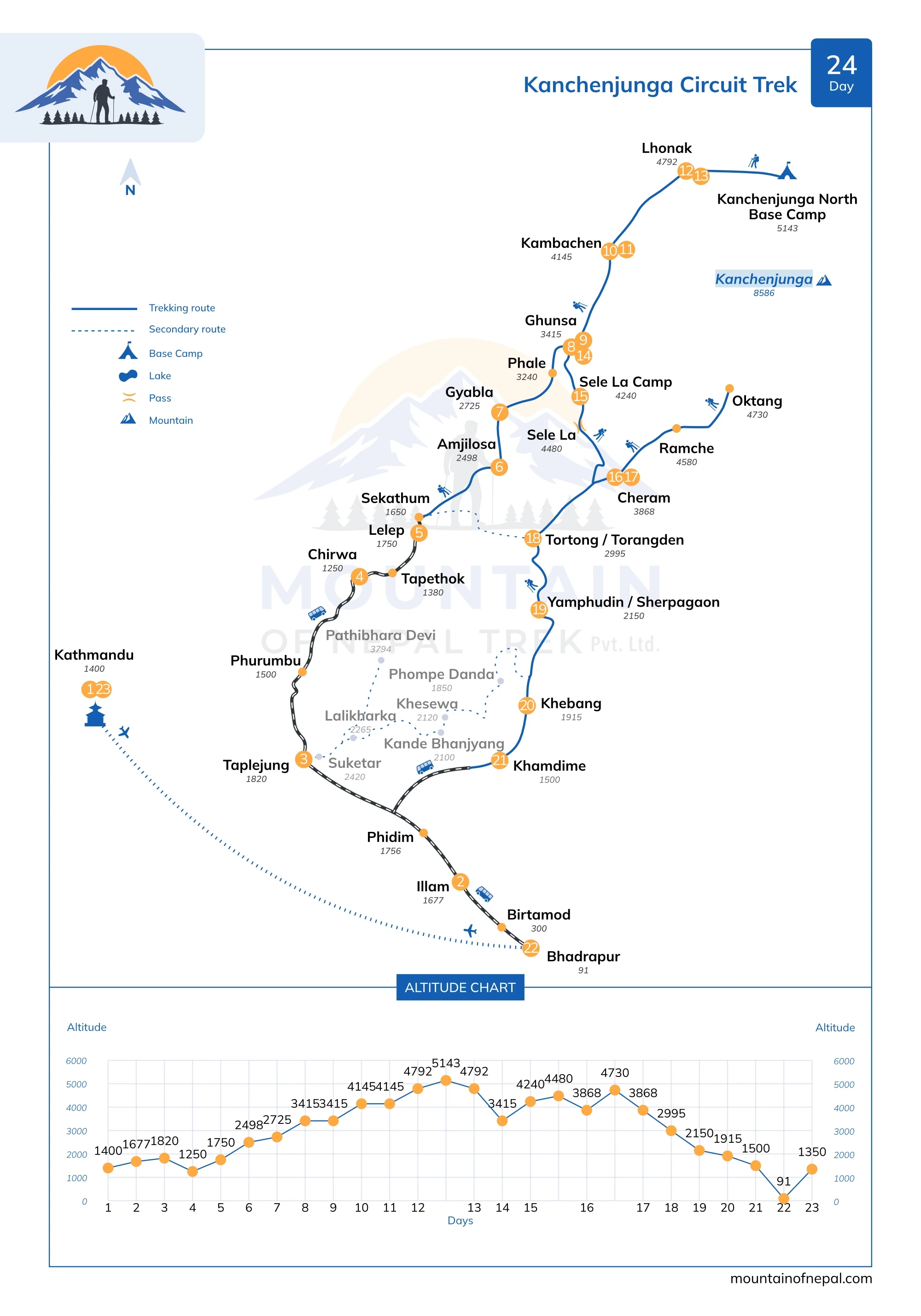
Your Start Date is the day you land in Nepal, and your End Date is when you fly home.
If the set Kanchenjunga Circuit Trek group dates don’t suit your schedule, we can offer alternative dates upon request.
The Kanchenjunga Circuit Trek is a remote and adventurous trekking route in eastern Nepal that circles the world’s third-highest peak, Mt. Kanchenjunga (8,586m). Organized by Mountain of Nepal, this trek combines both the North Base Camp (Pangpema) and South Base Camp (Oktang), offering a complete Himalayan experience. It passes through isolated villages, dense forests, high mountain passes, and glacial valleys. This trek is ideal for experienced trekkers seeking solitude, natural beauty, and cultural immersion in one of Nepal’s least explored regions.
The Kanchenjunga Circuit Trek is considered a challenging and physically demanding adventure. It involves long trekking days, steep ascents, high altitude terrain above 5,000 meters, and remote trail conditions. Trekkers must be well-prepared with good fitness and prior trekking experience. Mountain of Nepal ensures proper acclimatization days and professional guidance to manage altitude risks. While the trek is difficult, it is highly rewarding for those who want a true wilderness experience far from crowded trekking routes.
The journey begins with a flight from Kathmandu to Bhadrapur, followed by a scenic drive to Ilam and Taplejung. From Taplejung, the trekking route officially starts toward the remote mountain villages. Mountain of Nepal manages all transportation logistics, including flights, jeep transfers, and ground support. The route passes through tea gardens, hilly landscapes, and rural settlements before entering the high Himalayan trekking trail. This combination of air and road travel helps gradually adjust trekkers before the long hike.
Yes, altitude sickness is a possible risk since the trek reaches elevations above 5,000 meters at Kanchenjunga North Base Camp. However, Mountain of Nepal carefully designs the itinerary with acclimatization days in Ghunsa and Kambachen to minimize risks. Trekkers are advised to walk slowly, stay hydrated, and follow guide instructions. Symptoms like headache or dizziness should be taken seriously. With proper planning and guidance, altitude-related issues can be effectively managed throughout the journey.
Choosing Mountain of Nepal ensures a safe, well-organized, and professionally guided trekking experience in the Kanchenjunga region. The company provides experienced local guides, proper acclimatization planning, permit handling, and full logistical support. Their focus is on safety, sustainability, and authentic Himalayan exploration. Trekkers benefit from personalized service, cultural insights, and strong on-ground support in remote areas. With Mountain of Nepal, the Kanchenjunga Circuit Trek becomes not only an adventure but also a well-managed and memorable journey.
The best seasons for the Kanchenjunga Circuit Trek are spring (March to May) and autumn (September to November). During these months, the weather is stable, skies are clear, and mountain views are spectacular. Spring offers blooming rhododendron forests, while autumn provides crystal-clear Himalayan visibility. Mountain of Nepal recommends avoiding monsoon due to landslides and winter due to heavy snowfall. Choosing the right season ensures safety, comfort, and the best trekking experience in the Kanchenjunga region.
Yes, the Kanchenjunga region is a restricted area, so special permits are required. Trekkers must obtain the Kanchenjunga Conservation Area Permit (KCAP), Restricted Area Permit (RAP), and TIMS card. These permits can only be arranged through a registered trekking agency like Mountain of Nepal. A licensed guide is also mandatory, and at least two trekkers are required for the restricted permit. These regulations help protect the environment and ensure safety in this remote Himalayan region.
Accommodation on the Kanchenjunga Circuit Trek is mainly in basic tea houses and homestays run by local villagers. Rooms are simple, usually twin-sharing with minimal facilities such as beds, blankets, and shared bathrooms. As altitude increases, especially in places like Ghunsa, Kambachen, and Lhonak, facilities become more basic. Mountain of Nepal ensures safe and clean lodging throughout the journey. Despite the simplicity, the warm hospitality of local communities makes the experience comfortable and culturally enriching.
Food during the Kanchenjunga Circuit Trek is freshly prepared at tea houses and includes simple, energy-rich meals. Common dishes include dal bhat, noodles, fried rice, soups, potatoes, and Tibetan bread. Garlic soup is highly recommended for altitude adaptation. Mountain of Nepal ensures hygienic and nutritious food options throughout the trek. Vegetarian meals are widely available, but food variety becomes limited at higher elevations. Safe drinking water is provided through boiling or purification methods for trekkers’ health.
Yes, travel insurance is highly recommended and often mandatory for the Kanchenjunga Circuit Trek. Since the region is remote and evacuation options are limited, insurance should cover high-altitude trekking and helicopter rescue. Mountain of Nepal strongly advises all trekkers to obtain comprehensive insurance before arrival in Nepal. This ensures safety in case of emergencies such as altitude sickness, injuries, or unexpected weather conditions. Having insurance provides peace of mind throughout the entire expedition.


 (2)
(2)  100% recommend (0)
 (0)
(0)