The Himlung Expedition (7,126m) is one of Nepal’s most rewarding semi-technical Himalayan climbing adventures, located in the remote Nar-Phu Valley of the Annapurna region. Organised professionally by Mountain of Nepal, this expedition combines remote trekking, cultural immersion, and high-altitude mountaineering into a single journey. Himlung Himal is considered an ideal peak for climbers preparing for 7,000m and 8,000m expeditions due to its relatively stable weather, moderate technical difficulty, and well-established route.
The expedition begins in Kathmandu and gradually transitions through scenic drives, traditional villages, and restricted trekking regions before reaching Himlung Base Camp. From there, climbers establish higher camps and undergo acclimatisation rotations before attempting the summit. The journey is not only about climbing but also about experiencing the untouched Tibetan-influenced culture of Phu Gaon and the isolated Nar-Phu Valley.
One of the most remarkable aspects of this expedition is its remoteness. Unlike popular trekking peaks, Himlung offers solitude, wilderness, and a true expedition experience without heavy commercial traffic. Climbers gain both physical endurance and mental resilience throughout the journey.
The best time to undertake the Himlung Expedition is during the pre-monsoon (spring) and post-monsoon (autumn) seasons. These periods provide the most stable weather conditions, clearer skies, and safer climbing windows. Mountain of Nepal carefully selects expedition dates based on long-term weather forecasting and Himalayan climbing experience to ensure maximum success rates.
Spring (April to early June) is considered the most popular season. During this time, temperatures are moderate at lower altitudes, and snow conditions on the mountain are generally stable. The trails are also more accessible, and the landscape is filled with blooming rhododendrons in the lower regions. Autumn (late September to November) is another excellent window, offering crystal-clear mountain views and stable atmospheric pressure, which is crucial for summit attempts.
Winter and monsoon seasons are generally avoided due to extreme cold, heavy snowfall, and landslide risks. The Nar-Phu region becomes particularly challenging during these periods due to its remote geography and limited rescue accessibility.
Best Season Highlights:
The Himlung Expedition is classified as a moderately difficult high-altitude climb, suitable for climbers with prior trekking peak or mountaineering experience. While it is not as technical as 8,000m peaks, it still requires strong physical fitness, endurance, and basic ice-climbing skills. The climb involves glacier travel, fixed rope sections, crevasse navigation, and exposure to high-altitude conditions above 6,000 meters.
The expedition includes long trekking days before reaching base camp, followed by multiple acclimatisation rotations between Camp I and Camp II. The summit push is physically demanding, typically lasting 10–14 hours in cold, low-oxygen conditions. However, with proper guidance from Mountain of Nepal, climbers receive full technical support, including Sherpa assistance, rope fixing, and safety management.
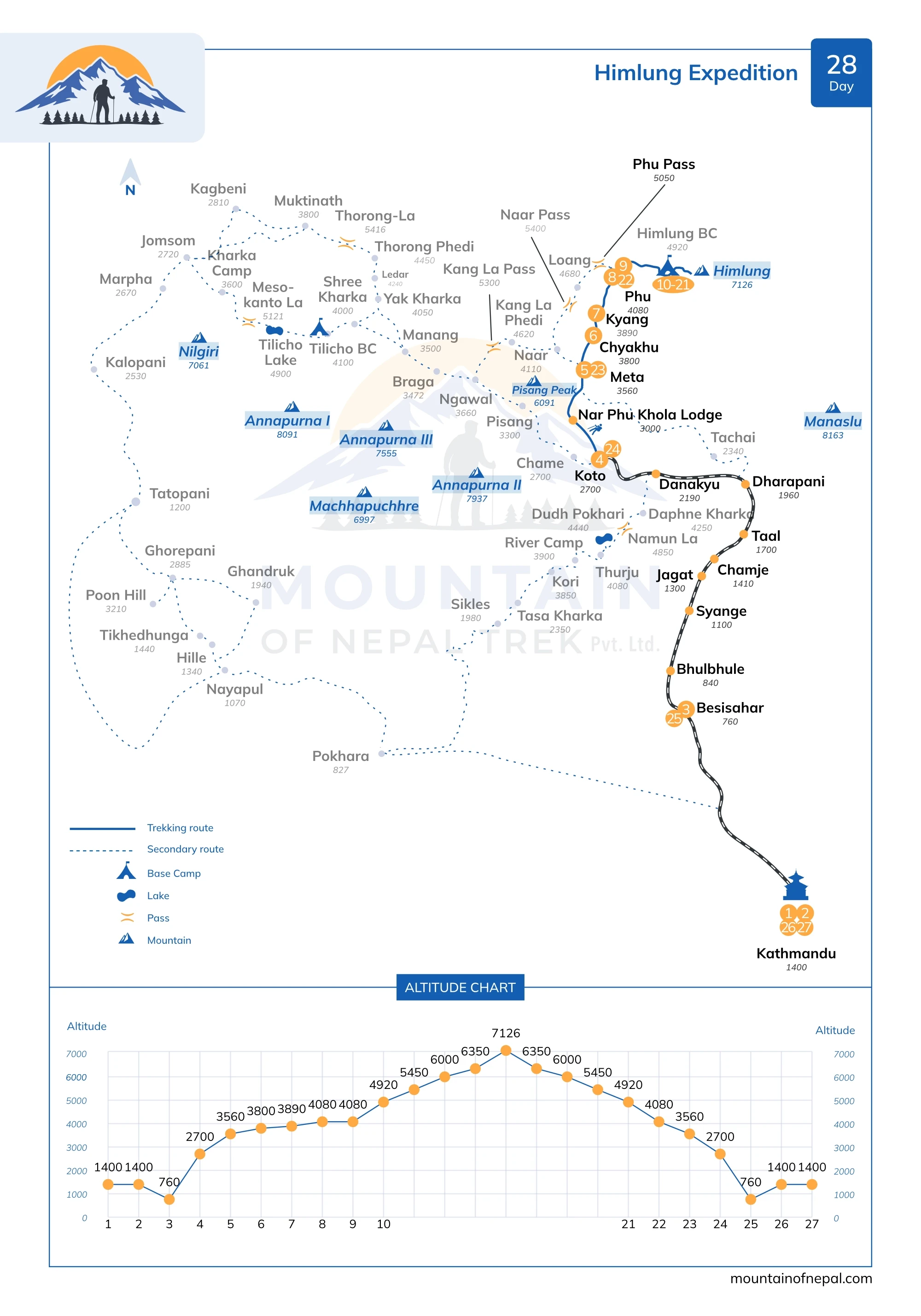
Transportation plays a key role in the expedition. The journey begins with a domestic or international arrival in Kathmandu, followed by a scenic drive to Besisahar and then a rugged jeep ride to Koto. From there, trekking begins into the restricted Nar-Phu region. All logistics, transport, and permits are professionally managed by Mountain of Nepal to ensure smooth progression from city to base camp.
Difficulty & Transport Highlights:
Food and accommodation during the Himlung Expedition vary significantly depending on altitude and location. In Kathmandu and lower trekking regions, climbers enjoy comfortable hotel stays with modern amenities. As the expedition progresses into remote areas like Phu Gaon and Meta, accommodation shifts to basic teahouses and camping setups.
At Base Camp and higher camps, Mountain of Nepal provides fully equipped expedition tents, kitchen tents, dining facilities, and trained cooks who prepare nutritious meals suitable for high-altitude conditions. Meals are designed to provide high energy, hydration, and proper nutrition, including carbohydrates, proteins, soups, and local Himalayan food options.
Food variety decreases at higher altitudes due to logistics limitations, but efforts are made to maintain quality and hygiene. Hot drinks like tea, soup, and electrolyte solutions are regularly provided to prevent dehydration and altitude sickness. Accommodation at higher camps is shared tented lodging, designed for warmth and safety in extreme weather conditions.
Food & Accommodation Highlights:
The Himlung Expedition requires multiple permits due to its location in a restricted and conservation-sensitive region. Since the route passes through the Nar-Phu Valley, special government authorisation is mandatory. Mountain of Nepal handles all permit arrangements to ensure legal compliance and smooth expedition flow.
Key permits include the Restricted Area Permit (RAP) for Nar-Phu Valley, the Annapurna Conservation Area Permit (ACAP), and the Himlung Himal Climbing Permit issued by the Nepal Mountaineering Association or relevant authority. Without these documents, entry into the region is not allowed.
The permit process also involves registration with local authorities and coordination with liaison officers. These steps ensure safety, environmental protection, and proper regulation of mountaineering activities in the region. All permits are arranged in advance so climbers can focus entirely on the expedition.
Permit Highlights:
The Himlung Expedition is an excellent choice for climbers seeking a balance between challenge, safety, and an authentic Himalayan experience. Unlike heavily commercialised peaks, Himlung offers solitude, cultural depth, and a true expedition atmosphere. With Mountain of Nepal, climbers receive expert guidance, professional logistics, and strong safety support throughout the journey.
One of the main reasons to choose Himlung is its ideal altitude for preparation for the higher 8,000m peaks. It helps climbers build technical skills, acclimatisation capacity, and confidence in real expedition environments. Additionally, the remote Nar-Phu Valley provides a rare opportunity to explore preserved Tibetan-influenced culture and untouched landscapes.
The success rate of Himlung is relatively high compared to more technical peaks, making it suitable for ambitious climbers aiming to step into serious mountaineering. The structured itinerary, gradual ascent, and professional Sherpa support significantly improve safety and summit chances.
Why Choose Highlights:
Upon arrival in Kathmandu, the capital of Nepal, you will be warmly welcomed by a representative from Mountain of Nepal and transferred to your hotel. After check-in, you can rest and recover from your international flight. In the evening, there will be a short briefing about the expedition, gear check overview, and introduction to your guide team. The vibrant streets of Thamel offer a first glimpse into Nepal’s trekking culture. This day is primarily for relaxation, jet lag recovery, and mental preparation for the journey ahead into the remote Himalayan region.
Today is dedicated to exploring the cultural and historical heritage of Kathmandu Valley. Guided by Mountain of Nepal, you will visit UNESCO World Heritage Sites such as Swayambhunath (Monkey Temple), Boudhanath Stupa, and Pashupatinath Temple. These sacred landmarks provide insight into Nepal’s deep spiritual traditions and mountaineering culture. You will also finalize permits, double-check climbing gear, and attend a detailed expedition briefing. The rest of the evening is free for preparation or shopping for missing equipment in Thamel. This day helps you transition from travel mode into expedition mindset.
After breakfast, the journey begins with a scenic drive from Kathmandu to Besisahar, the gateway to the Annapurna and Nar-Phu regions. The drive takes approximately 6–7 hours along winding roads following rivers, terraced hills, and small settlements. Organized by Mountain of Nepal, the transport is arranged for comfort and safety. Upon arrival, you will settle into a local lodge, stretch your legs, and prepare for the off-road journey ahead. This stop marks the transition from urban landscape to rural Himalayan foothills.
Today, you continue the rugged off-road drive toward Koto, a small settlement near Chame in the Manang district. The journey involves bumpy jeep tracks, river crossings, and dramatic cliffside roads. The scenery becomes increasingly alpine as you ascend into higher elevations. Managed by Mountain of Nepal, experienced drivers ensure safe passage through challenging terrain. Upon arrival in Koto, you will rest in a basic mountain lodge, preparing for the trekking phase that begins tomorrow into the restricted Nar-Phu Valley.
The trek officially begins today as you enter the restricted Nar-Phu region. You will hike through dense pine forests, suspension bridges, and narrow river valleys. The trail is less traveled, offering a sense of wilderness and isolation. Guided by Mountain of Nepal, the route is carefully paced for acclimatization and safety. The trek involves steady uphill climbing as you approach the high-altitude settlement of Meta. Upon arrival, you will stay in a basic teahouse surrounded by rugged Himalayan landscapes.
Today’s hike continues deeper into the Nar-Phu Valley with a gradual ascent toward Chyaku. The trail passes barren cliffs, ancient mani walls, and dramatic canyon-like terrain shaped by glacial activity. The altitude gain becomes more noticeable, so the pace is slow and steady under the supervision of Mountain of Nepal guides. Wildlife sightings and traditional yak grazing areas may be observed along the way. Chyaku is a remote seasonal settlement where you will camp or stay in basic shelters, fully immersed in the isolation of the high Himalaya.
The route today leads toward Kyang, a windswept highland area surrounded by rocky cliffs and alpine terrain. The trail is physically demanding with increasing altitude, requiring careful hydration and pacing. The landscape becomes more barren and glacial in character. The mountain of Nepal ensures proper acclimatization breaks and safety monitoring throughout the hike. By the time you reach Kyang, the air is noticeably thinner, and the environment more extreme. Overnight stay will be in tented camps or basic shelters, preparing for the approach to Phu Valley.
Today you descend slightly before ascending again toward the culturally rich village of Phu Gaon. The trail offers stunning views of Himalayan peaks and ancient Buddhist settlements. Stone houses, prayer flags, and monasteries define the unique atmosphere of the valley. Guided by Mountain of Nepal, you will experience local hospitality and traditional Tibetan-influenced culture. The trek is moderately long but rewarding, with gradual altitude gain. Upon arrival in Phu Gaon, you settle into a teahouse and prepare for acclimatization in this remote Himalayan village.
This rest and acclimatization day in Phu Gaon is essential for adapting to high altitude conditions before heading to base camp. You may take short hikes to nearby ridges or monasteries to improve oxygen adaptation. Mountain of Nepal guides will conduct health checks and briefings on high-altitude safety. You will also explore the ancient village, interact with locals, and learn about their traditional lifestyle. This slow-paced day helps your body adjust and prepares you physically and mentally for the upcoming ascent toward Himlung Base Camp.
Today marks your entry into the high-altitude climbing phase as you trek toward Himlung Base Camp near Himlung Himal. The route gradually climbs through alpine valleys, glacial moraines, and rugged terrain. Oxygen levels decrease significantly, making steady pacing crucial. Supported by Mountain of Nepal, the expedition crew sets up the base camp with proper tents, kitchen, and communication systems. Upon arrival, you settle into the climbers’ environment, marking the transition from trekking to mountaineering.
A full rest and acclimatization day at base camp allows your body to adapt to extreme altitude conditions. Short hikes around nearby ridges may be conducted to stimulate acclimatization. The Mountain of Nepal team provides climbing training refreshers, gear checks, and safety briefings. You will also organize equipment for rotation climbs. The base camp atmosphere is filled with anticipation as climbers prepare for summit rotations. Proper hydration, nutrition, and rest are prioritized to ensure readiness for the climbing phase ahead.
This extended climbing phase is dedicated to establishing higher camps, acclimatization rotations, and summit preparation on Himlung Himal. From Days 12–14, climbers establish Camp I and Camp II on technical ice and snow slopes, practicing rope handling and movement skills under Mountain of Nepal’s expert Sherpa guidance. Days 15–18 involve pushing to higher camps and completing acclimatization rotations while monitoring weather and physical condition.
On Day 19, summit push begins early in the morning, involving 10–14 hours of climbing through steep, icy terrain. Upon reaching the 7,126m summit, climbers enjoy panoramic Himalayan views before descending to high camp. Days 20–21 are reserved for safe descent back to base camp, recovery, and expedition debriefing with the support team.
After a successful summit or rotation phase, you begin the descent back to Phu Gaon. The trek is significantly easier but still requires caution due to fatigue and altitude effects. Guided by Mountain of Nepal, you retrace your steps through familiar landscapes, enjoying improved oxygen levels as you descend. Upon arrival in Phu Gaon, you can rest comfortably in a teahouse, celebrate achievements, and reflect on the climbing experience.
Today’s descent continues toward Meta. The trail leads through valleys, river crossings, and cliffside paths. The air becomes thicker as you lose altitude, making walking easier. The Mountain of Nepal team ensures a steady pace for recovery. This is a good day to enjoy photography and the changing landscapes of the Nar-Phu region. Overnight stay is in a lodge or camp at Meta.
You continue descending toward Koto, retracing the earlier trekking route. Forests reappear, and the environment becomes greener and more humid. The trek is relatively comfortable compared to high-altitude days. Mountain of Nepal guides manage pacing and logistics efficiently. Upon reaching Koto, you reconnect with road access and enjoy improved accommodation facilities, marking the nearing end of trekking.
A jeep drive takes you back to Besisahar along rugged mountain roads. The journey is long but scenic, offering views of waterfalls, rivers, and terraced hills. The transition from remote wilderness to semi-urban areas becomes noticeable. Managed by Mountain of Nepal, the drive ensures safety and comfort. Overnight stay is in a local lodge.
Today you return to Kathmandu by private vehicle. The drive takes several hours, passing through hills and river valleys. Upon arrival, you check into your hotel and enjoy a hot shower, comfortable bed, and city atmosphere. Mountain of Nepal organizes a farewell dinner in the evening to celebrate the successful expedition.
A free day in Kathmandu allows you to relax, shop for souvenirs, or explore local cafés and markets. Optional spa treatments or cultural visits can be arranged by Mountain of Nepal. This day is designed for recovery after the physically demanding expedition. You may also review expedition photos and share experiences with your team.
Your Himalayan journey concludes today. A representative from Mountain of Nepal will transfer you to the airport for your international flight. After nearly four weeks of trekking and climbing in the remote Himalayas, you depart with unforgettable memories of Himlung Himal, deep cultural experiences, and a strong sense of achievement.
Your Start Date is the day you land in Nepal, and your End Date is when you fly home.
If the set Himlung Expedition group dates don’t suit your schedule, we can offer alternative dates upon request.
The Himlung Expedition, organized by Mountain of Nepal, is a high-altitude climbing adventure to the summit of Himlung Himal at 7,126 meters. It is considered a moderately technical 7,000-meter peak, suitable for climbers with prior high-altitude trekking or basic mountaineering experience. The climb involves glacier travel, fixed rope sections, and exposure to extreme cold and altitude. Although not as technical as 8,000-meter peaks, proper acclimatization, physical fitness, and mental endurance are essential for success and safety.
Yes, Mountain of Nepal recommends prior experience in high-altitude trekking or basic mountaineering training. While Himlung is not extremely technical, climbers should be familiar with using crampons, ice axes, and walking on rope-fixed terrain. Previous experience above 5,000 meters is highly beneficial. Beginners with strong fitness levels may join if they undergo pre-expedition training. The guides provide technical support, but self-confidence in alpine conditions is important for safe and successful ascent of Himlung Himal.
The full expedition organized by Mountain of Nepal typically lasts around 28 days, including arrival, trekking, acclimatization, climbing rotation, summit attempt, and return. The climbing phase itself takes about 10–12 days depending on weather and climber condition. The schedule includes gradual ascent through the Nar-Phu Valley, base camp preparation, and multiple acclimatization rotations. Extra buffer days are included to handle unpredictable Himalayan weather conditions, which is crucial for safety on Himlung Himal.
The Himlung Expedition requires a high level of physical fitness. Mountain of Nepal recommends regular cardio training, strength exercises, and long trekking practice before arrival. Climbers should be capable of walking 6–8 hours daily in mountainous terrain while carrying a backpack. Endurance, stamina, and mental resilience are more important than speed. High-altitude training experience is a plus. Since the expedition reaches 7,126 meters on Himlung Himal, preparation should begin several months in advance.
Mountain of Nepal provides full logistical and technical support throughout the Himlung Expedition. This includes experienced climbing Sherpas, base camp management, route fixing, weather updates, and emergency coordination. The team assists in acclimatization rotations, gear checks, and summit push planning. Communication systems ensure constant contact between camps. The company also manages transport, accommodation, and meals, allowing climbers to focus fully on the ascent of Himlung Himal with maximum safety and efficiency.
The best seasons for the Himlung Expedition with Mountain of Nepal are spring (April–May) and autumn (September–October). These periods offer the most stable weather, clearer skies, and safer climbing conditions. Spring provides warmer temperatures and good snow conditions, while autumn offers excellent visibility and stable post-monsoon weather. Winter is too harsh due to extreme cold and heavy snowfall, while monsoon season brings unstable conditions and poor visibility, making climbing unsafe on Himlung Himal.
Accommodation during the Himlung Expedition is a mix of hotels, teahouses, and tented camps arranged by Mountain of Nepal. In Kathmandu, climbers stay in comfortable tourist-standard hotels. During trekking, basic teahouses or lodges are used where available, while remote sections require camping. At base camp and higher camps, fully equipped expedition tents are provided, including dining and kitchen setups. High-altitude camps are designed for safety and warmth, ensuring climbers remain protected throughout the journey to Himlung Himal.
Mountain of Nepal provides full-board meals throughout the expedition. In Kathmandu, breakfast is included at hotels, while during trekking and climbing, nutritious meals are prepared by the expedition cook team. Food includes rice, lentils, vegetables, soups, pasta, noodles, eggs, and high-energy snacks suitable for altitude conditions. At base camp, hygienic and freshly cooked meals are served to maintain strength and energy. Special dietary requirements can be arranged with prior notice for climbers heading toward Himlung Himal.
Climbing Himlung Himal requires several permits issued by the Government of Nepal. Mountain of Nepal handles all necessary paperwork, including the climbing permit, restricted area permit for Nar-Phu Valley, Annapurna Conservation Area entry permit, and TIMS card if required. Since the region is restricted, special authorization is mandatory. These permits ensure regulated access and environmental protection. Climbers only need to provide passport copies and photos, while the agency manages all official arrangements smoothly and efficiently.
Safety is a top priority for Mountain of Nepal during the Himlung Expedition. Experienced certified guides and Sherpas lead the climb, ensuring proper rope fixing, weather monitoring, and risk assessment. Emergency oxygen, first aid kits, and communication systems are available at base camp and higher camps. Weather conditions are closely tracked, and summit attempts are planned only during safe windows. Although climbing Himlung Himal involves inherent risks, proper acclimatization and professional guidance significantly reduce dangers.


 (2)
(2)  100% recommend (0)
 (0)
(0)