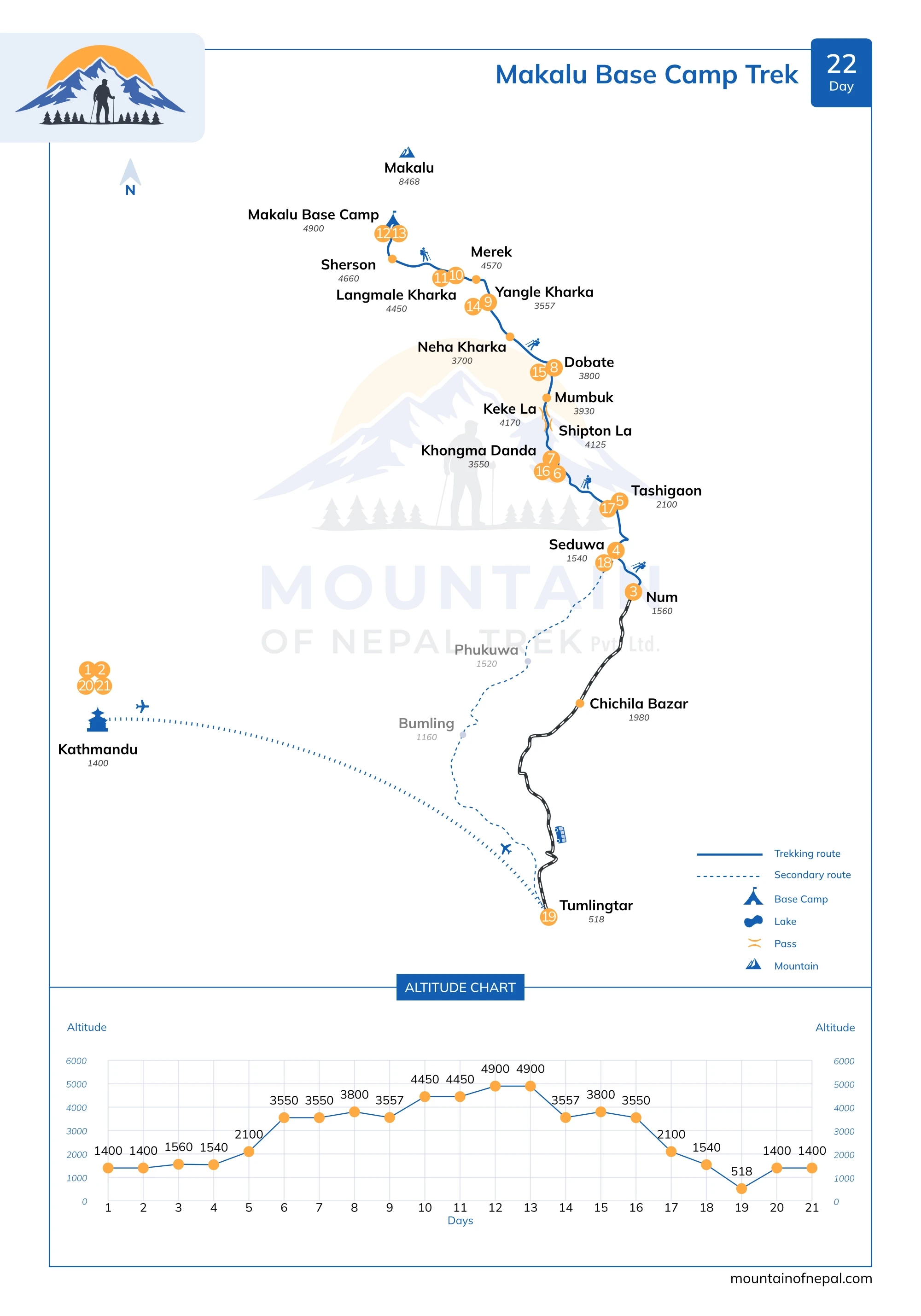
Today you take a morning flight from Kathmandu to Tumlingtar. The flight takes around 45 minutes and offers wide views of hills, river valleys, and the gradual transition from the Kathmandu Valley into the lower hilly regions of eastern Nepal. You land at a small regional airstrip surrounded by warm green hills and river valleys. This serves as the gateway to the Arun Valley Trek, the Makalu Base Camp Trek, and the Ice Col Pass Trek. After landing at Tumlingtar (410m), we meet the trekking crew and porters and complete final preparations for the trek. We enjoy lunch at Tumlingtar, then continue by 4WD vehicle toward Num. The drive first passes through the busy market town of Khandbari, then continues through terraced farmland and forested hills, offering a glimpse into rural life in eastern Nepal. The road then climbs to Chichila, where occasional panoramic views of Mount Makalu and Chamlang appear on the horizon. From here, the jeep track follows the ridge through the small Sherpa hamlet of Mure before descending toward Num. Num is perched on a promontory above the Arun River, offering dramatic views across the valley toward Seduwa and the surrounding hills. By late afternoon, we arrive at Num and check into one of the best available local lodges. After some relax, you will be introduced to your trekking staff and porters who will accompany you throughout the journey. This is a great opportunity to get to know your team, organize your gear, and prepare for the days ahead. You may also take a short walk around the village to enjoy the peaceful surroundings. This is an easy and comfortable day, allowing you to rest, adjust, and prepare for the trekking adventure ahead. From the lodge, on clear days, you may catch distant glimpses of Mount Makalu, the fifth-highest mountain in the world—an early hint of the greater Himalayan landscapes that lie ahead.
The day begins with a steep descent from Num through dense forests and terraced farmlands toward the Arun River at an altitude of 650m. This section offers a dramatic change in landscape, moving from ridge-top villages into deep river valleys. The Arun River, which originates in Tibet and flows into eastern Nepal, is one of the major Himalayan rivers and forms part of one of the deepest river gorges in the world. The crossing is done via a suspension bridge, offering impressive views of the powerful river below. After crossing the river, the trail ascends steeply on the opposite side, climbing through forested slopes and cultivated hillsides. The walk can feel warm in sections, but shaded forest paths provide relief along the way. As you gain elevation, the route enters the boundary of Makalu Barun National Park, where trekking permits are checked and registered. Seduwa is a small hillside settlement located at the entrance of the park. Upon arrival, you check into a local lodge and enjoy the peaceful mountain atmosphere, marking an important step deeper into the Makalu region.
We begin by following the trail out of the valley through rhododendron and bamboo forests, gradually gaining elevation as the landscape becomes quieter and more remote. The route continues across terraced rice fields toward Manigaon village, offering glimpses of traditional Sherpa and Rai rural life along the way. From Manigaon, the trail contours through a mix of forest and farmland as we approach Tashigaon. Tashigaon is a beautiful mountain village and the last permanent settlement before entering the high-altitude section of Makalu Barun National Park. It is an important resting point for trekkers before the challenging days ahead. Overnight in Tashigaon.
From today onward, the trail enters a more remote and rugged section. After breakfast, you start your day and leave Tashigaon, beginning the steep climb toward Khongma Danda. The trail quickly becomes more challenging, passing through dense forests of rhododendron, oak, and pine. The route ascends continuously, with stone steps and narrow mountain paths leading higher into the hills. As you climb, the air becomes noticeably cooler and the landscape more remote. There are fewer seasonal huts along the way, giving a strong sense of entering the high mountains. This section of the trek is physically demanding but very rewarding, with occasional openings in the forest offering views of deep valleys and distant ridgelines. Khongma Danda is a remote ridge-top settlement surrounded by forest and mountain scenery. It is an important acclimatization point before crossing higher passes in the Makalu region. On arrival, you stay in a basic mountain lodge and rest in preparation for the higher and more challenging sections ahead.
Today is an important rest and acclimatization day at Khongma Danda to help your body adjust to the increasing altitude (we ascended nearly 1,400m yesterday, which is a significant gain in a single day) and to prepare for crossing Shipton La tomorrow at an altitude of 4,216m, reducing the risk of altitude sickness. Proper acclimatization is essential for a safe and successful trek in the higher Himalayan region. Instead of complete rest, you may take a short hike to higher viewpoints around the ridge, which helps your body adapt while also offering beautiful views of the surrounding hills and distant peaks. The area around Khongma Danda is quiet and remote, with forested slopes and open ridgelines. From Khongma, you can enjoy beautiful views of the Kanchenjunga region to the east. It is a great place to relax, enjoy the mountain environment, and prepare mentally and physically for the more challenging days ahead. You can spend the rest of the day resting at the lodge, hydrating well, and organizing your gear. Your guide will also monitor your health and provide guidance for the upcoming high-altitude trekking days. This acclimatization day plays a key role in preparing you for crossing higher passes and reaching greater elevations safely. Overnight in Khongma Danda.
Today is one of the most challenging and rewarding days of the trek as you cross a series of high passes. From Khongma Danda, the trail climbs steeply on zig-zag paths through rhododendron forest before entering rugged and exposed alpine landscapes. The route steadily ascends toward Shipton La at 4,216m, a major high pass on the Makalu trekking circuit, where trekkers are rewarded with vast Himalayan views. This section is remote and physically demanding, with constant altitude changes, stone steps, and dramatic scenery. Weather conditions can change quickly at this altitude, so a steady and careful pace is important. From the pass, the trail descends to the sacred alpine lake of Kalo Pokhari before making another short but demanding climb to Keke La at 4,150m. After this pass, the trail descends into a quiet and isolated valley and continues toward Dobate. Upon arrival, you settle into a basic lodge and rest after a long and demanding day. Proper rest and hydration are essential as you continue gaining altitude.
After the demanding high-altitude crossing the previous day, today’s trek feels more gradual and relaxed as you descend from Dobate into the upper Barun Valley. The trail leads through alpine landscapes with rocky paths, open slopes, and scattered vegetation. From Dobate, you descend on a steep trail through blue pine forest. As you lose elevation, the air becomes easier to breathe and walking becomes more comfortable. You follow the Barun River valley, crossing several landslide-prone sections, surrounded by steep mountain walls and untouched wilderness. This remote section of the trek offers a sense of peace, with views of Peak 6 and Peak 7 along the way. Yangri Kharka is a small grazing area set in a wide valley, often used by yak herders during the warmer months. The open landscape and surrounding peaks create a calm and beautiful setting. Upon arrival, you settle into a simple lodge and enjoy a well-earned rest.
Today’s trek continues deeper into the remote Barun Valley as you move closer to the base of Mount Makalu. The landscape becomes more open and dramatic, with wide alpine valleys and towering peaks dominating the horizon. The trail follows a gradual ascent along the valley floor, passing through several yak pastures (kharkas), herder huts, and sparse vegetation. Trees are now mostly absent, replaced by rugged terrain, rocky paths, and glacial features. As you gain elevation, the views become more impressive. On clear days, you can enjoy closer views of the surrounding Himalayas, with the massive presence of Mount Makalu becoming more visible ahead. Langmale Kharka is a high-altitude grazing area set in a broad valley, surrounded by snow-capped peaks and steep mountain walls. The setting feels wild and untouched. Upon arrival, you settle into a basic lodge for the night. As you are now above 4,000m, the air is thinner, so it is important to move slowly, stay hydrated, and allow your body to adjust as you prepare for reaching Makalu Base Camp.
Today is a short acclimatization hike around Langmale Kharka to help your body adjust before the final push to Makalu Base Camp tomorrow. We begin a gradual walk up the grassy slopes above the lodge, gaining elevation slowly and safely. The route allows an ascent of over 800 meters, depending on fitness and pace. Throughout the day, you are rewarded with outstanding views of the surrounding Himalayas. The scenery becomes increasingly dramatic, with panoramic sights of Peak 3, Peak 4, Peak 5, and Chamlang, along with other surrounding Himalayan ridges. This is a relaxed but important day, giving you time to move slowly, enjoy the landscape, and prepare for the high-altitude journey ahead to Makalu Base Camp.
Today is one of the most important and rewarding days of the trek as you make your way to Makalu Base Camp. The journey takes you deeper into the upper Barun Valley up to Sherson, surrounded by some of the most dramatic mountain scenery. The trail gradually ascends along a wide glacial valley, with rugged terrain, rocky paths, and moraine landscapes. Vegetation is minimal at this altitude, and the environment feels truly wild and remote. As you move closer, the massive south face of Mount Makalu begins to dominate the skyline. Along the way, you are surrounded by towering Himalayan peaks, including Baruntse and other high ridges that define this remote region. The final approach to base camp is both exciting and unforgettable. Makalu Base Camp is set in a wide, open area with breathtaking views in every direction—glaciers, icefalls, and high Himalayan peaks create a true expedition atmosphere. Upon arrival, you settle into a basic lodge or camp and take time to explore the surroundings. The sense of achievement is immense, as you stand at the foot of one of the world’s highest mountains. This is a truly special moment of the trek—reaching Makalu Base Camp, a remote and less-visited destination, offering raw Himalayan beauty and a deep sense of adventure. We sleep two nights at Makalu Base to have opportunity to explore the area.
This is a rewarding day at Makalu Base Camp, offering time to absorb the achievement and enjoy the surrounding Himalayan panorama before beginning the descent tomorrow. Today, you take a short hike toward the Makalu Advanced Base Camp (High Camp) direction along the Makalu Glacier slopes. The round-trip walk takes approximately 4–5 hours, with an elevation gain of about 400–600 meters depending on weather conditions and fitness level. This is not a technical climb, but a gradual hike along a high ridge with your guide. The route passes through rocky moraine, sections of glacier, and open high alpine slopes, giving a true sense of the high mountain environment. From the viewpoint, you may enjoy distant views of Mount Everest and Lhotse, along with close-up views of Makalu. If you are trekking during April or May, you may encounter expedition climbers at High Camp preparing to summit Mount Makalu. This offers a unique opportunity to observe expedition life, hear about their climbing experiences, and, if welcomed, enjoy a warm tea or coffee from their kitchen staff. After this memorable experience, you return to base camp for lunch. The rest of the day is relaxed, focused on light exploration, photography, and enjoying the peaceful surroundings before preparing for the descent to lower elevations the following day.
After yesterday’s rewarding day, you begin your return journey, retracing your steps down the Barun Valley. The trail descends gradually through wide alpine landscapes, following rocky paths, glacial terrain, and open valleys. As you lose elevation, the air becomes easier to breathe, making the walk more comfortable compared to previous high-altitude days. The descent offers a fresh perspective of the landscape, with changing views of surrounding peaks and ridgelines. The sense of remoteness remains, but the journey now feels more relaxed. Upon arrival at Yangri Kharka, you may choose to stay at the same lodge used during your ascent.
Today’s trek continues along the return route as you follow the Barun Valley back toward Dobate. The trail gradually ascends again, making this a slightly more demanding day after yesterday’s descent. You walk through quiet alpine landscapes with rocky paths, open slopes, and sparse vegetation. The route feels remote and peaceful, with very few trekkers in this part of the Makalu region. As you gain elevation, the air becomes thinner once again, so it is important to maintain a slow and steady pace. The trail offers impressive views of the surrounding valleys and high ridges, providing a different perspective compared to the earlier ascent. After around 6 hours of trekking, retracing your steps, you arrive at Dobate—a small and isolated stop set below the high passes. Here, you settle into a basic lodge for the night and rest well, preparing for the next day’s climb back over the higher ridges.
Today is a challenging day as you climb back toward the high ridges above Debotay. The trail ascends steadily, retracing your route across rugged alpine terrain and rocky mountain paths. The climb includes steep sections and stone steps as you regain elevation toward the high passes of Keke La (4,150m) and Shipton La (4,216m). As you gain height, the landscape opens up, with fewer trees and wide views across valleys and ridgelines. Crossing these high sections once again highlights the dramatic and remote nature of the Makalu region. Weather is unpredictable at this altitude, so a steady pace and proper layering are essential. After crossing the ridges, the trail descends gradually toward Khongma Danda. Returning here brings a sense of familiarity after several days in the remote upper valley. Upon arrival, you settle into a lodge and rest for the night.
Today’s trek is a pleasant descent as you leave Khongma Danda and return toward the lower Himalayan hills. The trail follows forested ridges and stone steps, gradually losing altitude through rhododendron, oak, and pine forests. As you descend, the air becomes warmer and easier to breathe, and the landscape feels greener and more welcoming. Compared to the high alpine section of previous days, this part of the trail offers a more relaxed walking experience with occasional views of valleys and surrounding hills. Tashigaon is a traditional Himalayan settlement mainly inhabited by Sherpa (Bhotia) communities with strong Tibetan Buddhist cultural influence, known for farming, livestock, and seasonal yak herding. Upon arrival, you check into a local lodge and have lunch. In the afternoon, you explore the village and surrounding area to experience local culture and daily mountain life. After the visit, you return to the lodge and enjoy a relaxed evening in this peaceful hillside village.
Today’s trek continues your descent from Tashigaon as you gradually return toward the lower valleys of the Makalu region. The trail becomes easier and more comfortable as you lose altitude. You walk through lush forests, terraced fields, and small rural settlements. The surroundings become warmer and greener, with signs of everyday village life becoming more visible again. The path follows gentle ridgelines and forested slopes, offering a relaxed walking experience compared to the high mountain sections of previous days. Streams, farmland, and traditional houses mark your return to the lower hills. Seduwa welcomes you back as a quiet settlement at the entrance of Makalu Barun National Park. It feels noticeably warmer and more populated compared to the high alpine areas you explored earlier in the trek. Upon arrival, you check into a local lodge and enjoy a comfortable evening.
Today is the last day of the trek. We begin early in the morning and aim to arrive in Tumlingtar by late afternoon. After a quick breakfast, we walk for around 2 to 2.5 hours through the lower hills before reaching the roadhead. From here, your guide will arrange a 4WD jeep transfer, as the route follows a rough, unpaved mountain road that can be steep, uneven, and affected by weather conditions—making a four-wheel-drive vehicle essential for safety and stability. The drive to Tumlingtar takes approximately 6 hours. The journey continues through terraced fields, rural villages, and scenic hillside landscapes as we gradually descend toward the lowlands. Along the way, the mountain terrain slowly gives way to warmer, greener surroundings. Upon arrival in Tumlingtar, we check into a lodge and enjoy a relaxed lunch. The afternoon is free to rest and prepare for the flight back to Kathmandu the following day. Your guide will also reconfirm your flight tickets, as it is always advisable to double-check schedules in advance. In the evening, we celebrate a farewell dinner with the porters, staff, and crew, thanking them for their hard work and contribution to the success of the trek.
Today you take a short morning flight from Tumlingtar back to Kathmandu. The flight takes around 45 minutes and offers beautiful aerial views of the hills, river valleys, and terraced landscapes of eastern Nepal. As you leave the Arun Valley behind, you gradually return to the Kathmandu Valley, marking the transition from remote trekking regions back to the city. Upon arrival in Kathmandu (1,350m), you will be transferred to your hotel. The rest of the day is free to relax, rest, or explore the city at your own pace. This is a comfortable and easy day after completing your trekking adventure in the Makalu region.
Your Start Date is the day you land in Nepal, and your End Date is when you fly home.
If the set Makalu Valley Trek group dates don’t suit your schedule, we can offer alternative dates upon request.


 (2)
(2)  100% recommend (0)
 (0)
(0)