The Annapurna I Expedition (8091m) is one of the most technically demanding and historically significant 8000-meter peak climbs in the world. Organized by Mountain of Nepal, this expedition takes climbers deep into the Annapurna Himalaya range, where steep ice walls, unpredictable weather, and high avalanche risk make it a true test of mountaineering skill and endurance. Unlike trekking peaks, Annapurna I requires advanced technical climbing experience, high-altitude survival skills, and strong teamwork with Sherpa support.
The expedition follows a long progression route from Kathmandu through Pokhara, Tatopani, and remote high-altitude camps, gradually building acclimatization before establishing base camp and higher camps. The journey combines trekking, expedition camping, glacier travel, and ice climbing, making it a complete Himalayan mountaineering experience.
The expedition managed by Mountain of Nepal ensures professional logistics, safety planning, weather monitoring, and structured acclimatization schedules. Climbers experience both physical challenge and deep personal transformation while attempting one of the most dangerous mountains in the world.
Choosing the right season is critical for the success of the Annapurna I Expedition. Mountain of Nepal schedules expeditions primarily during the most stable weather windows in the Himalayas, when snow conditions, temperature, and visibility are optimal for high-altitude climbing.
The two main climbing seasons are pre-monsoon (spring) and post-monsoon (autumn). Each season offers unique advantages and challenges, but spring is generally preferred for summit attempts due to more stable snow conditions and longer weather windows.
Best climbing seasons:
During spring, temperatures are relatively stable at higher camps, and snowpack conditions are more predictable, reducing avalanche risks. Autumn offers excellent visibility and fewer climbers but colder summit conditions. Mountain of Nepal carefully monitors meteorological data and Himalayan forecasts to determine safe summit windows.
Proper seasonal timing significantly increases success rates while minimizing risks associated with Annapurna I’s unpredictable weather patterns.
The Annapurna I Expedition is considered one of the most difficult 8000m climbs in the world, even more dangerous than many higher peaks due to its steep faces and avalanche-prone slopes. Climbers must possess advanced technical skills in ice climbing, rope fixing, and glacier navigation.
Under Mountain of Nepal’s management, the expedition includes progressive acclimatization, but physical and mental endurance remain critical throughout the journey. The route involves long trekking sections followed by highly technical climbing at extreme altitude.
Difficulty factors:
Transportation begins with an international arrival in Kathmandu, followed by domestic overland travel to Pokhara and further trekking or jeep routes into the Annapurna region. The journey transitions gradually from urban roads to remote Himalayan trails.
Transport phases include:
The combination of remote access and extreme altitude makes this expedition physically demanding from the very beginning. Proper preparation is essential for success.
Food and accommodation during the Annapurna I Expedition are carefully managed by Mountain of Nepal to ensure climbers maintain high energy levels throughout the journey. As the expedition progresses into remote regions, food becomes more expedition-based, with a combination of lodge meals and high-altitude camping provisions.
In lower regions such as Kathmandu, Pokhara, and Lete, climbers stay in comfortable hotels and teahouses. As altitude increases, fully equipped tented camps are established with dedicated kitchen and dining facilities.
Food system during expedition:
Accommodation transitions from hotels to teahouses and finally to high-altitude expedition tents. Mountain of Nepal ensures insulated sleeping tents, dining tents, and kitchen setups even in extreme conditions.
Accommodation types:
This structured system ensures climbers remain well-fed, hydrated, and rested throughout the physically demanding expedition.
Climbing Annapurna I requires multiple official permits regulated by the Government of Nepal. Mountain of Nepal manages all documentation and administrative processes to ensure a smooth expedition experience for climbers.
Permits are mandatory not only for climbing but also for conservation and environmental protection of the Annapurna region.
Required permits include:
Each permit has specific regulations regarding environmental protection, waste management, and climbing ethics. Climbers must follow strict guidelines, especially in high-altitude camps where waste is required to be carried down.
The responsibilities of the Mountain of Nepal include:
Without proper permits, climbing Annapurna I is illegal and unsafe. Therefore, professional expedition companies like Mountain of Nepal play a crucial role in ensuring compliance and safety.
Choosing the Annapurna I Expedition with Mountain of Nepal ensures a professionally managed, safety-focused, and well-supported Himalayan climbing experience. Annapurna I is not just a climb; it is a serious high-altitude challenge requiring expert guidance, logistics, and risk management.
Mountain of Nepal provides a structured expedition system designed to maximize safety, acclimatization, and summit success while minimizing risks in one of the world’s most dangerous mountains.
Reasons to choose Mountain of Nepal:
The company emphasizes teamwork, discipline, and climber safety throughout the expedition. Each stage—from arrival in Kathmandu to summit attempt—is carefully managed to ensure climbers are physically and mentally prepared.
Most importantly, Mountain of Nepal focuses on ethical climbing practices, environmental responsibility, and respect for Himalayan culture. Climbers not only attempt a world-class peak but also gain deep insight into high-altitude mountaineering traditions.
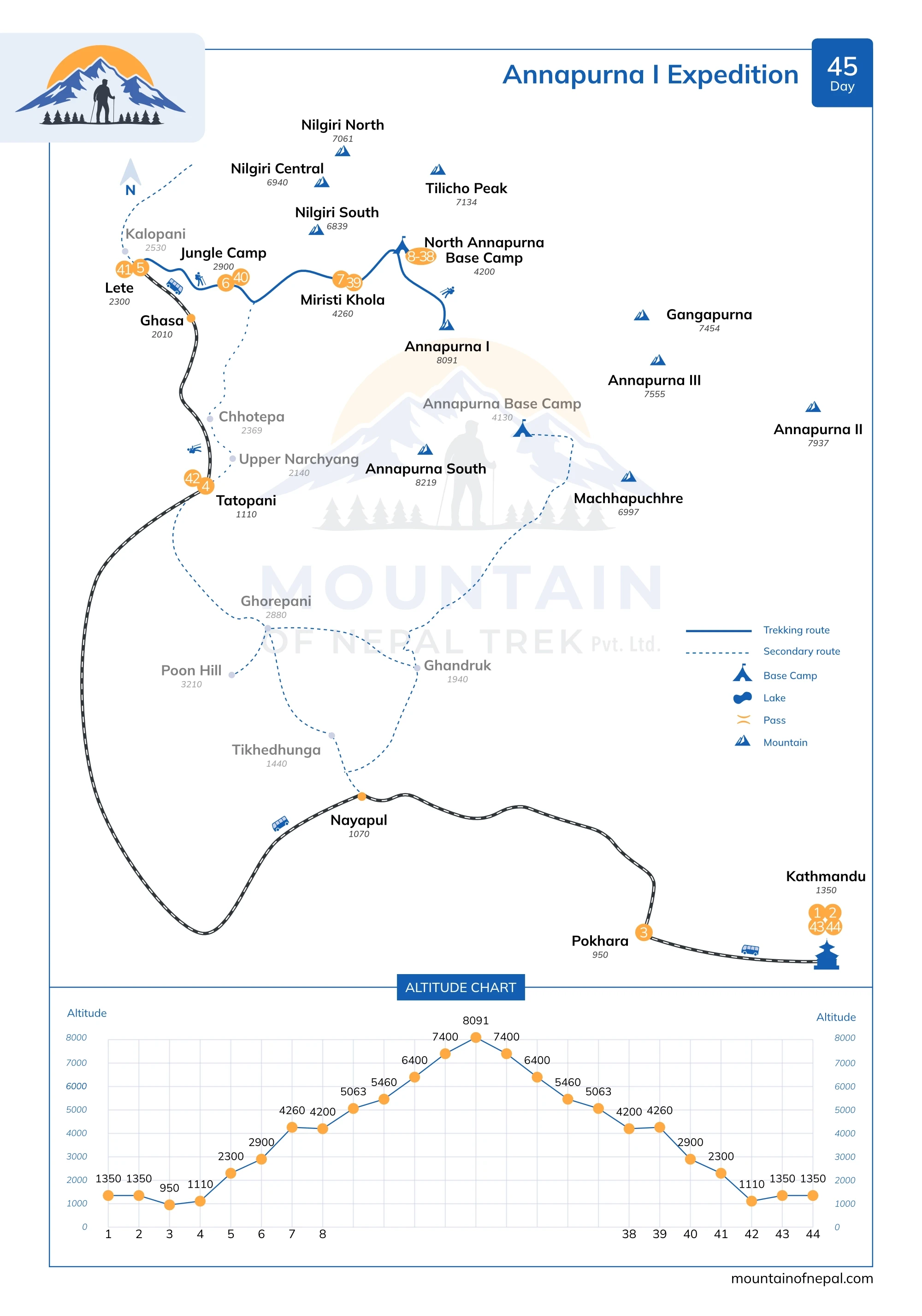
Upon your arrival at Tribhuvan International Airport in Kathmandu, a representative from Mountain of Nepal will warmly welcome you and assist with your transfer to the hotel. After check-in, you will have time to rest and recover from your journey. The evening is free for light exploration around Thamel, the tourist hub. A short briefing about the expedition will be provided, along with an introduction to the team. This day is important for initial orientation, jet lag recovery, and preparing mentally for the Annapurna I expedition ahead.
Today is dedicated to expedition preparation with Mountain of Nepal’s logistics team. You will attend detailed climbing briefings covering safety protocols, climbing strategies, and emergency procedures for Annapurna I. All required permits will be finalized, including Annapurna Conservation Area and climbing permits. Equipment checks will be conducted to ensure gear is suitable for high-altitude climbing. You will also have time for last-minute shopping or gear replacement in Thamel. The team-building process begins today, helping climbers and guides build trust before heading into the Himalayas.
After an early breakfast, the journey begins with a scenic drive from Kathmandu to Pokhara arranged by Mountain of Nepal. The route follows winding highways alongside rivers, terraced hills, and traditional villages. Pokhara, known as the gateway to the Annapurna region, offers stunning views of Machhapuchhre and surrounding peaks on clear days. Upon arrival, you will check into a hotel near the lakeside. The evening can be spent relaxing by Phewa Lake, enjoying the peaceful environment before the trekking phase begins.
Today’s journey continues toward Tatopani, a natural hot spring village in the Annapurna region. Depending on route conditions, Mountain of Nepal may arrange a drive or trekking combination. The trail gradually ascends through lush hills, waterfalls, and rural settlements. Tatopani is famous for its healing hot springs, providing an excellent opportunity for relaxation after travel. Upon arrival, you will settle into a teahouse or lodge, with time to soak in the natural pools and prepare for deeper entry into the mountainous terrain.
The trek begins in earnest as you move from subtropical landscapes into higher alpine terrain. The trail follows the Kali Gandaki Valley, one of the deepest gorges in the world. Mountain of Nepal guides will lead you through terraced farmlands, pine forests, and traditional settlements. As altitude increases, the air becomes cooler and views more dramatic. Lete is a peaceful mountain village offering panoramic sights of Dhaulagiri and surrounding peaks. Overnight accommodation is arranged in a comfortable lodge for rest and acclimatization.
Today’s route takes you deeper into remote wilderness areas, leaving behind established villages. The trail becomes steeper and more rugged, surrounded by dense forests and alpine vegetation. Mountain of Nepal’s trekking team will ensure safe navigation through less-traveled sections. Wildlife sightings may include Himalayan birds and mountain goats. Jungle Camp is a remote camping area, fully equipped by the support crew with tents and food facilities. The night is spent in tents under a clear Himalayan sky, marking your transition into expedition-style camping.
The trail today becomes more challenging as you ascend into high-altitude terrain. Crossing glacial rivers and rocky landscapes, you will reach Miristi Khola, a key staging point for Annapurna I expeditions. Mountain of Nepal Sherpa guides will carefully manage pacing to avoid altitude strain. The campsite is fully set up with expedition tents and support systems. The surrounding environment is wild and isolated, offering a true Himalayan wilderness experience. This day is crucial for further acclimatization before approaching base camp.
Today you arrive at the Annapurna Base Camp area dedicated for expedition climbers, not to be confused with trekking base camp. The trail passes glaciers, moraine fields, and steep icy sections. Mountain of Nepal staff establish a fully functional high-altitude base camp with dining tents, communication systems, and medical support. Upon arrival, climbers participate in final briefing for the climbing phase. The views of Annapurna massif are breathtaking, and the seriousness of the climb ahead becomes fully apparent.
This extended phase is the core of the expedition managed by Mountain of Nepal. Climbers undergo multiple rotations between higher camps (Camp I, II, III, and IV) to improve acclimatization and technical skills. Fixed ropes, ice climbing, and glacier navigation are key challenges. Weather windows are carefully monitored by the expedition leader. Summit push is attempted during optimal conditions, requiring endurance, teamwork, and high-altitude resilience. Annapurna I is one of the most dangerous 8000m peaks, demanding strict discipline, oxygen management, and strong Sherpa support.
After completing the climbing phase, the descent begins. You return to Miristi Khola, carefully navigating glacial and rocky terrain. Mountain of Nepal ensures safe descent with full support from Sherpa crew. Climbers feel a mix of exhaustion and achievement after the summit attempt. Camps are dismantled, and equipment is organized for transport. This day marks the transition from expedition mode back to trekking conditions, with improved oxygen levels and reduced physical strain.
The descent continues as you move back toward lower altitudes. The trail becomes easier, allowing climbers to recover gradually. Mountain of Nepal staff ensure all logistics and gear are properly managed. Jungle Camp offers a comfortable resting point surrounded by forested landscapes. Hot meals and recovery support are provided to help climbers regain energy. The psychological relief of descending from high altitude is noticeable, and group morale improves significantly.
Today you return to Lete village, re-entering inhabited regions. The descent allows improved breathing and physical recovery. The landscape transitions from alpine wilderness to green valleys and agricultural terraces. Mountain of Nepal guides may arrange short cultural interactions with locals. Comfortable lodge accommodation is provided in Lete, where climbers can rest, reflect, and celebrate progress. This day emphasizes recovery and preparation for the return journey to lower elevations.
A short but scenic drive brings you back to Tatopani. The lower altitude brings warmer temperatures and lush surroundings. Mountain of Nepal organizes transport for the team to ensure comfort after the long expedition. Upon arrival, climbers can once again enjoy natural hot springs, which are ideal for muscle relaxation and recovery. This is a well-earned rest stop after weeks in high-altitude conditions.
Today marks your return journey to Kathmandu. The drive passes through river valleys, terraced hills, and rural Nepalese landscapes. Mountain of Nepal ensures comfortable transport arrangements with scheduled breaks. Upon arrival in Kathmandu, you will check into the hotel and enjoy a warm shower and rest. The return to city life feels contrasting after weeks in remote mountain environments. The evening is free for relaxation or shopping in Thamel.
This is a leisure and recovery day in Kathmandu. You may explore cultural heritage sites, shop for souvenirs, or simply rest at the hotel. In the evening, Mountain of Nepal hosts a farewell celebration dinner with a traditional Nepali cultural program. This event honors the effort, teamwork, and achievement of the Annapurna I expedition. Climbers, guides, and staff gather to reflect on the journey and share experiences in a festive atmosphere.
After breakfast, Mountain of Nepal will transfer you to Tribhuvan International Airport for your final departure. The team will assist with luggage and ensure a smooth check-in process. This marks the official end of the Annapurna I Expedition. As you leave Nepal, you carry with you unforgettable memories of one of the world’s most challenging peaks, along with the experience of teamwork, endurance, and high-altitude adventure in the Himalayas.
Your Start Date is the day you land in Nepal, and your End Date is when you fly home.
If the set Annapurna I Expedition group dates don’t suit your schedule, we can offer alternative dates upon request.
The Annapurna I Expedition organized by Mountain of Nepal is considered one of the most technically difficult and dangerous 8000-meter peak climbs in the world. It requires advanced mountaineering skills, previous high-altitude experience, and strong physical endurance. The route includes steep ice walls, avalanche-prone sections, and complex glacier navigation. Climbers must be fully prepared for extreme weather and altitude challenges. This expedition is recommended only for experienced climbers who have previously summited peaks above 6500m or 7000m with technical difficulty.
To join the Annapurna I Expedition with Mountain of Nepal, climbers should have prior experience of climbing at least one or more 7000m or 8000m peaks. Strong knowledge of ice climbing, rope fixing, and glacier travel is essential. Experience using oxygen systems at high altitude is highly recommended. Physical and mental endurance are equally important due to long exposure in extreme conditions. Without proper high-altitude experience, climbers may struggle with the technical and environmental challenges of Annapurna I.
Mountain of Nepal strongly recommends that climbers undergo intensive physical and technical training before the expedition. This includes cardiovascular endurance training, strength conditioning, and long trekking practice. Technical mountaineering skills such as crampon use, ice axe climbing, rope fixing, and crevasse rescue should be well-practiced. Climbers should also train at altitude if possible to adapt their body to low oxygen conditions. Proper preparation significantly increases safety and summit success chances on Annapurna I.
The total duration of the Annapurna I Expedition with Mountain of Nepal is approximately 45 days. This includes arrival in Kathmandu, preparation, trekking to base camp, acclimatization rotations, and a full climbing period from Camp I to the summit. Weather conditions and individual acclimatization may slightly affect the timeline. The expedition is carefully planned to allow sufficient time for safe ascent and descent, ensuring climbers have the best possible opportunity for a successful summit attempt.
In case the summit of Annapurna I cannot be achieved due to weather, safety, or health reasons, Mountain of Nepal prioritizes the safety of climbers and ensures a safe descent. The expedition schedule includes buffer days to maximize summit chances, but nature is unpredictable. Even without a summit, climbers gain valuable high-altitude experience and technical training. The team ensures full logistical support during descent, and all members return safely to base camp and Kathmandu.
According to Mountain of Nepal, the best seasons for Annapurna I climbing are pre-monsoon (April to May) and post-monsoon (September to October). During these periods, weather conditions are relatively stable, with clearer skies and lower wind speeds. However, Annapurna I is known for unpredictable weather throughout the year, so climbers must always be prepared for sudden changes. Choosing the right season increases safety and improves the chances of reaching the summit successfully.
Yes, supplemental oxygen is typically used during the Annapurna I Expedition organized by Mountain of Nepal, especially above Camp III or Camp IV depending on conditions. The use of oxygen helps climbers perform better in the “death zone” above 8000 meters where oxygen levels are critically low. However, experienced climbers may choose to climb without oxygen based on personal capability. Sherpa guides also ensure proper oxygen management and safety protocols throughout the summit push.
Safety is the highest priority for Mountain of Nepal during the Annapurna I Expedition. The team includes experienced Sherpa guides, high-altitude medical kits, and emergency communication systems. Fixed ropes are installed on technical sections, and weather conditions are continuously monitored. Regular acclimatization rotations are conducted to reduce altitude risks. In case of emergencies, evacuation plans including helicopter rescue are available. Despite these measures, climbers must understand that Annapurna I remains one of the most dangerous mountains in the world.
During the Annapurna I Expedition, Mountain of Nepal provides a mix of hotel, lodge, and camping accommodations. In Kathmandu, climbers stay in comfortable hotels. During trekking, teahouse or lodge accommodation is provided where available. From Jungle Camp onward, full expedition-style camping is arranged with high-quality tents, dining facilities, and kitchen support. At base camp and higher camps, fully equipped alpine tents are used. The setup ensures climbers receive proper rest and nutrition throughout the journey.
Mountain of Nepal provides three full meals per day during trekking and climbing phases. Meals are designed to support high-energy requirements and include a mix of Nepali, Asian, and international cuisine. At base camp and higher camps, professional cooks prepare hygienic and nutritious food suitable for high altitude. Fresh vegetables, carbohydrates, proteins, and warm drinks are included. Special dietary requirements can be arranged in advance. Proper nutrition is essential for endurance and performance during the Annapurna I climb.
To book the Annapurna I Expedition with Mountain of Nepal, climbers must contact the company directly through their official communication channels. A detailed application process is required, including climbing experience verification and medical fitness documents. Once approved, a deposit is required to confirm the booking. The team then assists with permit processing, gear preparation, and pre-expedition briefings. Early booking is highly recommended due to limited expedition slots and high demand for Annapurna I.


 (2)
(2)  100% recommend (0)
 (0)
(0)