The Namun La, Kang La, and Mesokanto La Pass trek is one of the most challenging and rewarding high-altitude adventures in Nepal, combining remote wilderness, culturally rich villages, and extreme Himalayan crossings. This expedition connects the hidden valleys of the Annapurna region, including areas near Sikles, Koto, Phu Gaon, and concludes around Jomsom. It passes through three major technical and high-altitude passes: Namun La (4,850 m), Kang La (5,300 m), and Mesokanto La (5,121 m), making it a true Himalayan expedition rather than a simple trek.
This route combines three different trekking circuits—Sikles-Kori, Naar-Phu Valley, and Tilicho-Mustang—into one continuous traverse. Trekkers experience dramatic landscape transitions from lush rhododendron forests to arid high-altitude deserts near the Annapurna range and Tilicho region, including views of Tilicho Lake. The trek is fully organised by experienced operators like Mountain of Nepal, ensuring safety in highly remote terrain.
The best seasons for this trek are spring (March–May) and autumn (September–November), when weather conditions are stable, and mountain visibility is at its best. During these periods, the trails leading through Kori Danda, Phu Gaon, and Tilicho Base Camp are generally free from heavy snowfall, allowing safer passage across high passes like Kang La and Mesokanto La.
Winter (December–February) is extremely harsh, with deep snow blocking Kang La and Mesokanto La, while the monsoon season (June–August) brings landslides and slippery trails, especially in lower regions like Sikles and Koto. Therefore, timing is critical for safety and success on this expedition.
Best Season Highlights:
Mountain of Nepal carefully schedules departures in peak seasons to maximise safety and summit success rates.
This trek is classified as very challenging to strenuous, requiring excellent physical fitness, prior trekking experience, and strong acclimatisation ability. The route includes long trekking days (6–10 hours), glacier crossings, and steep ascents over high passes like Namun La, Kang La, and Mesokanto La. Oxygen levels are significantly reduced above 4,500 meters, especially near Kang La Pass and Mesokanto La Pass.
Transportation begins with a flight to Pokhara, followed by a jeep drive to Sikles. The return leg often includes a flight from Jomsom back to Pokhara. Most of the journey between villages like Phu Gaon, Naar, and Koto is entirely on foot due to the remote terrain.
Difficulty & Transport Points:
Mountain of Nepal provides trained guides, emergency protocols, and acclimatisation support for safety.
Accommodation throughout the trek is basic and primarily consists of teahouses in lower villages such as Sikles, Koto, and Phu Gaon. As the trek ascends toward high passes like Kang La and Mesokanto La, accommodation becomes more limited, often shifting to tented camping supported by the expedition team from Mountain of Nepal.
Meals are typically simple but high in carbohydrates and energy, including dal bhat, noodles, soups, potatoes, and tea. At higher elevations such as Tilicho Base Camp and near Dudh Pokhari, food availability is limited, so logistics teams carry dehydrated or pre-planned meals.
Food & Accommodation Points:
Mountain of Nepal ensures hygienic meal planning, kitchen staff support, and safe drinking water systems throughout the trek.
Multiple trekking permits are required because the route crosses restricted and conservation areas. Trekkers must obtain the Annapurna Conservation Area Permit (ACAP), the Manaslu/Restricted Area permits (for Naar-Phu region), and special permits for crossing restricted zones near Phu Gaon and Naar Village. These permits are strictly regulated by Nepalese authorities.
In addition, special permits are needed for high-pass crossings like Kang La and Mesokanto La due to their location in sensitive border and conservation regions. Mountain of Nepal handles all documentation, ensuring trekkers comply with national park regulations and safety guidelines.
Permit Requirements:
Without proper permits, entry into restricted valleys is not allowed, making guided trekking essential.
This trek is ideal for experienced adventurers seeking a true Himalayan expedition that combines remote culture, extreme altitude, and untouched landscapes. Unlike commercial trekking routes, this journey passes through isolated regions such as Phu Gaon, Naar Village, and high alpine zones around Tilicho Lake, offering an authentic wilderness experience.
Choosing Mountain of Nepal ensures professional guidance, safety management, and well-planned logistics across all three major passes. Their expertise in high-altitude expeditions makes them a trusted operator for demanding routes involving Kang La, Namun La, and Mesokanto La.
Why Choose This Trek:
Remote Villages and Hidden Valleys
High-Altitude Lakes
Diverse Landscapes
Fitness & Preparation for This Trek
The 3 High Pass Trek is a demanding high-altitude adventure. Proper fitness and preparation are essential for safety and enjoyment.
Trekkers should be comfortable walking 6–8 hours per day for multiple consecutive days, including climbs over 5,000 meters.
Recommended preparation:
You arrive in Kathmandu, the vibrant capital of Nepal, where a representative from Mountain of Nepal welcomes you at the airport and transfers you to your hotel. The rest of the day is free to recover from your journey and explore the bustling streets of Thamel if you wish. This ancient city is rich in culture, temples, and heritage sites. In the evening, there is a brief trek briefing session where your guide explains the upcoming route covering the remote Annapurna and Nar-Phu regions, including high passes like Namun La, Kang La, and Mesokanto La.
Today is dedicated to final preparations in Kathmandu. The team from Mountain of Nepal assists you with permit checks, gear inspection, and last-minute shopping if needed. You will review safety protocols, altitude sickness awareness, and trekking logistics. The guide ensures all camping or tea-house arrangements are confirmed for the remote sections ahead. You may also explore cultural landmarks such as Swayambhunath or Boudhanath Stupa in your free time. This preparation day is crucial for mental and physical readiness before heading into high-altitude wilderness.
Early morning, you take a scenic flight to Pokhara, followed by a drive to Siklis, one of the largest Gurung villages in the Annapurna region. The drive passes through terraced hills, rivers, and rural settlements. Upon arrival in Siklis (1,980 m), you settle into a traditional tea house. The village offers stunning views of Annapurna II and Lamjung Himal. This day helps you transition from urban life to rural Himalayan trekking conditions while experiencing authentic Gurung culture and hospitality.
The trek begins in earnest as you leave Siklis and ascend toward Tasa Kharka, a peaceful alpine pasture at 2,350 meters. The trail passes through dense rhododendron forests, stone staircases, and scattered grazing lands used by local herders. The approximately 6-hour walk involves gradual elevation gain, allowing good acclimatization. You may encounter birds, waterfalls, and occasional views of snow-capped peaks. Overnight stay is in a basic teahouse or tented camp depending on season. The region feels increasingly remote, marking the start of true wilderness trekking.
Today is a challenging but rewarding ascent to Kori Danda, one of the most spectacular viewpoints in the region. The 8-hour trek climbs steadily through alpine forests, yak pastures, and open ridgelines. As altitude increases, vegetation thins and panoramic views of the Annapurna and Lamjung ranges open up dramatically. Kori Danda (3,850 m) offers a breathtaking sunset and sunrise experience above the clouds. Overnight camping is arranged in a remote high camp. This day marks significant altitude gain, so a slow pace and hydration are essential.
The route continues toward River Camp, passing through Thulo Lekh ridge at around 3,900 meters. The trail is rugged and exposed, with sections of rocky terrain and narrow paths. The descent and ascent combination makes this a physically demanding 6-hour trekking day. River Camp is located near a glacial stream surrounded by alpine cliffs, offering a peaceful but remote camping environment. The sound of flowing water and crisp mountain air define the atmosphere. The team from Mountain of Nepal ensures safe campsite setup and warm meals.
Today involves crossing high ridges including Rambrong Ridge Pass (4,500 m) and Furju Deurali (4,380 m) before reaching Thurju (4,080 m). The 5–6 hour trek is physically demanding with steep ascents and exposed sections but rewards trekkers with sweeping Himalayan views. You traverse alpine ridgelines, prayer flag-marked passes, and glacial landscapes. Thurju serves as a high-altitude campsite surrounded by dramatic peaks. This region feels extremely remote, with minimal human settlement and pristine wilderness.
A full-day acclimatization hike takes you to Dudh Pokhari, a sacred alpine lake at 4,440 meters. The 6–7 hour round trip involves steep climbs and high-altitude walking, offering panoramic views of surrounding peaks. According to local belief, the lake holds spiritual significance for pilgrims. After spending time at the lake, you return to Thurju for overnight stay. This excursion is essential for acclimatization before crossing Namun La Pass. The landscape is stark, icy, and beautifully untouched, making it one of the most memorable days of the trek.
Today is one of the toughest sections as you cross Namun La Pass at 4,850 meters. The ascent is steep and requires careful pacing due to thin air and high altitude. Once at the pass, panoramic views of the Annapurna region and surrounding peaks are extraordinary. After crossing, you descend to Dafne Kharka (4,250 m) in about 6–6.5 hours total. The descent is long but easier on breathing. Overnight camping is in a remote pasture area. This is a major milestone in the trek.
You descend gradually toward Koto, entering the Nar-Phu valley gateway. The 5–6 hour trek passes through forests, suspension bridges, and river valleys. As altitude decreases, oxygen levels improve, making walking easier. Koto is a small settlement with basic teahouses and check-post facilities. This marks the transition from remote highlands to more structured trekking routes. The environment becomes greener and more inhabited, offering a contrast to the high alpine terrain of the previous days.
The trail climbs again toward Meta, a windswept plateau village at 3,560 meters. The 7–8 hour trek involves steady uphill walking through deep river gorges and dry cliffs. The landscape becomes more desert-like, resembling Tibetan plateau terrain. Meta is a small settlement with stone houses and limited facilities. Overnight stay provides views of rugged Himalayan cliffs and distant snow peaks. The isolation and raw beauty of this region become more pronounced.
A shorter 4-hour trek leads to Kyang, gaining altitude gradually. The trail passes through barren valleys and windswept landscapes typical of upper Manang region. Kyang is a seasonal settlement used by herders. The environment is quiet and exposed, with strong winds and wide mountain vistas. This stop is important for acclimatization before entering Phu village. The evening is peaceful with stunning sunset views over rocky Himalayan terrain.
Today you reach Phu Gaon, one of the most remote villages in Nepal, after a 4-hour trek. The trail follows ancient stone paths and dramatic canyon landscapes. Phu is culturally Tibetan-influenced, with monasteries, prayer flags, and traditional stone houses. The village sits in a dramatic amphitheater of mountains. Overnight stay here offers deep cultural immersion and stunning scenery. The isolation and preserved traditions make Phu Gaon a highlight of the trek.
This rest day in Phu Gaon is essential for proper acclimatization at high altitude. You spend the day adjusting your body to the thin mountain air while enjoying the peaceful surroundings of this remote Himalayan village. Short hikes to nearby viewpoints, ancient monasteries, and traditional stone settlements help maintain gentle activity without overexertion. You may also interact with local people and observe their unique Tibetan-influenced lifestyle. The trekking team from Mountain of Nepal carefully monitors your health, oxygen levels, and overall condition. The calm environment, spiritual atmosphere, and dramatic mountain scenery make this a valuable and restorative pause before continuing toward the challenging Kang La Pass.
The trail continues from Phu Gaon to Naar, a culturally rich village situated at 4,110 meters. This 6–7 hour trek involves crossing rugged terrain, high ridges, and open valleys carved by ancient glaciers. The landscape becomes increasingly dry and dramatic, offering wide views of surrounding Himalayan peaks and deep river gorges. Naar is closely linked with Phu Valley, sharing similar cultural and historical traditions influenced by Tibetan Buddhism. Upon arrival, you settle into a traditional settlement where stone houses and prayer flags define the environment. The evening is calm and reflective, allowing preparation for the major challenge of Kang La Pass the following day.
Today is one of the most demanding and rewarding highlights of the entire trek as you cross Kang La Pass at 5,300 meters. The climb is steep, physically challenging, and requires slow, steady pacing due to high altitude conditions. Upon reaching the pass, you are rewarded with breathtaking panoramic views of the Annapurna range and surrounding Himalayan giants. After taking in the scenery, you begin a long descent toward Ngawal, a beautiful village in the Manang region. The total trekking time is around 5–6 hours. The descent passes through alpine meadows, yak grazing areas, and Buddhist settlements, gradually reintroducing greener landscapes and more human habitation.
From Ngawal, the trail descends for about 4–5 hours toward Braga, a culturally significant village known for its ancient monastery. The walk today is relatively easier, allowing your body to recover after the strenuous Kang La Pass crossing. The route offers spectacular views of Annapurna III and surrounding peaks while passing through traditional Himalayan villages and terraced landscapes. Braga is quiet and spiritually rich, providing a peaceful atmosphere to rest and reflect. The centuries-old monastery adds cultural depth to the journey, offering insight into Tibetan-influenced Himalayan traditions and religious life.
Today’s trek gradually ascends for around 6 hours toward Shree Kharka, a high-altitude pasture area surrounded by rugged alpine terrain. The trail passes through rocky paths, sparse vegetation, and increasingly glacial landscapes. As you gain altitude again, the environment becomes more remote and dramatic, with fewer settlements and more open wilderness. Shree Kharka serves as a basic but important stop for trekkers heading toward the Tilicho region. The views of surrounding peaks and the crisp mountain air create a true sense of isolation and adventure in the heart of the Himalayas.
A shorter 3–4 hour trek takes you to Tilicho Base Camp, the gateway to the famous Tilicho Lake. The trail is rugged, exposed, and occasionally prone to landslides, requiring careful footing and attention. As you approach Base Camp, dramatic mountain scenery dominates the landscape, with towering cliffs and glacial valleys surrounding you. The campsite offers basic accommodation and serves as preparation for the high-altitude excursion to Tilicho Lake. The atmosphere is raw and powerful, reflecting the extreme nature of this remote Himalayan region.
Today you undertake a challenging yet unforgettable excursion to Tilicho Lake, one of the highest lakes in the world. The 5–6 hour round trip involves steep ascents, loose terrain, and high-altitude conditions that demand endurance and patience. Upon reaching the lake at 4,900 meters, you are rewarded with breathtaking views of turquoise waters surrounded by snow-covered peaks and vast glacial walls. The serene and almost surreal environment makes this one of the most memorable highlights of the entire trek. After spending time at the lake, you carefully descend back to Base Camp for an overnight stay.
A demanding and high-altitude day begins as you cross Mesokanto La Pass at 5,121 meters. The ascent is steep and physically intense, often involving snow, scree, and challenging trail conditions. Careful pacing and strong endurance are essential. After reaching the pass, you descend toward Kharka Camp at 3,600 meters. The total journey takes around 6 hours and requires full focus due to remote and rugged terrain. The descent eventually brings relief as oxygen levels increase and the landscape becomes more forgiving.
You continue descending toward Jomsom, a windy town located in the Kali Gandaki Valley. The 5-hour trek is mostly downhill and significantly easier compared to previous days. As you lose altitude, breathing becomes easier and the environment shifts to a more developed trekking region. Jomsom offers comfortable lodges, bakeries, and basic modern amenities, providing a welcome return to civilization after days in remote wilderness. It also marks the approaching conclusion of the trekking adventure.
A morning flight takes you to Pokhara, followed by onward travel to Kathmandu. The scenic flight offers stunning aerial views of the Annapurna and Dhaulagiri ranges. Upon arrival, you transfer to your hotel and enjoy a comfortable rest. The transition from rugged mountain landscapes to urban life feels smooth and refreshing. This day is dedicated to relaxation and reflecting on the incredible journey across high passes, remote villages, and alpine wilderness.
A full leisure day in Kathmandu allows you to rest, shop, or explore cultural landmarks at your own pace. You may visit UNESCO World Heritage sites, stroll through local markets, or simply relax after the demanding trek. The team from Mountain of Nepal remains available for any assistance, ensuring a smooth and comfortable post-trek experience. This day also gives you time to prepare for your international departure.
You are transferred from your hotel in Kathmandu to the international airport for your departure flight. This marks the conclusion of the journey organized by Mountain of Nepal. As you leave Nepal, you carry unforgettable memories of crossing Namun La, Kang La, and Mesokanto La Passes, exploring remote Himalayan villages, sacred lakes, and high-altitude landscapes that define one of the most adventurous trekking circuits in the Himalayas.
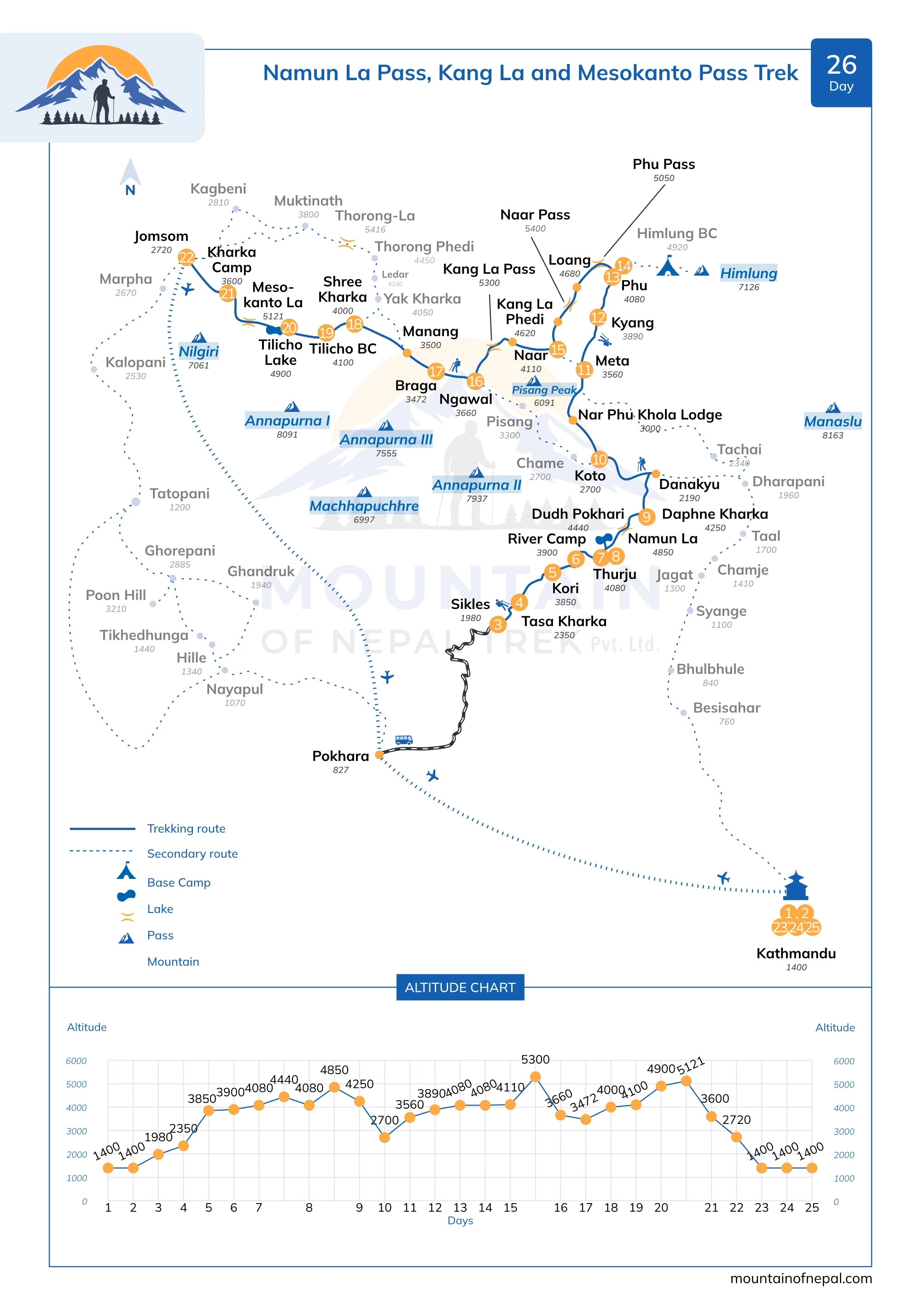
Your Start Date is the day you land in Nepal, and your End Date is when you fly home.
If the set Namun La, Kang La and Mesokanto Pass trek group dates don’t suit your schedule, we can offer alternative dates upon request.
Proper layering is important to stay warm and comfortable in changing mountain weather.
Good footwear makes trekking easier and safer.
The right gear keeps you safe, comfortable, and prepared.
Lightweight but important items keep you clean, healthy, and comfortable.
Keep important items safe and easy to reach.
This trek is considered a very challenging high-altitude expedition due to multiple passes above 5,000 meters, including Namun La (4,850 m), Kang La (5,300 m), and Mesokanto La (5,121 m). It involves long trekking days, remote terrain, steep ascents, and unpredictable weather conditions. Prior trekking experience at high altitude is strongly recommended. The journey demands good physical fitness, mental endurance, and proper acclimatization. The trekking team from Mountain of Nepal carefully designs the itinerary to ensure safety, gradual altitude gain, and professional guidance throughout the route.
Yes, previous trekking experience is highly recommended for this expedition. Since the route passes through extremely remote areas and crosses three major high passes above 4,800 meters, beginners may find it very demanding. Experience with altitude trekking such as Annapurna Circuit or Everest Base Camp is beneficial. However, with strong physical fitness and mental determination, first-time high-altitude trekkers can also complete it under expert supervision. Mountain of Nepal provides professional guides who support trekkers with pacing, acclimatization, and safety management throughout the journey.
Altitude sickness is a significant concern on this trek because several days are spent above 4,000 meters, and the passes exceed 5,000 meters. Symptoms may include headache, nausea, dizziness, and fatigue. Proper acclimatization days in places like Phu Gaon and Naar are essential. Slow ascent, hydration, and rest are key preventive measures. Guides from Mountain of Nepal are trained in altitude management and carry emergency protocols. In severe cases, descent is the only treatment. Therefore, monitoring your health daily is very important during the expedition.
The full journey typically takes around 22 to 26 days, depending on itinerary customization, acclimatization needs, and weather conditions. The trek includes multiple rest days, high passes, and remote valley exploration, making it a comprehensive Himalayan adventure. The duration is intentionally designed to allow proper altitude adjustment and reduce risk. The team at Mountain of Nepal carefully structures each itinerary to balance challenge and safety while ensuring trekkers experience the full beauty of the Annapurna and Nar-Phu regions.
A very high level of physical fitness is required for this trek due to long walking hours, steep ascents, and high-altitude conditions. Trekkers should be capable of walking 6–8 hours daily with a backpack at elevations above 4,000 meters. Cardiovascular endurance, leg strength, and stamina training are strongly recommended before arrival. Regular hiking, running, or stair climbing helps prepare. The experts at Mountain of Nepal often advise at least 2–3 months of pre-trek fitness training for a safe and enjoyable experience.
The best seasons for the Namun La, Kang La, and Mesokanto Pass trek are spring (March to May) and autumn (September to November). During these periods, the weather is generally stable, the skies are clear, and the mountain views are spectacular. Spring offers blooming rhododendrons and moderate temperatures, while autumn provides crystal-clear visibility and dry trails. Winter is extremely harsh with heavy snow at high passes, and the monsoon season brings landslides and slippery conditions. Mountain of Nepal always schedules departures in safe trekking windows for maximum success and safety.
Accommodation varies from basic teahouses in lower villages to tented camping in remote high-altitude areas. In places like Siklis, Koto, or Braga, simple lodges provide meals and beds. However, during sections such as Namun La, Kang La, and Mesokanto La crossings, camping is required due to the lack of settlements. The trekking crew from Mountain of Nepal handles full camping arrangements including tents, food, cooking equipment, and safety gear, ensuring trekkers remain comfortable even in extreme wilderness environments.
Food options vary depending on location. In lower villages, teahouses offer traditional Nepali meals like dal bhat, noodles, soups, and simple continental dishes. In higher and remote areas, meals are prepared by the trekking crew and focus on high-energy foods such as rice, lentils, pasta, and soups. Fresh vegetables become limited at higher altitudes. The team from Mountain of Nepal ensures hygienic meal preparation and provides nutritious food designed to maintain energy levels throughout long trekking days.
This trek is not recommended for independent solo trekking due to its remoteness, high altitude, and complex navigation. The region includes unmarked trails, glacier crossings, and long distances between settlements. Hiring an experienced guide and support team is essential for safety. Mountain of Nepal provides fully supported guided treks with licensed professionals, porters, and emergency backup systems. Traveling with an organized team significantly improves safety, logistical coordination, and overall trekking experience.
Several trekking permits are required, including Annapurna Conservation Area Permit (ACAP), Restricted Area Permits for Nar-Phu Valley, and special permits for crossing high passes in controlled regions. These permits ensure regulated access to protected and restricted zones. The paperwork process can be complex for independent trekkers. However, Mountain of Nepal handles all necessary permits and documentation on behalf of clients, ensuring smooth entry into all trekking regions without administrative hassle.


 (2)
(2)  100% recommend (0)
 (0)
(0)