The Kanchenjunga Expedition (8,586m) is one of the most challenging and remote high-altitude climbing adventures in the world. Organized professionally by Mountain of Nepal, this expedition takes climbers to the world’s third-highest peak, located in eastern Nepal on the border with India. Unlike more commercialized peaks, Kanchenjunga offers a raw and isolated Himalayan experience, demanding strong technical skills, endurance, and mental resilience.
The journey begins with a gradual approach through lowland villages, dense forests, and alpine valleys before reaching the extreme icy environment of the upper mountain. Climbers pass through several acclimatization camps, including Ramche, Glacier Camp, and Advanced Base Camp, before entering the high-altitude climbing zone. The expedition is not just about physical climbing but also about adapting to isolation, harsh weather, and complex logistics in one of the least visited regions of the Himalayas.
Under the guidance of Mountain of Nepal, climbers receive full logistical support, experienced Sherpa guidance, weather forecasting, and oxygen management systems. The expedition typically lasts around 50–60 days, including acclimatization, rotation cycles, and summit attempts.
The best time to attempt the Kanchenjunga Expedition is during the pre-monsoon (spring) season from April to May and the post-monsoon (autumn) season from late September to October. These periods offer the most stable weather conditions, clearer skies, and safer climbing windows, which are critical for such a technically demanding peak.
The spring season is particularly popular because temperatures are slightly warmer, and snow conditions are more predictable for establishing higher camps. However, strong winds and occasional snowfall are still expected at higher elevations. Autumn offers clearer visibility and more stable atmospheric conditions, although temperatures are colder compared to spring. Mountain of Nepal carefully analyzes weather patterns before scheduling summit pushes to ensure maximum safety.
Outside these seasons, the region experiences heavy monsoon rains or extreme winter cold, making climbing highly dangerous and impractical. Landslides, avalanches, and poor visibility are common during off-seasons, significantly increasing expedition risk.
Key Highlights:
The Kanchenjunga Expedition is classified as a very high-difficulty climb, requiring strong technical mountaineering skills, prior 7000m+ experience, and excellent physical conditioning. The route includes steep ice walls, crevasse navigation, avalanche-prone slopes, and long summit pushes above 8,000 meters where oxygen levels are critically low.
Climbers must be comfortable using fixed ropes, ice axes, crampons, and supplemental oxygen systems. The isolation of the region adds another layer of difficulty, as rescue operations are extremely limited compared to more commercial peaks like Everest. Mountains of Nepal ensure climbers undergo proper acclimatization rotations and safety training before attempting higher camps.
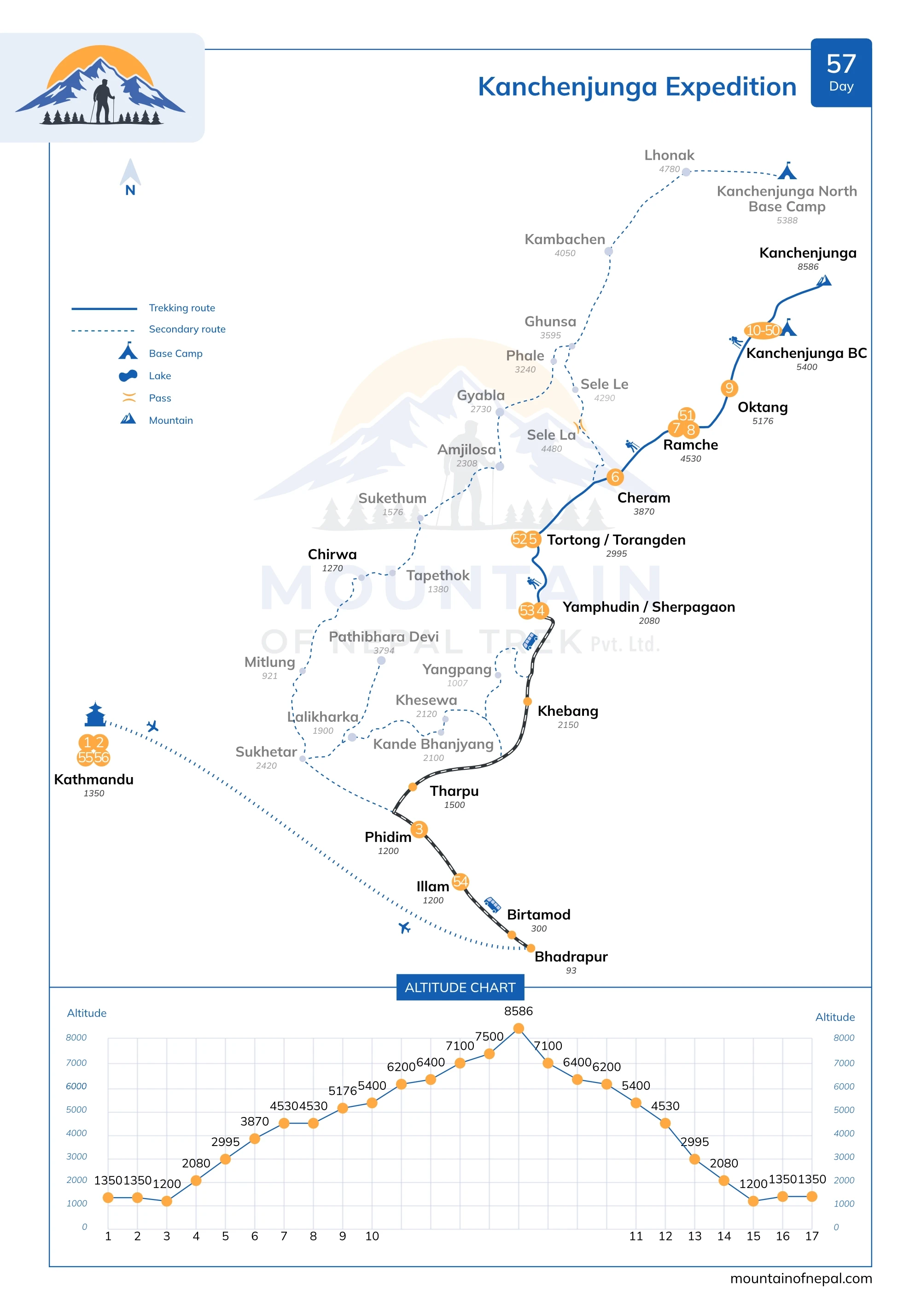
Transportation to the mountain is also complex. The journey includes a flight from Kathmandu to Bhadrapur, followed by long off-road drives through Phidim and Yamphudin. From there, a multi-day trek leads into remote wilderness areas with no road access. This combination of air, road, and trekking makes logistics a key challenge.
Key Highlights:
Food and accommodation during the Kanchenjunga Expedition vary depending on altitude. In Kathmandu and lower villages like Ilam or Phidim, climbers stay in comfortable hotels and lodges with a variety of meals available. As the expedition progresses into higher regions, accommodation becomes more basic, shifting to tented camps managed by Mountain of Nepal.
At base camp and higher camps, expedition-grade tents are used for sleeping, dining, and storage. Meals are prepared by experienced kitchen staff and Sherpa teams, ensuring high-calorie, nutritious food suitable for extreme altitude conditions. Typical meals include soups, rice, pasta, lentils, energy snacks, and hot drinks to maintain hydration and stamina.
Food quality is carefully managed to support energy levels during demanding climbs. Hydration is a major priority due to altitude sickness risks. At higher camps, food becomes simpler but calorie-dense to reduce weight and maximize efficiency.
Key Highlights:
Climbing Kanchenjunga (8,586m) requires multiple official permits issued by the Government of Nepal. These permits are mandatory and strictly regulated due to the mountain’s location in a restricted and environmentally sensitive region. Mountain of Nepal handles all documentation and legal procedures on behalf of climbers.
The primary permit is the Kanchenjunga Climbing Permit, which varies in cost depending on the season. In addition, climbers must obtain a Restricted Area Permit (RAP) for the eastern Nepal region, as well as national park entry permits for the Kanchenjunga Conservation Area. All permits require passport copies, visa details, and insurance coverage that includes high-altitude evacuation.
Proper insurance is essential, covering helicopter rescue up to extreme altitudes. Without valid permits, entry into the region is not allowed, and checkpoints are strictly enforced along the trekking route.
Key Highlights:
The Kanchenjunga Expedition is ideal for climbers seeking a true wilderness mountaineering experience far from crowded routes. Unlike commercial peaks, Kanchenjunga offers solitude, raw natural beauty, and a deep sense of achievement. Choosing Mountain of Nepal ensures professional guidance, safety-focused logistics, and experienced Sherpa support throughout the journey.
This expedition is not just a climb but a complete transformation in endurance, mindset, and mountaineering skill. The remote valleys, untouched landscapes, and challenging terrain make it one of the most rewarding climbs in the Himalayas. Climbers who successfully summit Kanchenjunga often consider it a defining achievement in their mountaineering careers.
Additionally, the structured approach of Mountain of Nepal ensures proper acclimatization, weather monitoring, and emergency preparedness. The company’s experienced team enhances safety while maintaining the authenticity of a high-altitude expedition.
Key Highlights:
Upon arrival at Tribhuvan International Airport in Kathmandu, you will be warmly welcomed by a representative from Mountain of Nepal and transferred to your hotel. The rest of the day is reserved for recovery from your international flight, relaxation, and light exploration of the vibrant city if time permits. In the evening, there will be a brief introduction meeting covering the expedition overview, team coordination, and basic safety guidelines. This first day helps climbers settle into Nepal’s environment, adjust to local time, and mentally prepare for the demanding adventure ahead.
This day is dedicated to essential expedition preparations. The team completes official permit procedures, equipment checks, and documentation required for the Kanchenjunga climbing region. Guides from Mountain of Nepal conduct detailed safety briefings, covering high-altitude risks, climbing techniques, and emergency protocols. You will also have time for last-minute gear shopping in Kathmandu’s trekking districts if needed. This is a crucial organizational day ensuring that everything from logistics to personal equipment is in place before the journey begins into eastern Nepal’s remote mountainous terrain.
Early morning flight from Kathmandu to Bhadrapur takes approximately one hour, offering scenic views of Nepal’s diverse landscapes. Upon landing, the journey continues by road toward Phidim, a long but scenic drive of around six hours covering approximately 105 km. The route passes through rolling hills, tea gardens, and rural settlements. This transition from air to land travel marks the beginning of the expedition’s remote approach phase. Overnight stay in Phidim allows rest and adjustment before entering deeper Himalayan terrain.
Today involves a challenging off-road drive from Phidim to Yamphudin, taking about seven hours over rugged terrain. The route becomes increasingly remote, passing through forested hills, terraced farmlands, and small Limbu and Rai villages. Yamphudin serves as a key entry point to the Kanchenjunga region. Upon arrival, the team prepares for trekking conditions and checks equipment for the upcoming days. The peaceful mountain settlement offers a first real taste of isolation and Himalayan culture, making it an important psychological transition into expedition mode.
The trekking phase begins as you leave Yamphudin and ascend toward Tortong. The trail passes through dense rhododendron and bamboo forests, with occasional suspension bridges and river crossings. The trek takes approximately eight hours, involving steady uphill climbs and moderate altitude gain. Wildlife sightings may include Himalayan birds and possibly red pandas in forested areas. Tortong is a quiet campsite surrounded by natural beauty, providing a peaceful overnight stop. The team continues acclimatization and monitors physical condition carefully as altitude increases.
Today’s trek to Cheram is longer and more demanding, lasting around seven hours. The route gradually climbs through alpine forests and opens into dramatic mountain valleys. As altitude increases, vegetation becomes sparse and views of snow-capped peaks begin to emerge. Cheram is an important settlement in the Kanchenjunga region and serves as a key acclimatization point. The expedition team from Mountain of Nepal ensures proper hydration, pacing, and rest breaks. Overnight in Cheram prepares climbers for higher altitude trekking in the coming days.
The trek to Ramche takes approximately five hours and involves a steady ascent into high alpine terrain. The landscape becomes stark and dramatic, with glaciers and towering peaks dominating the horizon. Ramche is located near the Yalung Glacier area and offers breathtaking views of Kanchenjunga’s southern face. Due to increased altitude, the pace is slow and controlled. Climbers focus on acclimatization and energy conservation. This location serves as a crucial staging point before entering glacier and base camp zones.
This rest and acclimatization day is essential for adapting to high altitude conditions. Short hikes around Ramche are organized to improve oxygen efficiency and monitor climbers’ health. Guides from Mountain of Nepal conduct health checks and reinforce safety protocols. The surrounding glacier views offer opportunities for photography and mental preparation. This pause reduces the risk of altitude sickness before progressing toward glacier camp and advanced base camp. Proper hydration, nutrition, and rest are prioritized throughout the day.
The trek to Glacier Camp takes around six hours and enters a more technical and icy environment. The trail moves over rocky moraines and glacial terrain, requiring careful footing. As oxygen levels drop significantly, climbers move slowly under guide supervision. The scenery becomes increasingly dramatic, with vast ice formations and panoramic Himalayan views. Glacier Camp serves as a critical acclimatization zone before reaching Advanced Base Camp. Proper layering and glacier travel awareness are essential at this stage.
Today’s short but challenging trek leads to Base Camp in about six hours depending on conditions. The route traverses glacial sections and unstable terrain, requiring rope support in certain areas. Upon arrival, climbers settle into one of the highest operational camps of the expedition. The atmosphere is extreme, cold, and remote. Expedition leaders from Mountain of Nepal finalize climbing rotations and logistical planning for summit attempts. This is the final preparation zone before entering full expedition climbing cycles.
This extended phase is dedicated to the full climbing operation of Mount Kanchenjunga, the world’s third-highest peak. Climbers rotate between Base Camp, Camp I, Camp II, and Camp III to gradually adapt to extreme altitude conditions. Technical sections include ice climbing, fixed rope ascents, crevasse navigation, and exposure to severe weather. Summit attempts are carefully planned based on weather windows and team readiness. Throughout this period, Mountain of Nepal ensures full logistical support, weather forecasting, oxygen management, and safety coordination. Successful ascent and return to Base Camp mark the completion of this intense phase.
After completing the climbing phase, the descent begins with a trek back to Ramche. The journey takes around seven hours, retracing glacial and alpine terrain. Physical fatigue is significant, but oxygen levels gradually improve, making movement easier. This descent provides emotional relief after the summit phase. The team reflects on achievements while ensuring safe travel back through high-altitude zones. Ramche offers a comfortable stop for rest and recovery.
The descent continues toward Tortong, taking approximately eight hours. As altitude decreases, breathing becomes easier and energy levels improve. The trail passes through familiar forested regions, offering a contrast to the harsh glacial environment above. This section allows climbers to physically recover while maintaining steady progress downhill. Overnight in Tortong provides comfort and rest after several demanding high-altitude weeks.
Today’s shorter trek of around five hours leads back to Yamphudin. The environment becomes greener and warmer, signaling a return to lower elevations. Local villages reappear along the route, offering cultural interaction opportunities. Climbers feel significant physical relief as oxygen levels normalize. The expedition team celebrates safe descent progress and prepares for the return journey to transportation routes.
A long scenic drive of approximately seven hours takes the team from Yamphudin to Ilam. The route passes through hills, tea plantations, and rural settlements. Ilam is famous for its tea gardens and peaceful atmosphere, making it a relaxing stop after the expedition. Climbers rest, recover, and enjoy warmer temperatures. This phase helps transition from trekking life back to road travel.
The journey continues with a four-hour drive back to Bhadrapur, followed by a one-hour flight to Kathmandu. Upon arrival, transfer to the hotel is arranged by Mountain of Nepal. This day marks the official return from the expedition region to the capital. Climbers can rest, refresh, and reconnect with city comforts after weeks in remote mountains.
This leisure day in Kathmandu allows for relaxation, personal exploration, and souvenir shopping. Participants may visit cultural sites or simply rest at the hotel. In the evening, a farewell celebration dinner is hosted by Mountain of Nepal to honor the successful expedition. Certificates, reflections, and team appreciation moments are shared. It is a celebratory closure of the challenging Kanchenjunga journey.
On the final day, participants are transferred to Tribhuvan International Airport for onward travel. The expedition officially concludes with heartfelt farewells from the Mountain of Nepal team. Memories of the Kanchenjunga climb, teamwork, and Himalayan adventure remain with climbers as they depart Nepal.
Your Start Date is the day you land in Nepal, and your End Date is when you fly home.
If the set Kanchenjunga Expedition group dates don’t suit your schedule, we can offer alternative dates upon request.
The Kanchenjunga Expedition is a high-altitude mountaineering journey to the world’s third-highest peak, Mount Kanchenjunga (8586m), located in eastern Nepal. Organized by Mountain of Nepal, this expedition involves trekking, acclimatization, and technical climbing through remote Himalayan terrain. It requires strong physical fitness, prior climbing experience, and mental endurance. The expedition typically spans several weeks, including rotations between camps before attempting the summit. It is considered one of the most remote and challenging climbs in Nepal.
The Kanchenjunga climb is extremely difficult and is classified as a serious mountaineering expedition. Climbers face technical ice and snow sections, unpredictable weather, crevasses, and very high altitude above 8000 meters. Proper use of oxygen systems, ropes, and climbing equipment is essential. The expedition organized by Mountain of Nepal is suitable only for experienced climbers with prior 6000m or 7000m peak experience. Physical endurance, technical skills, and mental resilience are all critical for a successful summit attempt.
Yes, prior high-altitude climbing experience is strongly recommended for the Kanchenjunga Expedition. Participants should ideally have successfully climbed peaks above 6000 meters, such as Island Peak or Mera Peak, before attempting this expedition. Mountain of Nepal carefully evaluates each climber’s experience before approval. Basic trekking experience alone is not sufficient due to the technical nature of the climb, long expedition duration, and extreme altitude conditions above 8000 meters.
The full Kanchenjunga Expedition typically takes around 50 to 60 days, depending on weather conditions, acclimatization needs, and summit windows. The itinerary organized by Mountain of Nepal includes trekking to base camp, multiple acclimatization rotations, and a long summit phase between Camp I, II, and III. Additional time is required for safe descent. The extended duration ensures proper acclimatization, reducing risks of altitude sickness and increasing the chances of a successful summit.
Yes, altitude sickness is one of the most serious risks during the Kanchenjunga Expedition. Symptoms may include headache, nausea, dizziness, and fatigue. Above 8000 meters, the risk increases significantly due to low oxygen levels. Mountain of Nepal follows a strict acclimatization schedule, including gradual ascent, rest days, and rotation climbs between camps. Supplemental oxygen and medical monitoring are used during high camps to reduce risks and ensure climber safety.
Choosing Mountain of Nepal ensures a professionally managed expedition with experienced Sherpa guides, strong safety protocols, and full logistical support from arrival to departure. The company specializes in high-altitude Himalayan expeditions and has structured itineraries designed for proper acclimatization and summit success. Their team provides personalized guidance, technical support, and emergency preparedness, making the Kanchenjunga Expedition safer and more organized for international climbers seeking one of the world’s most challenging peaks.
The best seasons for the Kanchenjunga Expedition are spring (April to May) and autumn (September to October). These periods offer more stable weather, clearer skies, and safer climbing conditions. During these months, winds are relatively lower, and visibility is better for summit attempts. Mountain of Nepal primarily schedules expeditions in these seasons to maximize safety and success rates. Winter is too harsh, and monsoon season brings heavy rain and unstable conditions, making climbing unsafe.
During the expedition, accommodation varies depending on location. In Kathmandu, climbers stay in comfortable hotel rooms with breakfast included. During trekking, teahouse lodges are used in lower regions, while higher camps require tented accommodation. At base camp and above, fully equipped expedition tents are provided by Mountain of Nepal. High-altitude camps are supported with shared sleeping tents, kitchen tents, and dining setups. Conditions become more basic as altitude increases, especially above base camp.
During the trek and expedition, meals are provided three times a day. In lower regions, fresh local meals are served in teahouses, while at higher camps, expedition cooks from Mountain of Nepal prepare nutritious, high-energy meals designed for extreme altitude conditions. The diet typically includes carbohydrates, proteins, soups, and energy-rich foods to support endurance. Special dietary requirements can be managed with prior notice, though options become limited at higher elevations.
Climbing Mount Kanchenjunga requires several official permits, including a climbing permit from the Nepal government and entry permits for Kanchenjunga Conservation Area. These permits are arranged in advance by Mountain of Nepal as part of the expedition package. The region is restricted and protected, so independent climbing is not allowed. Proper documentation, fees, and liaison officer arrangements are mandatory for legal access to the mountain.
Climbers must bring personal high-altitude gear such as insulated mountaineering boots, crampons, harness, helmet, down suit, gloves, goggles, and sleeping bags suitable for extreme cold. Technical climbing equipment like ropes and ladders is provided by Mountain of Nepal. Proper layering systems are essential due to extreme temperature variations. Good quality gear is critical for safety, especially above base camp where conditions become icy, windy, and unpredictable.
Yes, emergency support is available throughout the expedition. Mountain of Nepal provides first aid assistance, experienced guides trained in high-altitude rescue, and coordination for emergency evacuation if needed. Helicopter evacuation from high-altitude regions is possible but depends on weather and location. Climbers are strongly advised to have comprehensive travel insurance that covers high-altitude trekking and rescue operations. Safety is a top priority, especially in remote sections of the Kanchenjunga region.


 (2)
(2)  100% recommend (0)
 (0)
(0)