Need help with booking? Send us a message.
The Mera Peak expedition is a classic Himalayan journey that combines remote trekking, high-altitude acclimatisation, and a non-technical glacier climb to one of Nepal’s highest trekking peaks at 6,476m. The route follows the scenic Hinku Valley, offering a quieter and more wilderness-focused alternative to the Everest region.
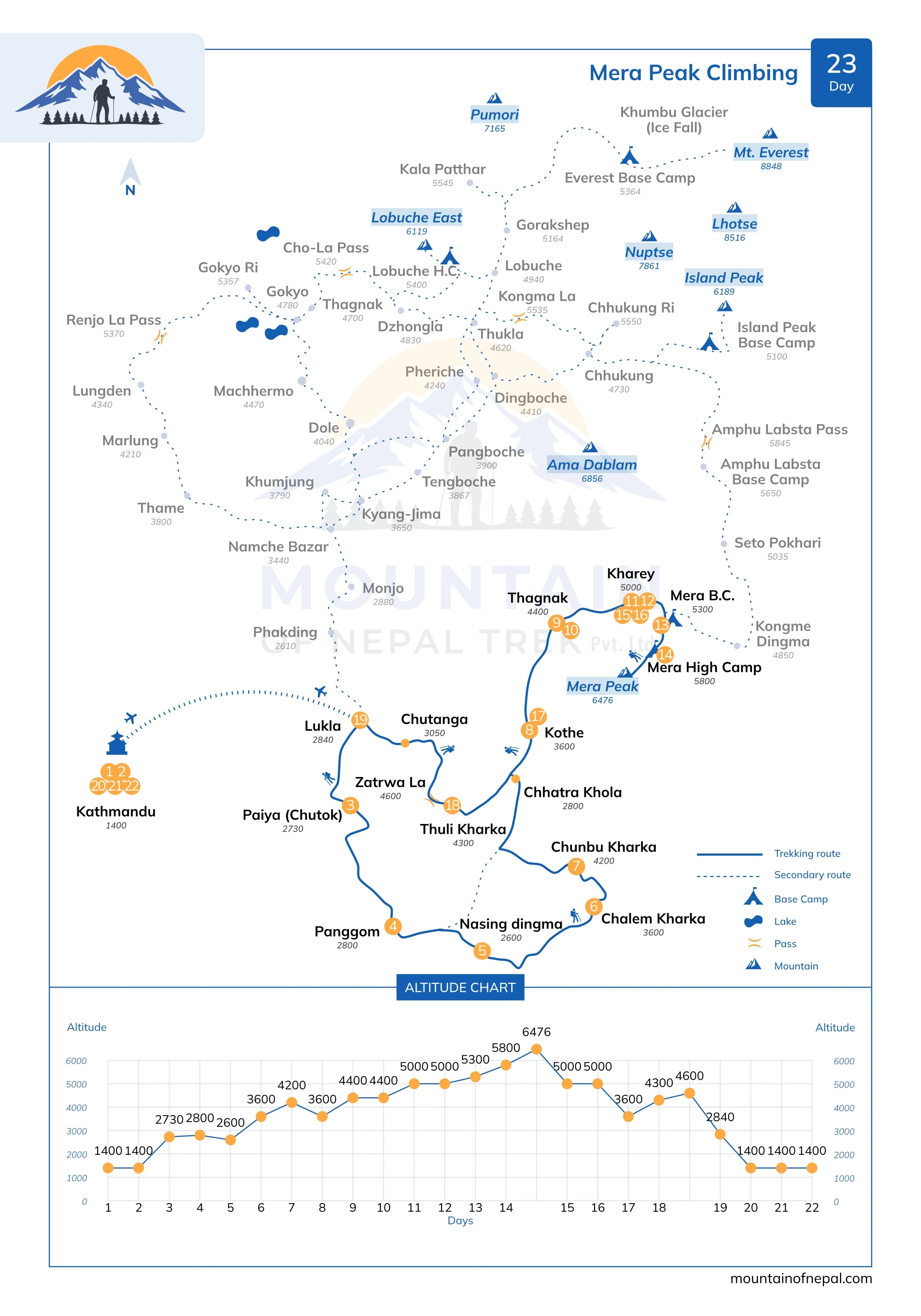
Your journey begins with a spectacular mountain flight to Lukla (2,800m), followed by several days of trekking through traditional villages, forested ridges, and high passes. The trail gradually descends and ascends through peaceful and less-travelled terrain, passing settlements such as Puiyan, Panggom, and Nashing Dingma before entering the remote Hinku Valley. As you move deeper into the Himalayas, the landscape shifts from lush rhododendron and pine forests to open alpine valleys and glacial terrain. Key stops include Kothe, Thaknak, and Khare (5,000m), where climbers prepare for the summit phase. A dedicated acclimatisation hike and pre-climb training session ensure safe progression into high altitude. From Khare, the route leads onto the glacier via Mera La (5,300m) and up to High Camp (5,800m), where climbers prepare for the summit push. The ascent of Mera Peak involves an early morning glacier climb using crampons and ropes, rewarded with panoramic views of Mount Everest, Makalu, Kanchenjunga, Lhotse, and other Himalayan giants from the summit. After the successful climb, the route retraces back through the Hinku Valley and crosses Zatrwa La Pass (4,600m) before descending to Lukla, completing a full circuit through one of Nepal’s most beautiful and remote mountain regions. This expedition is ideal for trekkers seeking a challenging high-altitude adventure with basic mountaineering experience, combining wilderness trekking, glacier travel, and a rewarding Himalayan summit.
The best seasons for Mera Peak Climbing with Mountain of Nepal are spring (March to May) and autumn (September to November). These periods provide the most stable weather conditions, clear skies, and excellent mountain visibility, making the summit attempt safer and more enjoyable. Spring is especially beautiful due to blooming rhododendron forests and slightly warmer temperatures at higher elevations.
Autumn, on the other hand, is considered the most popular season because of its post-monsoon clarity. The air is clean, the trails are dry, and the visibility of the Himalayan peaks is at its peak. Winter climbing is possible but extremely cold, especially above Khare and High Camp, while the monsoon season (June to August) is not recommended due to heavy rainfall, slippery trails, and flight disruptions to Lukla.
Season highlights:
Choosing the right season ensures better acclimatisation, safer climbing conditions, and a higher chance of successful summit with the Mountain of Nepal.
Mera Peak is classified as a non-technical trekking peak, but it should not be underestimated. The main challenge is altitude rather than technical climbing skills. Climbers must be prepared for long trekking days, glacier walking, and extreme cold at higher camps. The summit day involves early morning ascent, use of crampons, ropes, and basic ice axe techniques, which are taught during acclimatisation at Khare by the climbing guides of Mountain of Nepal.
The trek requires good physical fitness, stamina, and mental endurance. Altitude sickness is a real risk as the route climbs above 5,000m before reaching High Camp at 5,780m. Proper acclimatisation days, hydration, and a slow ascent are essential for success. The climb is considered moderate to challenging, depending on weather and individual fitness.
Transportation begins with a scenic flight from Kathmandu to Lukla, one of the most thrilling air routes in the world. From Lukla, the journey continues on foot through remote valleys. Return is also via Lukla flight back to Kathmandu.
Difficulty & transport summary:
During the Mera Peak expedition with Mountain of Nepal, food and accommodation are provided in a combination of teahouses and tented camps, depending on altitude. In lower regions such as Paiya, Panggom, and Kothe, trekkers stay in local teahouses that offer basic but comfortable lodging with twin-sharing rooms and warm blankets. As altitude increases, especially beyond Khare, accommodation becomes more basic and often involves shared lodges or camping setups.
Meals are provided three times a day (breakfast, lunch, and dinner). The food is designed to be high-energy and nutritious, helping trekkers maintain strength at high altitude. Common meals include rice, lentils (dal bhat), noodles, pasta, potatoes, soups, eggs, and seasonal vegetables. Hot drinks like tea, coffee, and ginger lemon honey are widely available and essential for hydration and warmth.
At High Camp, climbers stay in tented accommodation arranged by the expedition team. Here, food is prepared by the support crew in extreme conditions. Clean drinking water is treated or boiled throughout the journey.
Food & accommodation highlights:
To climb Mera Peak legally, several permits are required, all of which are fully managed by Mountain of Nepal as part of the package. These permits ensure safety, conservation, and regulated access to the Khumbu and Makalu-Barun regions.
The main permits include the Mera Peak Climbing Permit, issued by the Nepal Mountaineering Association (NMA), and the Makalu Barun National Park Entry Permit, as much of the trek passes through protected areas. Additionally, a Lukla–Hinku Valley local entry permit or municipality tax may be required, depending on the route variation.
These permits are essential and checked at various checkpoints along the trail. Without proper documentation, entry into the region is not allowed. The climbing permit fee varies depending on the season, with spring being the most expensive due to peak demand.
Required permits:
All permits are arranged in advance by Mountain of Nepal, ensuring a hassle-free trekking experience.
Choosing Mountain of Nepal for Mera Peak Climbing ensures a safe, well-organised, and professionally guided Himalayan expedition. The company provides experienced certified climbing guides, proper acclimatisation schedules, and strong logistical support from arrival in Kathmandu to summit and return. Safety is the top priority, especially in high-altitude environments where weather and health conditions can change rapidly.
Another key advantage is personalised service. The itinerary is carefully designed with enough acclimatisation days, including training at Khare before the summit push. This increases success rates significantly. The company also ensures quality equipment support, emergency backup plans, and communication systems for remote trekking regions.
Additionally, climbers benefit from cultural immersion, scenic trekking routes, and less crowded trails compared to Everest Base Camp. The combination of adventure, safety, and professional guidance makes this expedition ideal for aspiring climbers seeking their first Himalayan summit experience.
Why choose us:
Upon arrival at Tribhuvan International Airport, you will be warmly welcomed by a representative from Mountain of Nepal Trek and transferred to your hotel in Kathmandu. After check-in, the rest of the day is free to rest and recover from your international flight. If time permits, you may explore Thamel, Kathmandu’s lively tourist district, known for trekking shops, cafés, restaurants, and local handicrafts. In the evening, enjoy a welcome dinner at a traditional Nepali restaurant, where you will experience authentic cuisine and meet your guide for a brief introduction before the expedition begins. Accommodation: Hotel, Meals: Welcome Dinner
Today is an essential preparation day for your Mera Peak Climbing expedition. The day begins with a detailed briefing from your climbing guide, where you will review the full Mera Peak climbing itinerary, trekking and climbing route, altitude challenges, safety guidelines, and overall expedition plan. Along with your climbing guide, you will also meet your climbing team and gain a clear understanding of how the journey will be organized from start to summit and return. A complete gear check follows to ensure you are fully prepared for high-altitude conditions. Your guide will inspect all trekking and climbing equipment, including boots, crampons, harness, helmet, sleeping bag, clothing layers, backpack, and other essentials. If anything is missing or needs adjustment, equipment can be rented or purchased in Thamel, Kathmandu. The rest of the day is free for rest, finally shopping in Kathmandu, or personal preparation at your own pace. This preparation day ensures everything is in place—logistically, physically, and mentally—so you can begin your journey into the Himalayas with confidence, clarity, and peace of mind.
Start your Mera Peak climb with an early morning scenic flight to Lukla, operating either from Kathmandu (approx. 35 minutes) or Manthali Airport in Ramechap (approx. 20 minutes), depending on the season. This short mountain flight offers breathtaking views of the Himalayas, including snow-capped peaks and deep valleys, before landing at the famous Tenzing–Hillary Airport, where your trekking crew will welcome you. The guides and porters will collect your luggage, and once everything is packed and ready, you will set off on today’s walking journey. You begin with a descent from the airstrip down a scenic mountain trail toward the Surke Khola River. It is a beautiful downhill walk through natural terrain, with the river guiding us toward the larger Dudh Kosi, known for its fast-moving glacial waters. The trail then follows old trading routes used for generations. We pass small mountain villages where locals farm the land, growing crops like millet, corn, and buckwheat for daily life. As we continue our journey, we gradually ascend again. The elevation changes, and the landscape transforms as the trail enters the lush Himalayan Forest. Open fields give way to peaceful woodland filled with oak, maple, and rhododendron trees, creating a quiet and refreshing trekking environment. Overnight in a lodge in Puiyan.
After your first breakfast in the mountains, you begin walking along a well-marked main trekking trail for a short distance before turning onto a quieter forest path. This section can sometimes be less defined and requires careful attention as you move deeper into a more remote and natural landscape. Gradually, the route becomes more isolated as you traverse a series of ridges toward the Khari Khola valley. Although the altitude remains similar to the previous day, the trail is not flat. You steadily ascend and descend across two main passes: Chutok La (2,945m) and Khari La (3,080m). These passes are not very high, but they make the day more physically engaging with continuous ups and downs. As you approach Pangum, the trail enters a quiet, bowl-shaped valley just below Pangum La. The surroundings become increasingly peaceful, with dense forests of rhododendron, pine, and oak. This is a less-traveled route, so you will encounter very little foot traffic, mostly limited to local villagers. Finally, you arrive at Pangum, a traditional and historic village that remains largely untouched by modern development. Stone-built houses line the hillside, and a newly built monastery (gompa) sits above the settlement, with prayer flags and prayer wheels reflecting the region’s spiritual heritage. From the village, wide views open across the surrounding valley and distant ridgelines. Overnight in a lodge in PuiyanPanggom.
Today’s journey begins with a short but rewarding climb to Pangum La (3,175m), where the route opens into the dramatic entrance of the beautiful Hinku Valley. From the pass, you get your first view of Mera Peak. The trail then turns east and then north, leading you deeper into less-traveled Himalayan terrain. You then descend sharply to the Hinku River—a long but rewarding drop through changing landscapes. The descent can be steep and demanding on the knees, so trekking poles can be a valuable companion. After reaching the valley floor, the route climbs steadily again toward a high camp near Surke La, offering a true sense of adventure and accomplishment. This is a true expedition day—marked by significant elevation loss and gain—that helps build strength for the higher altitudes ahead. Throughout the day, you’ll experience a rich mix of scenery—from cultivated slopes with traditional grain farming to thick rhododendron forests mixed with pine and scattered fir—making this one of the most varied and rewarding sections of the trek. Overnight at a lodge or camp in Nashing Dingma.
From your camp, you ascend until you reach a beautiful mountain pass called Surke La (3,085m). From the pass, you continue for about another hour before stopping at a suitable point for lunch, as there are no reliable water sources along this exposed section of the Surke Danda ridge. After the lunch break, the trek continues along the Surke Danda ridge, gradually heading north into a quieter and more remote part of the Himalayas. This scenic ridge walk is covered with thick bamboo and rhododendron forests, and the trail gradually leads you deeper toward the Hinku Valley and in the direction of Mera Peak. This section is remote and off the main trekking routes, with no teahouses, making it feel like true wilderness trekking. The landscape becomes increasingly wild and untouched as you move further into the mountains. Continuing deeper into the wilderness, you eventually arrive at your campsite at Chalem Kharka, a seasonal yak grazing area used by lowland communities. Overnight in a tented camp.
A challenging day today as we traverse two dramatic high passes at approximately 4,200m and 4,450m before descending to our campsite. After breakfast, we begin the ascent to the first pass at around 4,200m, taking approximately two hours of steady climbing along the ridge. As we gain height, the views open up dramatically across the valley, and on the far side, we can even spot the route over Zatra La, leading back toward Lukla. At the top of the first pass, the scenery expands further, revealing sweeping views of the Kanchenjunga range, where the towering peak of the world’s third-highest mountain dominates the horizon in a truly unforgettable panorama. From the pass, we continue the ascent toward the second pass at 4,450m, which is reached in about another two hours. At this altitude, the landscape becomes fully alpine—no forests, only vast grassy slopes, stone ridges, and dramatic cliffs. This is also a good area for spotting wildlife, including birds of prey such as griffon vultures, lammergeiers, and eagles soaring overhead. A short descent then leads to the sacred Panch Pokhari lakes, a cluster of five alpine pools where Hindu pilgrims visit during seasonal festivals. From the lakes, a steady 30-minute descent brings us to our campsite at Chunbu Kharka (around 4,200 m).
Today’s trek takes you deeper into the Hinku Valley, entering more remote and scenic terrain as you approach Kote. The day begins with a steady ascent to a ridge at around 4,400 m, followed by a long traverse along the eastern side of the valley. The trail then gradually descends through dense rhododendron forest, with some sections of loose, rocky terrain, leading to a lunch stop after approximately 4 hours of walking. After lunch, the trail continues for around 3 hours, descending deeper into the valley. As you descend further, the sound of the river gradually grows stronger. Along the way, the landscape opens up to a striking natural feature—a wide erosion scar above the Hinku River. This area was significantly shaped by a major flood event in 1998, when Sabai Tsho breached its moraine dam, significantly reshaping the valley’s landscape. The route then continues to a river crossing via a suspension bridge before reaching Kote. This peaceful campsite is set on a grassy terrace above the river, surrounded by forest and mountain scenery. Overnight: at the lodge in Kote.
Today, you enter the high alpine zone as the trail leads deeper into the Hinku Valley. The landscape becomes more open and rugged, and the surrounding peaks feel much closer, creating a true high-mountain experience. The morning begins with a steady walk along the river on a rocky trail, with a gradual ascent through the valley. As you gain elevation, the terrain opens up, offering impressive views of Kyashar (6,769m) and Kusum Kanguru (6,367m. Leaving the river valley behind, the trail climbs gently toward wide alpine yak pastures (kharka), where the scenery becomes broader and more dramatic. After approximately 3 hours, you reach a suitable lunch stop. From here, you have the option to take a short detour to a small cave monastery located above the main trail. While simple, it offers insight into local culture and a peaceful mountain setting. The trek continues for another 2 hours toward Thagnak, following a gradual ascent through increasingly rugged terrain. Basic tea houses can be found along the route, though facilities remain simple compared to the Everest main trail. By the time you reach Thagnak, you are fully in the high mountain environment, surrounded by open valley landscapes and towering peaks—an important step in your acclimatization and journey toward Mera Peak. Overnight: Teahouse / Lodge in Thagnak
Today, you make an acclimatization hike to a viewpoint at approximately 5,100 m. The route involves a steady climb up the grassy ridge rising behind Thagnak. This acclimatization hike follows the “climb high, sleep low” approach, allowing your body to adjust effectively before heading to higher elevations. The round trip takes around 5–6 hours, depending on weather, trail conditions,, and walking pace. At the top, the effort is well rewarded with stunning views of Mera Peak, Kyashar, and Kusum Kanguru, rising dramatically above the surrounding landscape. The high-altitude setting offers a true sense of being deep in the Himalayas. After a short rest, you descend back to Thagnak. This is not a summit day, but it is a critical part of the expedition, helping build the strength and altitude adaptation needed for a safe and successful climb of Mera Peak.
Today’s trek begins on a rough and rocky trail, where walking becomes slower as the terrain turns increasingly rugged with scattered boulders and glacial debris. After about an hour, there is a short detour to the Sabai Tsho glacial lake area, a significant site formed by the 1998 flood event when a glacial lake burst its natural moraine dam, reshaping parts of the Hinku Valley. The route then continues deeper into the valley toward Dig Kharka, reached after around three hours of steady trekking across open alpine terrain. Following a short break, the final section involves a gradual ascent of about an hour to Khare, the main base area for Mera Peak, located beneath dramatic surrounding peaks of the Hinku region. By the time you arrive, you are fully in high-altitude terrain, marking an important stage of acclimatization before entering the glacier zone. Overnight at a lodge in Khare (5,000m).
Before the summit push of Mera Peak, a pre-climb training session is conducted at Khare. This essential preparation helps climbers refresh key mountaineering skills and build confidence for high-altitude peak climbing. With guidance from our experienced climbing guides, you will learn the essential techniques required for glacier travel and high-altitude climbing. This includes the correct use of crampons, harness, ice axe, and rope systems in alpine conditions. You will also train in rope team movement across snow and glacier terrain, including safe ascent and descent procedures, practicing balance, coordination, and mountain safety. The session includes an introduction to basic self-arrest techniques, building confidence, and readiness for the challenges of Mera Peak climbing. This hands-on session ensures climbers are well-prepared for the technical sections of Mera Peak, including glacier travel and high-altitude movement, improving both safety and summit success chances. Overnight at a tented camp
Today’s climb begins with a steady ascent over a moraine ridge, followed by a steeper scree slope as you gain height above the valley. The trail continues toward the snout of the glacier, taking approximately two hours. From here, the nature of the climb changes, and the real high alpine section begins. You gear up with crampons and a harness before stepping onto the ice. After preparation, a short climb over icy terrain leads you onto a broad glacial plateau. The route then continues across the glacier toward Mera La (5,300m), which offers spectacular panoramic views of Himalayan giants including Mount Everest, Makalu, Kanchenjunga, Lhotse, Nuptse, Chamlang, and Baruntse on clear days. As there are no designated camping areas at the pass itself, you descend approximately 20–30 minutes to the eastern side to find a suitable place to set up camp on rocky terrain, often covered with snow. Overnight: Tented Camp
Leaving Mera La behind, you begin the climb to Mera High Camp, following the route along the rocky north flank. The trail gradually gains elevation over a mix of snow, ice, and loose terrain, becoming more exposed as you move higher and requiring a steady, controlled pace. After a 3-4 hour climb, you reach Mera High Camp (5,800m), set on a narrow ridge with outstanding Himalayan views. On clear days, peaks such as Everest, Makalu, and Kanchenjunga dominate the skyline. From this elevated position, tomorrow’s summit route becomes clearly visible, leading across the glacier toward the upper slopes of Mera Peak. At High Camp, you rest, hydrate, and prepare equipment for the early morning summit push. An early dinner is taken before resting for the night. Overnight: Tented Camp
The summit push begins in the early hours of the morning, typically around 2:00–3:00 AM, when conditions are most stable on the upper mountain. Under a starlit sky and by headlamp light, you leave Mera High Camp and step onto the vast, frozen slopes of the Mera Glacier. The ascent starts gradually but steadily, following a broad snowfield where the effects of altitude become noticeable. Moving in rope teams, you maintain a slow and consistent rhythm, conserving energy for the long climb ahead. Although the route is generally non-technical, it is physically demanding, with deep snow and continuous high altitude requiring strong endurance, as well as the use of crampons, ropes, and ice axes. As you gain height, the terrain opens into a wide, exposed glacial amphitheatre. The air becomes thinner, and each step demands focus and determination. Depending on conditions, short steeper sections lead toward the final ridge, where the slope narrows, and the mountain reveals its vast Himalayan surroundings. From the summit ridge, a final push brings you to the top of Mera Peak (6,476m / 21,247ft). On clear days, the view is one of the most spectacular in the Himalayas, with panoramic sights of Mount Everest, Makalu, Kanchenjunga, Lhotse, Cho Oyu, as well as Baruntse, Chamlang, and Nau Lekh, along with countless other Himalayan giants stretching across the horizon. After a short but unforgettable time at the summit, you begin your descent carefully, retracing your steps down the glacier. The descent requires steady movement and full concentration, especially on steeper sections where fatigue can set in. Upon returning to Mera High Camp, you take a short rest before continuing the long descent back toward Khare. The route follows familiar terrain, gradually losing altitude as breathing becomes easier and the landscape transitions back toward alpine valleys. By late afternoon or evening, you arrive in Khare, where a well-earned rest awaits after a demanding yet highly rewarding summit day. Overnight: Lodge
This day is reserved as a contingency to provide flexibility for the summit attempt of Mera Peak. In the high Himalayas, weather conditions can change quickly, and factors such as strong winds, snowfall, or poor visibility may delay climbing plans. If the summit attempt cannot be completed as scheduled, this extra day provides another opportunity to reach the summit under safer and more favorable conditions. Your climbing team will carefully assess the weather, route conditions, and the group’s overall health before making any decisions. If the summit has already been successfully achieved, the day can be used for rest and recovery at Khare or nearby camps, allowing time to relax after the physical demands of the climb. It also provides flexibility in case of delays or changes to domestic flights in the Everest region. Overnight: Lodge
After 9–10 hours of trekking the previous day, the effects are still felt in the body—heavy legs and tired muscles, but a mind still lifted by the scale of the journey. We pack up camp and begin a gentle descent, slowly retracing familiar paths back into the valley. The route drops away from the high ground and reaches Thaknak. From here, we continue through rolling pastures and juniper meadows, where the landscape gradually opens and unfolds behind us as we descend. After a couple of hours, the terrain becomes steeper, guiding us down toward the riverbed. The trail then narrows into a rugged, boulder-strewn path, where each step requires focus as we follow the sound of the river through the valley all the way to Kote.
The trail begins gently, following the Hinku River through an undulating valley floor, where the walk feels calm and unhurried at first. Soon, the rhythm changes as the path begins to climb steadily toward Tattor, where we pause for lunch beneath the rising slopes. Beyond this point, the trail enters a dense forest filled with rhododendron and blue pine. The air becomes cooler as the trees grow thicker around us. The ascent continues, gradually becoming steeper, turning into a steady uphill walk through rich mountain woodland and natural vegetation. As we gain height, we move above the tree line and traverse a series of exposed ridges toward our final camp at Chetrabu, also known as Thuli Kharka. The trail rises through rugged Himalayan terrain, gradually pulling us into a quieter, more exposed landscape where the valley drops away beneath us. Today we gain around 700 meters in elevation as we climb toward our camp below tomorrow’s dramatic pass, Zatrwa La. The landscape becomes wilder and more exposed, marking the final approach into high alpine terrain before the crossing ahead. Lodge accommodation
Today we cross two passes. A steady climb leads to the first pass, Zatrwa La (4,600m), where the landscape opens into wide Himalayan views. From here, the route follows an exposed ridge to the second pass, Zatrwa Og (4,592m), slightly lower but equally dramatic. Beyond the pass, the descent is long and demanding, often icy and slippery in colder conditions. When required, your climbing guides will fix a rope to ensure a safe and controlled descent. We stop for lunch along the way before continuing the long descent toward Lukla. Lodge accommodation.
On the final day, you are transferred to Tribhuvan International Airport for your onward journey. Depending on your flight schedule, you may have time for a short walk or final shopping in Kathmandu. The expedition officially concludes with lifelong memories of the Himalayas, teamwork, and achievement. The Mountain of Nepal team ensures a smooth departure and farewell, marking the end of your Mera Peak climbing adventure.
Your Start Date is the day you land in Nepal, and your End Date is when you fly home.
If the set Mera Peak Climbing group dates don’t suit your schedule, we can offer alternative dates upon request.
Mera Peak is one of the highest trekking peaks in Nepal, standing at 6,461 meters. It is located in the Everest region and is known for offering stunning panoramic views of five 8,000-meter giants: Everest, Lhotse, Makalu, Cho Oyu, and Kanchenjunga. The peak is considered less technical compared to other climbing peaks, making it ideal for trekkers transitioning into mountaineering. Mountain of Nepal organizes this expedition with proper acclimatization, experienced guides, and safety-focused planning. Its popularity comes from the combination of high altitude adventure, relatively moderate technical difficulty, and breathtaking Himalayan scenery.
Mera Peak is classified as a moderately difficult trekking peak, but it still requires strong physical fitness and basic mountaineering skills. The climb involves long trekking days, high altitude exposure, glacier walking, and steep snow slopes. While it is not highly technical, the altitude above 6,000 meters makes it physically demanding. Climbers need to be prepared for cold temperatures, thin air, and endurance challenges. Mountain of Nepal ensures proper training at Khare before the summit attempt, which helps participants learn how to use crampons, ropes, and ice axes safely, significantly increasing success and safety rates.
No prior technical climbing experience is strictly required for Mera Peak, but good trekking experience is highly recommended. Beginners can also join if they are physically fit and mentally prepared for high-altitude conditions. Before the summit push, Mountain of Nepal provides essential pre-climb training in Khare, including rope handling, walking on snow, and safety techniques. This training is designed to prepare even first-time climbers for the ascent. However, participants should have strong stamina, as the expedition involves multiple days of trekking at increasing altitudes and demanding physical conditions.
The Mera Peak climbing itinerary typically takes around 15 to 18 days, depending on the route, weather conditions, and acclimatization needs. The journey includes trekking from Lukla through remote valleys, gradual altitude gain, training days, summit preparation, and return trekking. Mountain of Nepal designs a carefully structured itinerary that prioritizes proper acclimatization to reduce altitude sickness risks. Additional reserve days are also included in case of weather delays or summit adjustments, ensuring flexibility and safety throughout the expedition.
Yes, altitude sickness is one of the most important risks during Mera Peak climbing due to the elevation above 6,000 meters. Symptoms may include headache, nausea, dizziness, and fatigue. Proper acclimatization is essential to minimize risks. The itinerary designed by Mountain of Nepal includes gradual ascent, rest days, and training at intermediate elevations like Khare. Guides are trained to monitor climbers’ health and respond quickly to symptoms. Staying hydrated, maintaining a slow pace, and following safety instructions greatly reduce the chances of severe altitude-related issues.
Mera Peak requires a good level of physical fitness, endurance, and mental determination. Climbers should be comfortable walking 5–7 hours daily with a backpack over uneven terrain and at high altitude. Cardiovascular fitness, strength training, and hiking experience are highly beneficial. Preparation should ideally begin weeks or months before the expedition. Mountain of Nepal recommends regular trekking, jogging, and stair climbing exercises before joining. While technical skills are taught during the trip, physical readiness is essential for a safe and enjoyable experience.
The best seasons for Mera Peak climbing are spring (March to May) and autumn (September to November). During these periods, the weather is generally stable, the skies are clear, and the mountain views are spectacular. Temperatures are more predictable, and the chances of successful summit attempts are higher. Winter is extremely cold and challenging, while the monsoon season brings heavy rain and poor visibility. Mountain of Nepal carefully schedules expeditions during optimal weather windows to ensure safety, comfort, and the best possible climbing experience for participants.
Accommodation during the Mera Peak expedition mainly consists of teahouses and basic mountain lodges. In lower elevations, rooms are relatively comfortable with twin-sharing beds, blankets, and simple meals. As altitude increases, especially above Khare, facilities become more basic due to remoteness. During the high camp phase, climbers stay in tented camps arranged by Mountain of Nepal. Although amenities are limited at higher altitudes, the team ensures proper sleeping arrangements, warm food, and safety support throughout the journey.
During the Mera Peak expedition, meals are provided in teahouses and camps, focusing on high-energy and easily digestible foods. Common options include rice, noodles, soups, potatoes, eggs, vegetables, and traditional Nepali meals like dal bhat. At higher altitudes, food variety becomes limited but is carefully prepared to support energy needs. Mountain of Nepal ensures hygienic and nutritious meals throughout the journey. Special dietary requirements can also be arranged with prior notice, although options may be limited in remote areas.
To climb Mera Peak, several permits are required, including the Mera Peak climbing permit, Makalu Barun National Park entry permit, and TIMS (Trekkers’ Information Management System) card. These permits are mandatory for legal entry and climbing in the region. Mountain of Nepal handles all necessary paperwork and permit arrangements on behalf of climbers, ensuring a smooth and hassle-free process. Permit fees vary depending on the season, with higher costs during peak climbing months like spring and autumn.
Climbers need specialised trekking and mountaineering gear for Mera Peak. Essential items include warm down jackets, insulated boots, thermal layers, gloves, crampons, harness, ice axe, helmet, and sleeping bags rated for extreme cold. Personal trekking gear, such as backpacks, trekking poles, and sunglasses, is also necessary. Mountain of Nepal provides guidance on equipment selection and may supply some technical climbing gear if needed. Proper equipment is crucial for safety, comfort, and success during high-altitude climbing conditions.
Safety is a top priority for Mountain of Nepal during all Mera Peak expeditions. The company employs experienced climbing guides, supports proper acclimatization schedules, and carries essential safety equipment such as oxygen and first aid kits. Weather conditions are closely monitored, and decisions are made based on safety rather than schedule pressure. Pre-climb training, emergency protocols, and health monitoring further enhance safety. While mountain climbing always involves risks, careful planning and professional guidance significantly reduce dangers and improve the chances of a successful summit.


 (2)
(2)  100% recommend (0)
 (0)
(0)